Drei geistliche Lieder
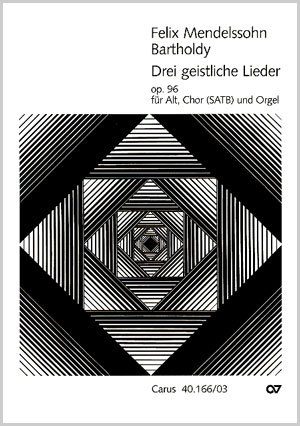
for alto solo, choir and organ (organ version) MWV B 33, 1840
In 1840, Mendelssohn composed the Three Sacred Songs on an English paraphrase of the 13th Psalm for solo alto, choir and organ. The text was written by the English legal scholar and music lover Charles B. Broadley, who commissioned the work. Mendelssohn specifically wanted to match the tone of the English Verse Anthem with the these songs. The Three Sacred Songs soon appeared in print in England and Germany (also with a German text).
The organ part can also be played on the piano. The Carus edition contains the contemporary German text as well as a modern English text.
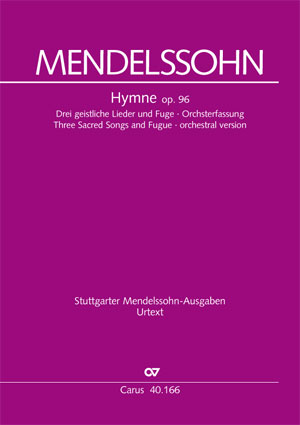
In 1842/43, at Broadley's request, Mendelssohn created an orchestral version of the Three Songs and added a final fugue to the piece. This four-movement orchestral version was only published after Mendelssohn's death as Hymne op. 96. The orchestral version is also available from Carus (score (Carus 40.166), piano reduction (Carus 40.166/53), choral score (Carus 40.166/05) and orchestral parts (Carus 40.166/19).
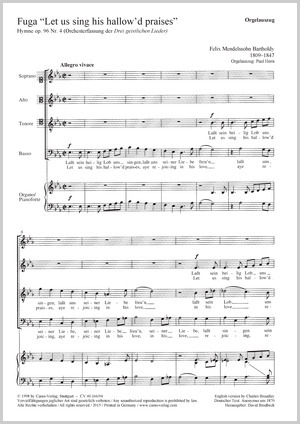
The fugue, which Mendelssohn newly composed for the orchestral version (Hymne), is available separately as an organ reduction (Carus 40.166/04).


 Listen
(2)
Listen
(2)
- Help me, Lord, in my affliction
- Choral: Father, hear thy child’s petition (organ version)
Contents


-
Composer
Felix Mendelssohn Bartholdy
| 1809-1847Felix Mendelssohn Bartholdy (1809–1847) is regarded as one of the most important composers of the Romantic period. His compositions combine the formal clarity of the Viennese Classical period with the heightened expressiveness of the 19th century. His engagement with the music of Johann Sebastian Bach was particularly influential; he played a key role in its rediscovery through the performance of the St Matthew Passion in 1829.
Among his best-known vocal works are his two oratorios, Paulus and Elias, as well as his chorale cantata Verleih uns Frieden gnädiglich. Furthermore, Mendelssohn worked as a conductor, pianist and music teacher, and made a significant contribution to the professionalisation of the concert scene and to the development of the Leipzig Conservatoire. His work occupies a central position in 19th-century music history and combines a sense of tradition with Romantic sound aesthetics.
Personal details
-
Editor
Günter Graulich
| 1926The publisher, church musician and teacher Günter Graulich is one of the major personalities in German publishing of the post-war period. With his wife Waltraud he founded Carus-Verlag Stuttgart in 1972, which he built up from a 2-person family firm to a medium-sized business with around 60 employees. A trained church musician and Kantor for many years at the Matthäuskirche Stuttgart, he also directed the Motettenchor Stuttgart for 50 years. With his choir he made LP and CD recordings, and undertook numerous concert tours to other European countries and America. Personal details
-
Translator
Jean Lunn
Reviews on our website can only be submitted by customers with a registered user account. A check whether the rated products were actually purchased does not take place.
Frequent questions about this work
Are the vocal scores of the organ version Three Sacred Songs and the orchestral version Hymne op. 96 compatible?
Can the choral score of the orchestral version also be used for the organ version (Drei geistliche Lieder)?
Gibt es von der Fuge aus der Orchesterfassung einen Orgelauszug?
 There are no questions and answers available so far or you were unable to find an answer to your specific question about this work? Then click here and send your specific questions to our Customer Services!