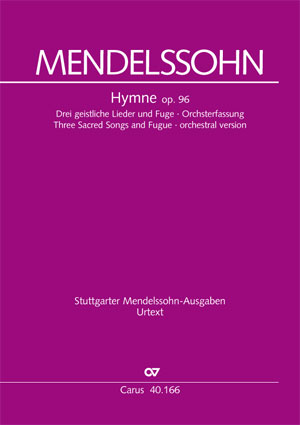

Hymne
Three Sacred Songs and Fugue (orchestral version) MWV A 19 (op. 96)
The Hymne op. 96 is closely linked to the Drei geistliche Lieder / Three Sacred Songs from 1840 (Carus 40.1166/03). It is an expansion and orchestral version of these songs.
In 1840, Mendelssohn composed the Three Sacred Songs on an English paraphrase of the 13th Psalm for solo alto, choir and organ. The text was written by the English legal scholar and music lover Charles B. Broadley, who commissioned the work. Mendelssohn specifically wanted to match the tone of the English Verse Anthem with the these songs. The Three Sacred Songs soon appeared in print in England and Germany (also with a German text).
In 1842/43, at Broadley’s request, Mendelssohn created an orchestral version of the Three Sacred Songs and added a final fugue to the piece. This four-movement orchestral version was only published after Mendelssohn’s death as Hymne op. 96.
The full score is the first critical edition of the work and contains the original English singing text as well as the German text. The full score, a study score, a vocal score, choral score and orchestral parts are available.
 Listen
(4)
- Laß, o Herr, mich Hilfe finden
- Choral: Father, hear thy child’s petition (organ version)
- Herr, wir trau’n auf deine Güte
- Lasst sein heilig Lob uns singen
 Additional material
- Purchase additional material as a download product.
-
 Digital text (without sheet music) incl. printing licence, html file, singing text, originalhtml file, singing text, original (Sample)Lass, o Herr, mich Hilfe finden
Lass, o Herr mich Hilfe finden
Lass, o Herr mich Hilfe finden,
neig‘ dich gnädig meinem Fleh’n,
willst gedenken du der Sünden,
nimmermehr kann ich besteh’n.
Soll mein Sorgen ewig dauern?
Sollen Feinde spotten mein?
Schwach und hilflos soll ich trauern
und von dir vergessen sein?
Deines Kind’s Gebet erhöre Deines Kind’s Gebet erhöre,
Vater, schau‘ auf mich herab;
meinen Augen Licht gewähre,
rette mich aus dunkelm Grab.
Sonst verlacht der Feind mich Armen,
triumphiert in stolzer Pracht,
sonst verfolgt er ohn‘ Erbarmen
und verspottet deine Macht.
...
-
Digital text (without sheet music) incl. printing licence, html file, singing text, english translationhtml file, singing text, english translation (Sample)Lass, o Herr, mich Hilfe finden
Why, O Lord, delay for ever
smiles of comfort to impart?
Oh if thou forget me, never
more shall gladness cheer this heart.
Shall my soul still pine in sorrow?
Still shall foes their insults pour?
Weak and fainting shall the morrow
bring thine aid to me no more?
Deines Kind's Gebet erhöre On thy love my heart reposes,
hear me draw my falt’ring breath;
raise me while mine eyelid closes
lest I sleep the sleep of death.
Lest my haughty foes prevailing
proudly boast we laid him low?
Lest the scorner hear my wailing
and he triumph in my woe.
...

-
Composer
Felix Mendelssohn Bartholdy
| 1809-1847Felix Mendelssohn Bartholdy (1809–1847) is regarded as one of the most important composers of the Romantic period. His compositions combine the formal clarity of the Viennese Classical period with the heightened expressiveness of the 19th century. His engagement with the music of Johann Sebastian Bach was particularly influential; he played a key role in its rediscovery through the performance of the St Matthew Passion in 1829.
Among his best-known vocal works are his two oratorios, Paulus and Elias, as well as his chorale cantata Verleih uns Frieden gnädiglich. Furthermore, Mendelssohn worked as a conductor, pianist and music teacher, and made a significant contribution to the professionalisation of the concert scene and to the development of the Leipzig Conservatoire. His work occupies a central position in 19th-century music history and combines a sense of tradition with Romantic sound aesthetics.
Personal details
Reviews on our website can only be submitted by customers with a registered user account. A check whether the rated products were actually purchased does not take place.
Frequent questions about this work
 There are no questions and answers available so far or you were unable to find an answer to your specific question about this work? Then click here and send your specific questions to our Customer Services!