

The 115th Psalm, Op. 31, was the first of five major psalm settings by Mendelssohn. Before publishing the work, the composer himself supplied a German translation to the original Latin (Non nobis Domine). Today this German version is the most frequently performed. The energy and dramatic development of the opening chorus demands the close attention of all choir members. With a little practice, this is a hugely impressive work!
Simply practice. Anytime. Everywhere.
Whether at home on your tablet or PC or on the road on your smartphone: with carus music, the Choir Coach, you always have your choral works with you to practice! With the carus music choir app, you can listen to your score together with a first-class recording on any device and easily practice your own choir part with a coach. With carus music, your concert preparation is easy, efficient and fun to master!
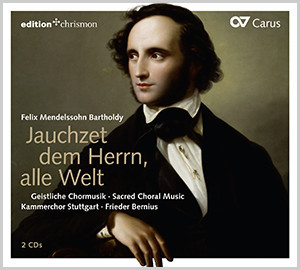
Performers: Ruth Ziesak (Soprano), Christoph Prégardien (Tenore), Gotthold Schwarz (Basso) – Kammerchor Stuttgart, Deutsche Kammerphilharmonie Bremen – Frieder Bernius
Explore
 Listen
(4)
Listen
(4)
- Coro: Nicht unserm Namen, Herr
- Duetto: Israel hofft auf dich
- Arioso: Er segne euch je mehr
- Coro: Die Toten werden dich nicht loben
 Additional material
- Purchase additional material as a download product.
-
 Digital text (without sheet music) incl. printing licence, html file, singing text, english translationhtml file, singing text, english translation (Sample)1. Choir
Not to us, O Lord, but to thy name give, for the sake of thy steadfast, love and thy faithfulnes! Why should the nations say, “Where is their God?”
2. Duet (Soprano, Tenor) with ChoirO Israel, trust in the Lord! He is their help and their shield. O house of Aaron, put your trust in the Lord! You who fear the Lord, trust in the Lord! He is their help and their shield. The Lord has been mindful of us; he will bless us; he will bless the house of Aaron; he will bless the house of Israel; he will bless those who fear the Lord, both small and great.
3. Arioso (Bass)May the Lord give you increase, you and your children!
4. ChoirThe dead do not praise the Lord, nor do any that go down into silence. But we will bless the Lord
...
-
Digital text (without sheet music) incl. printing licence, html file, singing text, originalhtml file, singing text, original (Sample)1. Chor
Nicht unserm Namen, Herr,
2. Duett (Sopran, Tenor) mit Chor
nur deinem geheiligten Namen sei Ehre gebracht.
Lass deine Gnad und Herrlichkeit
und Wahrheit uns umleuchten,
lass nicht die Heiden sprechen,
wo ist die Macht ihres Gottes?
Im Himmel wohnet unser Gott,
er schaffet alles, was er will.Israel hofft auf dich,
du wirst sie beschützen in Not,
denn du bist ihr Helfer,
ihr Erretter bist du allein,
ihr Helfer bist du allein.
Aaron hofft auf dich,
du wirst sie beschützen in Not,
denn du bist ihr Helfer,
ihr Erretter bist du allein,
ihr Helfer bist du allein.
Alles Volk hofft auf dich.
Wahrlich, der Herr gedenket unser
und segnet seine Kinder, denn er segnet das Haus Israel,
und er segnet das Haus Aaron,
und er segnet alles Volk,...
-
Digital text (without sheet music) incl. printing licence, html file, Introductory text, frenchhtml file, Introductory text, french (Sample)Texte du livret du CD Carus 83.204
Barbara Mohn
Traduction (abrégée) : Jean Paul Ménière« [...] Si quelque ressemblance existe avec Seb. Bach, je n’y suis à nouveau pour rien, car j’ai écrit comme je me sentais, et si je me suis senti une fois, mot pour mot, comme le vieux Bach, il n’en est que mieux pour moi [...]. » C’est ce qu’écrivit Felix Mendelssohn Bartholdy le 15 juillet 1831 à son ami intime, le chanteur Eduard Devrient. Ce dernier, un peu soucieux de l’évolution de son talentueux ami en tant que compositeur, avait remarqué que Mendelssohn, à la fin des années 20, s’orientait de plus en plus vers la musique d’église en se laissant inspirer pour cela par les œuvres du grand Cantor de Saint-Thomas. A une époque décisive de son processus créateur, Mendelssohn n’écrivait pas des opéras ou de grandes œuvres orchestrales grâce auxquelles il eût pu se faire un nom, mais, simplement parce qu’il « se sentait ainsi », des motets et des psaumes, ainsi qu’un
...
-
Digital text (without sheet music) incl. printing licence, html file, Introductory text, englishhtml file, Introductory text, english (Sample)Text from the CD Carus 83.204
Barbara Mohn
Translation (abridged): Alan Pope“[...] If it resembles Seb. Bach, I cannot do anything about it, since I have written it according to how I feel and, if I am inspired by the words as Bach was, then it should be all the better for me [...]” wrote Felix Mendelssohn Bartholdy on 15th July 1831 to his close friend, the singer Eduard Devrient. Devrient was observing with some trace of anxiety about the compositional development of his gifted friend that at the end of the 1820s Mendelssohn was devoting himself increasingly to church music and in the process was being inspired by the great Cantor of St. Thomas’ Church Leipzig. In a crucial phase of his creativity, Mendelssohn did not compose operas or great instrumental works, but in accordance with his “feelings” he simply wrote motets and psalms as well as a group of works, which, as his mother complained, “no one would get to hear” – eight cantatas
...
-
Digital text (without sheet music) incl. printing licence, html file, Introductory text, germanhtml file, Introductory text, german (Sample)Booklet-Text der CD Carus 83.204
Barbara Mohn
„[...] Hat es Ähnlichkeit mit Seb. Bach, so kann ich wieder nichts dafür, denn ich habe es so geschrieben, wie mir zu Muthe war, und wenn mir einmal bei den Worten so zu Muthe geworden ist, wie dem alten Bach, so soll es mir nur umso lieber sein [...]“, schrieb Felix Mendelssohn Bartholdy am 15. Juli 1831 an seinen engen Freund, den Sänger Eduard Devrient. Mit einem Anflug von Sorge um die kompositorische Fortentwicklung seines begabten Freundes hatte dieser beobachtet, was wohl keinem verborgen bleiben konnte: dass sich Mendelssohn Ende der 1820er Jahre zunehmend der Kirchenmusik zuwandte und sich dabei vom Werk des großen Thomaskantors inspirieren ließ. In einer entscheidenden Phase seines Schaffens, in den Jahren 1827 bis 1832, komponierte Mendelssohn nicht Opern oder große Instrumentalwerke, mit denen er sich einen Namen hätte machen können, sondern, einfach weil ihm „so zu Muthe war“, Motetten und Psalmen sowie eine Gruppe von Werken, die – wie seine Mutter klagte – „kein Mensch zu sehen bekommt“: acht Kantaten über die Choralmelodien Christe, du Lamm Gottes; Jesu, meine Freude; Wer nur den lieben Gott lässt walten; O Haupt voll Blut und Wunden; Vom Himmel hoch; Verleih uns
...
Purchase
Additional product information
Contents

-
Composer
Felix Mendelssohn Bartholdy
| 1809-1847
Reviews on our website can only be submitted by customers with a registered user account. A check whether the rated products were actually purchased does not take place.
No feedback available for this product.
Frequent questions about this work
 There are no questions and answers available so far or you were unable to find an answer to your specific question about this work? Then click here and send your specific questions to our Customer Services!