

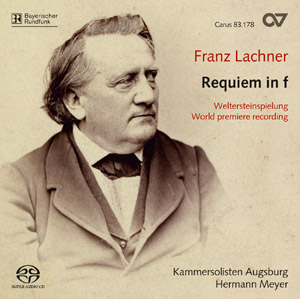
World premiere recording
Franz Lachner’s Requiem in F minor was composed for the Mozart commemorative year of 1856. It is an expressoni of his admiration for Mozart, even though requiem settings of both composers have little in common. After almost 27 years of composing church works strictly in a cappella style, Lachner’s Mass for the Dead represents a milestone and an exception in his creative output. The choice of a large orchestra for the Requiem led to the consequence that performances conducted by Lacher took place not in a sacred setting, but rather in a concert hall. A special tension arises from the contrast between the large orchestral ensemble, which only reveals its full effect in a few dramatic passages, and the rather introverted mood which prevails throughout most of the work. Under the direction of Hermann Meyer, the Kammersolisten Augsburg has devoted its energies to discovering rare and forgotten works. Thus this world premiere recording of Lachner’s Requiem enriches the repertoire of requiem settings with an important and exciting work in the genre.
Franz Lachner’s Requiem in F minor was composed for the Mozart commemorative year of 1856. It is an expressoni of his admiration for Mozart, even though requiem settings of both composers have little in common. After almost 27 years of composing church works strictly in a cappella style, Lachner’s Mass for the Dead represents a milestone and an exception in his creative output. The choice of a large orchestra for the Requiem led to the consequence that performances conducted by Lacher took place not in a sacred setting, but rather in a concert hall. A special tension arises from the contrast between the large orchestral ensemble, which only reveals its full effect in a few dramatic passages, and the rather introverted mood which prevails throughout most of the work. Under the direction of Hermann Meyer, the Kammersolisten Augsburg has devoted its energies to discovering rare and forgotten works. Thus this world premiere recording of Lachner’s Requiem enriches the repertoire of requiem settings with an important and exciting work in the genre.
Explore
 Listen
(14)
Listen
(14)
- Requiem
- Kyrie
- Dies irae
- Recordare
- Confutatis
- Lacrimaosa
- Domine Jesu Christe
- Quam olim Abrahae
- Hostias
- Quam olim Abrahae
- Sanctus
- Benedictus
- Agnus Dei
- Lux aeterna
 Additional material
-
 Digital text (without sheet music) incl. printing licence, html file, singing text, french translationhtml file, singing text, french translation (Sample)
Introitus - Kyrie 1. Requiem (Coro) Requiem aeternam dona eis Domine:
et lux perpetua luceat eis.
Te decet hymnus Deus in Sion,
et tibi reddetur votum in Jerusalem:
exaudi orationem meam,
ad te omnis caro veniet.
Requiem aeternam dona eis Domine:
et lux perpetua luceat eis.2. Kyrie (Coro) Kyrie eleison.
Christe eleison.
Kyrie eleison.Sequenz 3. Dies irae (Solo T, Coro) Dies irae, dies illa
solvet saeclum in favilla:
teste David cum Sibylla.
Quantus tremor est futurus,
...
-
Digital text (without sheet music) incl. printing licence, html file, singing text, english translationhtml file, singing text, english translation (Sample)
Introitus - Kyrie 1. Requiem (Coro) Lord, grant them eternal rest,
and let the perpetual light shine upon them.
Thou shalt have praise in Zion, oh God,
and homage shall be paid to Thee in Jerusalem.
Hear my prayer.
All flesh shall come before Thee.
Lord, grant them eternal rest,
and let the perpetual light shine upon them.2. Kyrie (Coro) Lord, have mercy upon us.
Christ, have mercy upon us.
Lord, have mercy upon us.Sequenz 3. Dies irae (Solo T, Coro) This day, this day of wrath
shall consume the world in ashes,
as foretold David and the Sibyl.
What trembling there shall be
...
-
Digital text (without sheet music) incl. printing licence, html file, singing text, german translationhtml file, singing text, german translation (Sample)
Introitus - Kyrie 1. Requiem (Coro) Gib ihnen die ewige Ruhe, Herr,
und das ewige Licht leuchte ihnen.
Dir gebührt ein Loblied, Gott, auf Zion,
und Dir erfülle man sein Versprechen in Jerusalem.
Erhöre mein Gebet,
zu Dir kommt alles Fleisch.
Gib ihnen die ewige Ruhe, Herr,
und das ewige Licht leuchte ihnen.2. Kyrie (Coro) Herr, erbarme Dich.
Christus, erbarme Dich.
Herr, erbarme Dich.Sequenz 3. Dies irae (Solo T, Coro) Tag des Zornes, jener Tag
legt die Welt in glühende Asche,
wie David und die Sibylle künden.
Welch ein Beben wird herrschen,
...
-
Digital text (without sheet music) incl. printing licence, html file, Introductory text, frenchhtml file, Introductory text, french (Sample)Texte du livret du CD Carus xxx
Herbert Lölkes
Traduction (abrégé) : Sylvie CoquillatLa vie de Franz Lachner (1803–1890) couvre pratiquement tout le 19ème siècle, allant historiquement et musicalement parlant, de l’époque de Beethoven et Schubert, qu’il connaissait tous les deux, jusqu’au culte wagnérien en essor dans sa patrie d’adoption, Munich. Lachner est issu d’une famille musicale. Lui-même et ses frères cadets Ignaz et Vincenz, tous deux eux-mêmes musiciens professionnels par la suite, apprirent tout d’abord la musique auprès de leur père, Anton Lachner, qui était organiste dans leur ville natale, Rain am Lech (Haute-Bavière). Franz Lachner apprit non seulement le jeu obligatoire du piano et de l’orgue, mais aussi le violon, le violoncelle, le cor et le chant. En 1822, il partit pour Munich et suivit l’enseignement de contrepoint et d’orgue de Kaspar Ett, longtemps organiste à l’église Saint-Michel de la cour.
...
-
Digital text (without sheet music) incl. printing licence, html file, Introductory text, englishhtml file, Introductory text, english (Sample)Text from the CD Carus 83.178
Herbert Lölkes
Translation (abridged): Peter PalmerFranz Lachner’s life (1803–1890) stretches over most of the 19th century from the age of Beethoven and Schubert, both of whom he knew, to the flourishing Wagner cult in his adopted home town of Munich. Lachner was born into a musical family. He and his younger brothers Ignaz and Vincenz – who, too, became professional musicians – received their first music lessons from their father Anton Lachner, the organist in their native town of Rain am Lech (Upper Bavaria). Franz Lachner studied not only the obligatory piano and organ but also violin, cello, horn and singing. In 1822 he went to Munich and studied counterpoint and organ under Kaspar Ett, the veteran organist at the Court Church of St. Michael.
Two years later, Lachner moved to Vienna to study under Maximilian Stadler as well as under
...
-
Digital text (without sheet music) incl. printing licence, html file, Introductory text, germanhtml file, Introductory text, german (Sample)Booklet-Text der CD Carus 83.178
Herbert Lölkes
Ein Requiem zu Ehren Mozarts Franz Lachners Leben (1803–1890) erstreckt sich fast über das ganze 19. Jahrhundert, reicht musikgeschichtlich von der Zeit Beethovens und Schuberts, mit denen beiden er bekannt war, bis zum aufblühenden Wagner-Kult seiner Wahlheimat München. Geboren ist Lachner in einer musikalischen Familie. Er und seine jüngeren Brüder Ignaz und Vincenz, beide später ebenfalls professionelle Musiker, erhielten den ersten Musikunterricht bei ihrem Vater Anton Lachner, der in ihrem Geburtsort Rain am Lech (Oberbayern) Organist war. Franz Lachner lernte nicht nur das obligatorische Klavier- und Orgelspiel, sondern auch Violine, Violoncello, Horn und Gesang – ideale Voraussetzungen für seine spätere Karriere als Konzert- und Opernkapellmeister. Nach einigen Jahren Gymnasialunterricht in Neuburg an der Donau entschloss
...
Purchase
Additional product information
Contents

-
Composer
Franz Lachner
| 1803-1890Franz Lachner was active as a composer, organist and conductor.
His extensive oeuvre covers almost all genres and seems to be influenced above all by the music of Beethoven and Schubert, but also Spohr and Meyerbeer. Personal details
-
Preface writer
Herbert Lölkes
-
Ensemble
Kammersolisten Augsburg
-
Conductor
Hermann Meyer
-
Soloist - soprano
Marina Ulewicz
-
Soloist - soprano
Ruby Hughes
-
Soloist - alto
Roxana Constantinescu
-
Soloist - tenor
Colin Balzer
Canadian born Colin Balzer studied singing with David Meek in Canada and Edith Wiens in Germany. He has participated in master classes given by Helmut Deutsch, Robert Tear, Elly Ameling, Brigitte Fassbaender and Christoph Prégardien. Colin Balzer has won a range of international prizes, and has embarked on a busy international concert schedule with a repertoire ranging from Monteverdi to Penderecki. He has been heard at Festivals in Baden-Baden, Aix-en-Provence and at the Early Music Festivals in Boston and Vancouver, and he regularly performs with various Canadian orchestras. He has also enjoyed considerable success as a lieder singer. He recorded his first CD, Hugo Wolf’s Italienisches Liederbuch, with Hartmut Höll. Personal details
-
Soloist - tenor
Gerhard Werlitz
-
Soloist - bass
Günther Papendell
Reviews
Lieder zu Advent und Weihnachten
[...] Eine tief empfundene Komposition, die es wert war eingespielt zu werden!
Quelle: Singende Kirche 4/2006, S. 293
Diese Musik will nicht drohen. Franz Lachners kaum bekanntes f-Moll-Requiem op. 146 ist ein Fest der Lyrik, eine Quelle der Zuversicht. Ein inniger, warmer, gefälliger Ton prägt jene Totenmesse, deren Anlass Mozarts 100. Geburtstag anno 1856 war. Bisweilen glaubt man Reminiszenzen ans Requiem des Salzburgers zu erkennen. Doch in der lyrischen Grundhaltung und als Kontrapunktiker ging der wie sein Schüler Josef Rheinberger in München wirkende und auch ästhetisch mit dem Liechtensteiner vergleichbare Lachner (1803 bis 1890) eigene Wege. Die Wiederentdeckung lohnt sich. Mit dieser SACD legen die Kammersolisten Augsburg unter Hermann Meyers Leitung die gelungene Weltersteinspielung vor. Ein schönes Werk - nicht nur bei den Bratschenlinien im "Lacrimosa". Mehr Trost als Trauer.
Johannes Adam
Quelle: Badische Zeitung, 28.09.2007
[...] Jedenfalls gerät in der vorliegenden Aufnahme insbesondere das solistische, innige Hostias zu einem Ereignis: In Lachners Requiem ist dieser betörend schöne Satz der lyrische Mittelpunkt. [...]
Dr. Franz Gratl
klassik.com, 28.02.2007
Reviews on our website can only be submitted by customers with a registered user account. A check whether the rated products were actually purchased does not take place.
No feedback available for this product.
Frequent questions about this work
 There are no questions and answers available so far or you were unable to find an answer to your specific question about this work? Then click here and send your specific questions to our Customer Services!