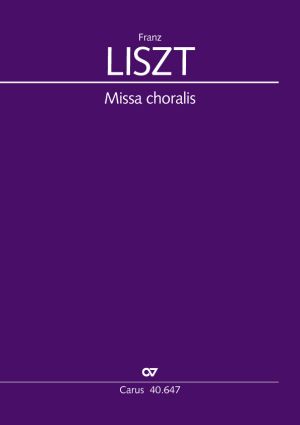
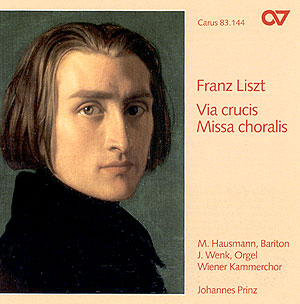
Franz Liszt’s Missa choralis, composed in Rome in 1865, combines Gregorian motifs with the vividness and expressive chromaticism of the Romantic period. The work reflects Liszt’s intensive study of Gregorian chant and his ideas for liturgical reform. As a stylistic synthesis of liturgical dignity and musical innovation, it is considered Liszt’s most important mass and a key work of nineteenth-century sacred choral music.
Explore
 View
View
 Listen
(6)
Listen
(6)
- Kyrie
- Gloria
- Credo
- Sanctus
- Benedictus
- Agnus Dei
 Additional material
- Purchase additional material as a download product.
-
 Digital text (without sheet music) incl. printing licence, html file, singing text, originalhtml file, singing text, original (Sample)Kyrie
Kyrie eleison. Christe eleison. Kyrie eleison.
GloriaGloria in excelsis Deo.
Credo
Et in terra pax hominibus bonae voluntatis.
Laudamus te, benedicimus te, adoramus te, glorificamus te.
Gratias agimus tibi propter magnam gloriam tuam.
Domine Deus, Rex coelestis, Deus Pater omnipotens.
Domini Fili unigenite, Jesu Christe.
Domine Deus, Agnus Dei, Filius Patris.
Qui tollis peccata mundi, miserere nobis.
Qui tollis peccata mundi, suscipe deprecationem nostram.
Qui sedes ad dexteram patris, miserere nobis.
Quoniam tu solus sanctus, tu solus Dominus, to solus Altissimus, Jesu Christe.
Cum Sancto Spiritu, in Gloria Dei Patris. Amen.Credo in unum Deum, Patrem omnipotentem,
factorem coeli et terrae, visibilium omnium, et invisibilium.
Et in unum Dominum Jesum Christum, Filium Dei unigenitum.
Et ex Patre natum ante omnia saecula....
Purchase
Additional product information
Contents
-
Composer
Franz Liszt
| 1811-1886Franz Liszt was born in 1811 in Raiding (formerly Hungary) and died in Bayreuth in 1886. From the age of six he took piano lessons from his father and in 1822/23 he studied with Czerny and Salieri in Vienna. He spent the years after 1823 in Paris, where his acquaintances with Rossini, Bellini, Meyerbeer, as well as Chopin, Berlioz, and Paganini had a strong influence upon him. Literarily he was also impressed by Victor Hugo. During his extended concert tours from 1838 to 1847 Liszt enjoyed great triumphs. Beginning in 1848 he then lived in Weimar, where he composed the symphonic poems and some of his most important piano works (Sonata in B minor, Piano Concerto No. 1, etc.). From 1861 he lived in Rome, where he took minor orders . Personal details
-
Editor
Thomas Kohlhase
| 1941
Reviews
Franz Liszt, Ausgewählte Werke vokaler Kirchenmusik Heft 4
Franz Liszt, Ausgewählte Werke vokaler Kirchenmusik Heft 4
Der Carus-Verlag legt hier eine sehr beachtenswert Neuausgabe dieser bedeutenden Messe des 19. Jahrhunderts vor. In einem gründlichen Vorwort werden alle Fragen erörtert, die mit der Entstehung, den choralen Vorlagen, der Rezeptionsgeschichte und der Aufführungspraxis dieses Werkes zusammenhängen. Interessant vor allem auch das vollständige Faksimile der autographen Urschrift von 1865, die doch einige Abweichungen zum Erstdruck von 1869 aufweist. Neben dieser Gesamtpartitur mit der sehr sparsamen Orgelstimme Liszts, die wegen ihrer langen Pauseneinschnitte gewiss manche Probleme für die Intonation des Chores aufwirft, ist auch eine Chorpartitur erschienen.
Quelle: Musica Sacra 1/86, S. 68
Reviews on our website can only be submitted by customers with a registered user account. A check whether the rated products were actually purchased does not take place.
No feedback available for this product.
Frequent questions about this work
 There are no questions and answers available so far or you were unable to find an answer to your specific question about this work? Then click here and send your specific questions to our Customer Services!