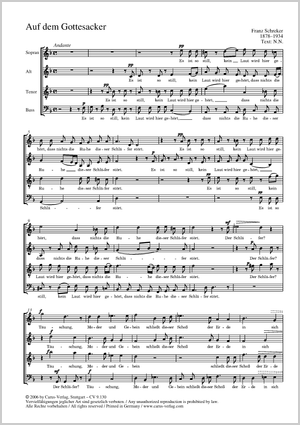
Auf dem Gottesacker, Vergangenheit
Franz Schreker's a cappella motets Auf dem Gottesacker and Vergangenheit show the deeper, more introspective side of a composer who is otherwise best known for his opulent operas. These two works for mixed choir provide an insight into Schreker's most personal musical work.
The motet Auf dem Gottesacker was probably composed around 1899/1900 during Schreker's time as a student at the conservatory. The questioning, searching text by an unknown poet is reflected in Schreker's harmonic language, which gives the probing questions about life and death a haunting musical form. The composer most likely dedicated the piece to his sister Henriette, who had already died in 1890 at the tender age of eight.
As Schreker's last independent choral work, dated July 22, 1906, the composer set the poem Vergangenheit by the poet Nikolaus Lenau (1820-1850) to music. Lenau's characteristic use of images of nature to describe mental states finds its musical counterpart in Schreker's subdued, largely homophonic setting. The composer's typical harmony unfolds here in a subtle manner - less dissonant than in his later works, but already with the unmistakable harmonic sophistication that characterizes Schreker's style.
Separate edition from Franz Schreker: Das Chorwerk (Carus 4.103)
 View
View

 Listen
(2)
Listen
(2)
- Vergangenheit
- Auf dem Gottesacker
Contents


-
Composer
Franz Schreker
| 1878-1934Franz Schreker was an Austrian composer and librettist. During his lifetime, Schreker was known alongside Richard Strauss as one of the most famous opera composers after Wagner. His late Romantic musical language also features expressionist elements. He wrote most of his opera libretti himself. In them, he created psychological portraits of his protagonists, some of which contain autobiographical references.
Franz Schreker's music was also denounced as ‘degenerate’ by the National Socialists, and it was not until the late 1970s that a renewed interest in Schreker's music began. Since then, more and more recordings of his music have been released.
Personal details
Reviews on our website can only be submitted by customers with a registered user account. A check whether the rated products were actually purchased does not take place.
Frequent questions about this work
 There are no questions and answers available so far or you were unable to find an answer to your specific question about this work? Then click here and send your specific questions to our Customer Services!