

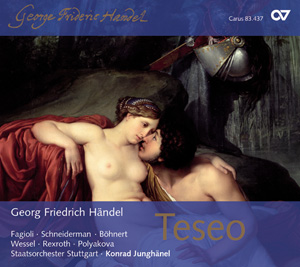
Georg Friedrich Händel: Teseo
Oper in fünf Akten HWV 9, 1713
Following the triumphant success of Rinaldo, Handel’s third London opera, Teseo (1713), was intended to make the still unusual genre of opera more attractive to the English public. That in fact Handel was able to latch on to the success of Rinaldo was due, likewise, to the many stage effects and a richness of musical ideas. At the same time Teseo is in many respects an exception, since the Italian libretto of Nicola Haym is based on a French model, and therefore retains the structure of five acts which was usual in France. And Handel proved that apparently he too had grappled with the Franch opera tradition. As an exception, one finds forms here which do not fit into the standard patterns of secco recitative and da capo aria. Only for the role of Medea did Handel compose several accompagnato recitatives and arias, which, though on the surface they follow the da capo form, as in the example of “Morirò, ma vendicata” from act 5, with its abrupt changes from dark plaintive tones and wild outbreaks of anger in the A section, depart markedly from the rules of aria composition at that time. Many duets, as well as a chorus point musically to the French tradition. The present CD is based on a live recording of the much-acclaimed performance at the Stuttgart State Opera under the direction of Konrad Junghänel.
“And as sensitive and lively as Konrad Junghänel on the podium, must the machinery of Handel theater be driven; one must sing the magnificent arias around Theseus, the democratic hero as brilliantly polished and finely shaded in the softest moods. Note, among the three formidable countertenors, in recent years the tremendously matured Argentine, Franco Fagioli, in the title role, is as outstanding as the beguiling, richly-toned soprano Jutta Böhnert in the role of his steadfast lover Agilea. Only in the exemplary Stuttgart production does everything fit together with the historically substantiated and, at the same time, contemporary baroque opera.”
FAZ, 30th Mai 2009
“Konrad Junghänel is a sensualist, who obtains a remarkably fine and buoyant tone from the Stuttgart State Opera Orchestra.”
DIE ZEIT, 10th June 2009
“Casting an opera with three equally good countertenor roles, an exemplary success. Franco Fagioli (Teseo), Kai Wessel (Teseo’s father and adversary), and Matthias Rexroth (Arcane): It hardly gets better than this. Medea the magician also comes to the fore; Handel wrote for her the most interesting, richly-varied music: The magnificent dramatic power of Helen Schneiderman makes Medea the central figure. And then the opera orchestra under the early music specialist, Konrad Junghänel: such a crisp, buoyant sound has not been heard here for a long time.”
Die Welt
Explore
 Listen
(80)
Listen
(80)
- Ouverture
- Recitativo (Agilea): Sia qual vuole il mio fato
- Recitativo (Agilea, Clizia): Clizia, son gli Ateniesi
- Aria (Agilea): E’ pur bello in nobil core
- Recitativo (Agilea, Arcane): Ora svelaci Arcane
- Aria (Agilea): Deh serbate o giusti Dei
- Recitativo (Clizia, Arcane): Parte Agilea per venerar la Dea
- Aria (Clizia): Ti credo, sì, ben mio
- Recitativo (Arcane, Clizia): Comanda dunque, o bella
- Aria (Arcane): Ah! cruda Gelosia
- Recitativo (Clizia, Arcane): Dunque all’affetto mio
- Duetto (Clizia, Arcane): Addio, mio caro bene
- Aria (Egeo): Serenatevi, o luci belle
- Recitativo (Egeo, Agilea): Or ch’affermito ho il soglio
- Aria (Egeo): Ricordati, oh bella
- Recitativo (Agilea): Ah, che sol per Teseo arde quest’alma
- Aria (Agilea): M’adora l’idol mio
- Arioso (Medea): Dolce riposo, ed innocente pace
- Recitativo (Medea): L’infelice Medea
- Aria (Medea): Quell’amor ch’è nato forza
- Recitativo (Egeo, Medea): Delle armi nostre, il fortunato evento
- Duetto (Medea, Egeo): Si ti lascio, si ti sprezzo
- Recitativo (Arcane, Egeo): Sire, tutto è periglio
- Coro di Ateniesi: Ogn’un acclami il nostro Alcide
- Recitativo (Teseo): Amici, a bastanza mostraste il vostro affetto
- Recitativo (Medea, Teseo): Teseo, dove ten vai?
- Aria (Teseo): Quanto che a me sian care
- Recitativo (Medea, Teseo): Ai vostri Amori, temo
- Aria (Teseo): Non so più che bramar
- Recitativo Accompagnato (Medea): Ira, sdegno, e furore
- Aria (Medea): O stringerò nel sen
- Aria (Arcane): Luci del mio bene
- Recitativo (Arcane, Clizia): Opportuna quì giunge Clizia mio ben
- Aria (Clizia): Risplendete amiche stelle
- Recitativo (Arcane, Clizia): Perdona, omai perdona
- Aria (Arcane): Più non cerca libertà
- Recitativo (Clizia, Agilea): Quivi sarà tra poco
- Aria (Agilea): Vieni, torna, idolo mio
- Recitativo (Teseo, Agilea): Pur ti riveggio al fine
- Aria (Teseo): A te mia bella sempre omai fedel, sarà
- Recitativo (Arcane, Agilea, Clizia): Egeo di qui venir m’impose
- Recitativo (Medea, Agilea): Tu ben sai principessa
- Terzetto (Agilea, Acrane, Clizia): Numi, chi ci soccorre
- Recitativo Accompagnato (Medea, Agilea): Ombre, sortite dall’eterna notte
- Aria (Medea): Sibillando, ululando, fulminate, la rival
- Recitativo (Arcane, Egeo): Sire, come imponesti
- Aria (Egeo): Voglio stragi, e voglio morte
- Recitativo (Arcane): Amor per Agilea
- Aria (Arcane): Benché tuoni, e l’etra avampi
- Recitativo (Agilea, Medea): Cruda; ed ancor non vuoi
- Recitativo (Agilea): E che mai veggio, oh Dio
- Aria (Agilea): Deh! v’aprite, o luci belle
- Recitativo (Medea): E ancor su’gli occhi miei
- Aria (Medea): Dal cupo baratro venite, o Furie
- Recitativo (Agiliea, Medea): S’arma contro di me tutto l’inferno?
- Arioso (Teseo): Chi ritorna alla mia mente
- Recitativo (Medea, Teseo): Mira qual cura prendo
- Recitativo (Teseo, Agilea): Agilea più non m’ama
- Aria (Teseo): Qual tigre e qual megera
- Recitativo (Teseo, Agilea): Tu piangi! e a me, l’ascondi!
- Aria (Agilea): Amarti sì vorrei
- Recitativo (Medea, Agilea, Teseo): Non vi lagnate più fidi amatori
- Duetto (Teseo, Agillea): Caro/Cara, ti dono in pegno il cor
- Recitativo (Medea): Dunque per vendicarmi, ora degg’io
- Aria (Medea): Morirò, ma vendicata
- Recitativo (Medea): Scorprii, ma non veduta
- Recitativo (Medea): Questo vaso che miri
- Aria (Egeo): Non è da Rè quel cor
- Recitativo (Medea, Egeo): Ma del popolo
- Aria (Egeo): Tengo in pugno l’idol mio
- Recitativo (Teseo, Egeo) Sire, a piedi tuoi Teseo s’inchina
- Recitativo Accompagnato (Teseo, Egeo): Giuro per questo acciaro
- Recitativo (Arcane, Egeo, Agilea, Teseo): Ah! perfida Medea!
- Aria (Teseo): Sì t’amo, oh caro, quanto un dì t’amai
- Recitativo (Arcane, Egeo, Agilea, Clizia): Signore, in questo giorno
- Duetto (Clizia, Arcane): Unito ad un puro affetto
- Recitativo (Medea): Essenti dal mio sdegno ancor non siete
- Recitativo (Agilea e Clizia, Egeo, Teseo e Arcane): Soccorreteci o Numi!
- Recitativo Accompagnato (Sacerdos di Minerva): Il ciel già si compiace
- Coro (Tutti): Goda ogn’alma in sì bel giorno
Purchase
Additional product information
Contents
-
Composer
Georg Friedrich Händel
| 1685-1759George Frideric Handel put his exceptionally versatile compositional abilities to the test at an early age. After moving to London in 1712, where he was appointed Composer of Musick for His Majesty’s Chapel Royal in 1723, he wrote numerous masterpieces for the royal court as well as his major opere serie. For many years he enjoyed triumphant successes with his operas, which were sung by outstanding performers, with serenades, and later also with oratorios such as Saul and Israel in Egypt. Over the years Handel’s reputation grew far beyond the city where he worked; some of his choral works, particularly Messiah, have enjoyed a performance tradition which remains unbroken to this day, and are sung by choirs throughout the world. Personal details
-
Songwriter / Librettist
Nicola Haym
-
Preface writer
Silke Leopold
-
Ensemble
Staatsorchester Stuttgart
Konrad Junghänel is one of the most renowned lutenists internationally and leading interpreters of the works for lute by Bach and Silvius Leopold Weiss. He was awarded the Deutscher Schallplattenpreis for his recording of the solo works of Weiss. Konrad Junghänel has performed as a soloist and chamber musician throughout Europe, the USA, Japan, Australia, South America and Africa and works regularly with René Jacobs and the ensembles Les Arts Florissants, La Petite Bande and Musica Antiqua Köln. In 1987 he founded the vocal ensemble Cantus Cölln which he directs. Recently Konrad Junghänel has increasingly worked in the theatre, and has conducted “Combattimenti” with madrigals by Monteverdi in Amsterdam and Brussels, Cavalli’s La Calisto in Cologne and Mazzocchi’s La catena d’Adone in Innsbruck and Antwerp. At the Theater Basel he conducted Wie liegt die Stadt so wüste with music by Heinrich Schütz and Handel’s oratorio Israel in Egypt as well as Semele, Monteverdi’s L’incoronazione di Poppea, the staged production of Bach cantatas “Ein geistliches Bankett” in Hamburg, Purcell’s Hail! Bright Cecilia in Hannover, Poro, Rè dell’Indie at the Göttingen Handel Festival, Così fan tutte and Die Entführung aus dem Serail in Potsdam. He has also conducted Lucio Silla in Stuttgart, the “Florentine Intermedii” and Handel’s Agrippina in Saarbrücken and Armida in Berlin. Konrad Junghänel is currently preparing another Gluck production, Orfeo ed Euridice, in Cologne. Personal details
-
Conductor
Konrad Junghänel
Konrad Junghänel is one of the most renowned lutenists internationally and leading interpreters of the works for lute by Bach and Silvius Leopold Weiss. He was awarded the Deutscher Schallplattenpreis for his recording of the solo works of Weiss. Konrad Junghänel has performed as a soloist and chamber musician throughout Europe, the USA, Japan, Australia, South America and Africa and works regularly with René Jacobs and the ensembles Les Arts Florissants, La Petite Bande and Musica Antiqua Köln. In 1987 he founded the vocal ensemble Cantus Cölln which he directs. Recently Konrad Junghänel has increasingly worked in the theatre, and has conducted “Combattimenti” with madrigals by Monteverdi in Amsterdam and Brussels, Cavalli’s La Calisto in Cologne and Mazzocchi’s La catena d’Adone in Innsbruck and Antwerp. At the Theater Basel he conducted Wie liegt die Stadt so wüste with music by Heinrich Schütz and Handel’s oratorio Israel in Egypt as well as Semele, Monteverdi’s L’incoronazione di Poppea, the staged production of Bach cantatas “Ein geistliches Bankett” in Hamburg, Purcell’s Hail! Bright Cecilia in Hannover, Poro, Rè dell’Indie at the Göttingen Handel Festival, Così fan tutte and Die Entführung aus dem Serail in Potsdam. He has also conducted Lucio Silla in Stuttgart, the “Florentine Intermedii” and Handel’s Agrippina in Saarbrücken and Armida in Berlin. Konrad Junghänel is currently preparing another Gluck production, Orfeo ed Euridice, in Cologne. Personal details
-
Soloist - soprano
Helene Schneiderman
-
Soloist - soprano
Jutta Böhnert
After completing her studies, engagements have taken Jutta Böhnert to Munich, Hannover, Düsseldorf, Salzburg and Berlin, and she has enjoyed great success in Göttingen as Cleofide in Poro. She sang Gilda in Rigoletto, Belinda in Dido and Aeneas and made her debut as Fiordiligi in Così fan tutte under Konrad Junghänel at the Potsdam Winteroper. On the concert stage, she has sung with the Gewandhaus Orchestra and performed in the Philharmonie Cologne and at the Handel Festival in Halle. She has performed with leading conductors including Arman, Boulez, Fischer, Paternostro, Reuss, Rilling and Gatti and sang under Lothar Zagrosek in Gluck’s Paride ed Elena at the Konzerthaus Berlin and in Brahms’s German Requiem with the West Australian Symphony Orchestra in Perth. Personal details
-
Soloist - soprano
Olga Polyakova
The Russian Olga Polyakova is a former member of the Zurich Opera Studio. She made her debut at age 19 in Bach cantatas, followed by concert engagements includ-ing Beethoven’s Missa Solemnis, Bruckner’s Te Deum, Mozart’s Exsultate Jubilate and Purcell’s King Arthur. Her operatic repertoire includes Adina in L’elisir d’amore, Lucy in Menotti’s The Telephone, Mrs. Wordsworth and Emmy in Albert Herring, Zerlina in Don Giovanni, Blonde in Die Entführung aus dem Serail, Arminda and Sandrina in La finta giardiniera, Cunigonde in Candide, the Queen of Shemakha in The Golden Cockerel, Gilda in Rigoletto, Olympia in Les Contes d’Hoffmann, Adele in Die Fledermaus, Violetta in La traviata and the Queen of the Night in The Magic Flute. Personal details
-
Soloist - countertenor
Kai Wessel
The Countertenor Kai Wessel studied music theory (R. Ploeger), composition (F. Döhl), and voice (U. v. Garczynski) at the Lübeck Academy of Music as well as baroque performance practice at the Schola Cantorum Basiliensis (René Jacobs). As one of the leading countertenors Wessel received numerous prizes, is invited by orchestras and conductors all over the world and has been involved in performances, radio broadcasts, as well as more than ninty recordings. He has been invited to numerous opera houses (Barcelona, Nizza, Hamburg, München, Berlin, Dresden, Stuttgart und Basel). Kai Wessel is professor at the Cologne Academy of Music/Germany, and teaches at the Bern University of the Arts/Switzerland. Personal details
-
Soloist - countertenor
Matthias Rexroth
Matthias Rexroth studied in Karlsruhe and at the Schola Cantorum Basiliensis. He is the only countertenor to have won both the Francesco Viñas International Singing Competition in Barcelona and the International Hans Gabor Belvedere Singing Competition in Vienna. He made his operatic debut in Stuttgart in Purcell’s King Arthur. Engagements have included the title roles in Admeto at the Handel Festival in Halle, Giulio Cesare at the Oslo Opera, Der geduldige Sokrates under René Jacobs in Berlin and at the Innsbruck Festival of Early Music and in Ezio at the Düsseldorfer Hofmusik. In concert, Rexroth has performed under Harnoncourt, Muti, Luisi, Luisotti and Rilling and in 2000 as soloist in the worldwide TV and radio broadcast of the B Minor Mass with the Gewandhaus Orchestra, Leipzig. Personal details
-
Soloist - countertenor
Franco Fagioli
Franco Fagioli was born in 1981 in San Miguel de Tucumán, Argentina. He began studying the piano at the music college in his home town, then studied singing at the Institute of Art at the Teatro Colón in Buenos Aires. In 1997 he founded the choir of San Martín de Porres with the aim of providing opportunities for young people in his region to experience music. Encouraged by his singing teacher Annelise Skovmand, as well as Celina Lis and maestro Ricardo Yost, he decided to pursue a career as a countertenor. In 2003 he won the prestigious Bertelsmann International Singing Competition “Neue Stimmen.“ This marked the beginning of his international career, leading to performances at the Handel Festivals in Karlsruhe and Halle, the Ludwigsburg Schlossfestspiele, Bonn Opera, Aalto Theater in Essen, Cologne Opera, Staatsoper Stuttgart, Zürich Opera, Innsbruck Festival of Early Music, Oslo Opera, Teatro Carlo Felice in Genoa, Festival della Valle d’Istria in Martina Franca, Théâtre des Champs-Elysées, Teatro Colón in Buenos Aires, and the Teatro Argentino in La Plata. His portrayal of the title role in Handel’s Giulio Cesare in Zürich, Oslo, and Karlsruhe was a sensation. His US debut at the Chicago Opera Theater in the title role of Cavalli’s Giasone in 2010 was enthusiastically received. Franco Fagioli has performed with conductors including Rinaldo Alessandrini, Alan Curtis, Gabriel Garrido, Nikolaus Harnoncourt, Michael Hofstetter, René Jacobs, Konrad Junghänel, José Manuel Quintana, Marc Minkowski, Riccardo Muti, and Christophe Rousset. His discography includes the title roles in Gluck’s Ezio, Handel’s Teseo (Carus 83.437), and Handel’s Berenice. Personal details
Reviews on our website can only be submitted by customers with a registered user account. A check whether the rated products were actually purchased does not take place.
No feedback available for this product.
Frequent questions about this work
 There are no questions and answers available so far or you were unable to find an answer to your specific question about this work? Then click here and send your specific questions to our Customer Services!