

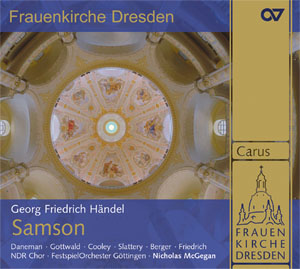
George Frideric Handel composed his oratorio Samson in 1741, immediately following completion of Messiah. The enthusiasm for the work by many of Handel's contemporaries, some of whom valued it more highly than Messiah, survived into the 19th century, when Samson was considered among the most popular works at large choir festivals. The story tells of Samson, the man of superhuman strength, leader of the people of Israel, who let himself be seduced by Dalila and then reveals the secret of his strength: it lies in his long hair. Dalila cuts off his hair when he sleeps so that the Philistines can overpower him. However, with trust in God, the hero regains his strength, topples the temple and in so doing dies in their ruins. After hearing a reading of John Milton's drama Samson Agonistes Handel was enthusiastic about the story and was inspired to great music. It is not only the impressive choruses of the Israelites and the Philistines which make this oratorio one of his great masterpieces. In his recording from the Dresdner Frauenkirche Nicholas McGegan succeeds in conveying his enthusiasm for Handel's Samson to all of the participants, especially the listeners. It would not be surprising if this recording acted to spark a rediscovery of this great work for concert and music hall.
Explore



 Listen
(72)
Listen
(72)
- Symphony
- Menuet
- Recit. (Samson): This day, a solemn feast
- Chorus: Awake the trumpet’s lofty sound!
- Air (Philistine Woman): Ye men of Gaza
- Chorus: Awake the trumpet’s lofty sound!
- Air (Philistine Man): Loud as the thunder’s
- Recit. (Samson): Why by an angel
- Air (Samson): Torments, alas!
- Recit. (Micah): Oh change beyond report
- Air (Micah): Oh mirror of our fickle state!
- Recit. (Samson, Micah): Whom have I
- Air (Samson): Total eclipse!
- Chorus: O first created beam
- Recit. (Samson, Micah): You see, my friends
- Recit. (Manoa, Micah): Brethren and men
- Accomp. (Manoa): Oh miserable change!
- Recit. (Israelite Man): Oh ever failing trust
- Air (Israelite Man): God of our fathers
- Accomp. (Manoa): The good we wish for
- Air (Manoa): Thy glorious deeds
- Recit. (Samson): Justly these evils
- Accomp. (Samson): My griefs for this
- Air (Samson): Why does the God of Israel
- Recit. (Micah): There lies our hope
- Chorus: Then shall they know
- Recit. (Manoa), Accomp. (Samson): For thee
- Chorus: Then round about the starry throne
- Recit. (Manoa, Samson, Micah): Trust yet
- Air (Micah), Chorus: Return, Oh God of hosts
- Recit. (Micah, Samson, Dalila): But who is
- Air (Dalila): With plaintive notes
- Recit. (Samson): Did love constrain thee?
- Air (Samson): Your charms to ruin
- Recit. (Dalila): Forgive what’s done
- Duet (Dalila and Virgin): My faith and truth
- Air (Dalila) and Chorus: To fleeting pleasures make your court
- Recit. (Samson, Dalila): Ne’er think of that
- Duet (Dalila and Samson): Traitor to love! Recit. (Micah, Samson): She’s gone!
- Air (Micah): Fly in virtue’s veil
- Recit. (Samson): Favour’d of heaven is he
- Chorus: To man God’s universal law
- Recit. (Micah, Harapha, Samson), Air (Harapha): No words of peace
- Air (Harapha): Honour and arms
- Recit. (Samson, Harapha): Cam’st thou for this
- Duet (Samson and Harapha): Go, baffled coward, go
- Recit. (Micah): Here lies the proof
- Chorus: Hear, Jacob’s God, Jehovah, hear!
- Recit. (Harapha): Dagon, arise!
- Chorus: To song and dance
- Soli (Dalila, Samson, Harapha and Manoa), Chorus: Fix’d in his everlasting seat
- Recit. (Micah, Samson, Harapha): More trouble is behind
- Air (Harapha): Presuming slave
- Recit. (Micah, Samson): Reflect then, Samson
- Chorus: With thunder arm’d
- Recit. (Samson, Micah, Harapha): Be of good courage
- Air (Samson): Thus when the sun
- Accomp. (Micah): With might endu’d
- Air (Micah) and Chorus: The Holy One of Israel
- Recit. (Micah, Manoa): Old Manoa with youthful steps
- Air (Philistine Man) and Chorus: Great Dagon has subdued our foe
- Recit. (Manoa, Micah): What noise of joy
- Air (Manoa): How willing my paternal love
- Recit. (Micah, Manoa), Symphony and Chorus: Your hopes of his deliv’ry
- Recit. (Micah, Manoa): Noise call you this?
- Recit. (Messenger, Micah, Manoa):_x000D_ Where shall I run
- Air (Micah) and Chorus: Ye sons of Israel
- Dead March
- Recit. (Micah, Manoa): The body comes
- Accomp. (Manoa, Israelite Woman) and Chorus: Glorious hero
- Recit. (Manoa): Come, come!
- Air (Israelite Woman) and Chorus: Let the bright Seraphims
Purchase
Additional product information
Contents
-
Composer
Georg Friedrich Händel
| 1685-1759George Frideric Handel put his exceptionally versatile compositional abilities to the test at an early age. After moving to London in 1712, where he was appointed Composer of Musick for His Majesty’s Chapel Royal in 1723, he wrote numerous masterpieces for the royal court as well as his major opere serie. For many years he enjoyed triumphant successes with his operas, which were sung by outstanding performers, with serenades, and later also with oratorios such as Saul and Israel in Egypt. Over the years Handel’s reputation grew far beyond the city where he worked; some of his choral works, particularly Messiah, have enjoyed a performance tradition which remains unbroken to this day, and are sung by choirs throughout the world. Personal details
-
Preface writer
Dorothea Schröder
-
Ensemble
FestspielOrchester Göttingen
The FestpielOrchester Göttingen (FOG) has convinced audiences and critics alike since its foundation in 2006, and it is especially appreciated for the richness of its tone color and its light, flexible and sensual sound. The FOG includes specialists in authentic period performance practice from such internationally famous early music ensembles as Les Arts Florissants, the Akademie für Alte Musik Berlin, Concerto Köln, the Freiburger Barockorchester, the Philharmonia Baroque Orchestra (San Francisco), Il Complesso Barocco, and the Orchestra of the 18th century. Under the direction of Nicholas McGegan they have become a homogeneous ensemble, which has confirmed the reputation of the Internationale Händel-FestspieIe Göttingen as an innovative and first class festival. During the 2008 festival season the orchestra has taken part in the oratorio Samson, giving guest performances in Dresden, Hanover, Kassel and Halle/Saale, which aroused enthusiasm in both the audiences and the press: “The Göttinger play like gods” wrote a critic in the Mitteldeutsche Zeitung following the concert in Halle/Saale. During the Handel celebration year 2009, the 250th anniversary of the composer’s death, the FestspielOrchester Göttingen is taking part in a staged opera production at venues including the Drottningholm Slotstheater in Sweden. Personal details
-
Ensemble
NDR Chor
Ever since the NDR Choir came into existence in 1946, it has been committed not only to the classical and romantic repertoire but also to contemporary music, which had been banned for a considerable period prior to the choir’s establishment. As a result, the preparation and performance of Schönberg’s unfinished opera Moses und Aron was the focus of worldwide attention in the post-war years. Especially under the direction of Helmut Franz, Max Thurn’s successor, a-cappella literature became a special trade- mark of the choir, a tradition maintained by subsequent conductors such as Roland Bader, Horst Neumann, Robin Gritton and Hans-Christoph Rademann. The choir has also enjoyed the stimulus of working with notable guest conductors such as Eric Ericson, Marcus Creed, Michael Gläser and Rupert Huber. Since the 2008/09 season, Philipp Ahmann has been choral director of the NDR Choir. Among the highpoints of recent years have been performances of Handel’s Israel in Egypt, the Ligeti Requiem and Schönberg’s Gurrelieder. Of the choir’s many CD recordings, the a-cappella works by Max Reger (dir. by H.-Chr. Rademann), which received the 2005 “Prize of the German Record Critics,” deserves special mention. Plans for the 2009/2010 season include Haydn’s The Creation under Martin Haselböck and a concert performance of Bizet’s opera Carmen as well as the choir’s own subscription series under the direction of Philipp Ahmann. Personal details
-
Conductor
Nicholas McGegan
For the London Independent Nicholas McGegan is “one of the finest baroque conductors of his generation,” and for the New Yorker magazine, “an expert in 18th century style.” But the Cleveland Plain Dealer was more direct when it praised Nicholas McGegan for “bringing rhythmic zest to all things baroque.” And as such he is known throughout the world for performances that match authority with enthusiasm, scholarship with joy, and curatorial responsibility with evangelical exuberance. Through more than twenty years as its music director, McGegan has established the San Francisco-based Philharmonia Baroque Orchestra as the leading Baroque ensemble in America – and at the forefront of historical performance practice worldwide, thanks to notable appearances at Carnegie Hall, the London Proms, the Amsterdam Concertgebouw, and the International Handel Festival, Göttingen where he has been artistic director since 1991. In Göttingen and with the PBO he has defined an approach to period style that sets the current standard: probing, serious but undogmatic, recognizing that the music of the past does not belong in a museum or in academia, but in vigorous engagement with an audience, for pleasure and delight on both sides of the stage. He has been a pioneer in the process of exporting historically informed practice beyond the small world of period instruments to the wider one of conventional symphonic forces. His discography includes the world premiere recording of Handel’s oratorio Susanna, which attracted both a Gramophone Award and Grammy nomination, and recent issues on Carus of the same composer’s Solomon, Samson, and Acis and Galatea (the latter a rarity in that it unearths the little-known version adapted by Felix Mendelssohn). Born in England, Nicholas McGegan was educated at Oxford, Cambridge and the Royal College of Music, London. His awards include an honorary professorship at Georg-August University, Göttingen, and an official Nicholas McGegan Day, declared by the Mayor of San Francisco in recognition of two decades of distinguished work with the Philharmonia Baroque. He holds an honorary degree at London’s Royal College of Music and the Handel Prize of the Halle Handel Festival. Personal details
-
Soloist - soprano
Sophie Daneman
A specialist in period performance, SOPHIE DANEMAN studied at the Guildhall School of Music. She has toured with William Christie and Les Arts Florissants, as well as performing with Christopher Hogwood, Sir Neville Marriner, Gérard Lesne, Jean-Claude Malgoire, Marcus Creed, Phillipe Herreweghe, Robert King, Richard Hickox and Ivor Bolton. Her opera engagements have included the title roles in Handel’s Rodelinda and Arianna, an acclaimed Mélisande (Opéra Comique with Georges Prêtre), the title role in Handel’s Theodora with Christie in New York, Paris and Salzburg, and Bernstein’s Wonderful Town for Grange Park Opera. Among her numerous CDs are several award-winning recordings with William Christie. Sophie recently sang the role of Telaire (Castor et Pollux) with Sir John Eliot Gardiner at the Salle Pleyel, Paris. An accomplished recitalist, Sophie Daneman has appeared at many of the world’s major concert venues, including the Wigmore Hall and Queen Elizabeth Hall, London, Concertgebouw, Amsterdam, Musikverein, Vienna, and Carnegie Hall, with Julius Drake, Roger Vignoles, Graham Johnson, Eugene Asti and Imogen Cooper. Personal details
-
Soloist - alto
Franziska Gottwald
Franziska Gottwald received her first vocal training from Eugen Rabine, followed by studies at the conservatories in Saarbrücken, Hannover and Weimar. She began her career a guest soloist at the Staatsoper Hannover in Lower Saxony and sang as a permanent member of the Deutsche Nationaltheater Weimar. Further engagements brought her to Brunswick and Bielefeld, to the Komische Oper Berlin, to the Handelfestpiele in Göttingen and to the Teatro La Fenice in Venice. In 2002 she won the International Bach Competition in Leipzig and in 2006 she was nominated by the yearbook of the magazine Opera World for the award as best young female singer of the year. As a concert singer much in demand, the mezzo-soprano has appeared at important musical venues such as the Concertgeouw, Amsterdam, Gasteig Munich, the Philharmonie, Berlin, in Athens, Vienna, Naples, Milan, Bilbao and Paris, as well as at important festivals, including the Rheingau Musik Festival, the Semana de Religiosa in Cuenca, the Herrenchiemsee Festival, the Bachwoche in Ansbach, and the Folle Journée in Nantes. She has worked with the leading interpreters of early music, such as Vittorio Ghielmi, Reinhard Goebel, Konrad Junghänel, Ton Koopman, Andrea Marcon and ensembles including the Amsterdam Baroque Orchestra, Musica Antiqua Köln, the Akademie für Alte Musik Berlin and the RIAS Kammerchor. Numerous radio and CD productions document her musical versatility. Personal details
-
Soloist - tenor
Michael Slattery
Upon graduating from The Juilliard School, the young American tenor Michael Slattery sang his first Mozart Requiem with Esa-Pekka Salonen and the Los Angeles Philharmonic. He appeared with the LA Phil in 2006 in Philip Glass’s Akhnaten, and his concert career has also included Handel oratorios and Bach cantatas. Recently he has greatly enjoyed giving his first master classes at Universities across the US. The International Herald Tribune has described Slattery as a singer with an “American gusto that would have made Bernstein smile”, and indeed, his knack for the Maestro’s music has taken him all across Europe: from Paris to the Royal Festival Hall in London where he sang the title role in Bernstein’s Candide, a role he premiered in Rome. Recently Michael sang the title role in Monteverdi's L’Orfeo at Glimmerglass Opera, a role he had already performed with Emmanuelle Haïm at the Châtelet Theater in Paris. Outside his musical activities, Michael Slattery devotes much of his spare time to painting; his works were recently exhibited at Glimmerglass Opera. Personal details
-
Soloist - tenor
Thomas Cooley
Thomas Cooley, tenor, was born in Minnesota and studied voice at the university there, then at the Richard Strauss Conservatory in Munich. He has participated in master classes in Aldeburgh, England, with Anthony Rolfe-Johnson and Ian Partridge, and has studied the art of Lieder singing with Peter Schreier and Rudolf Piernay. His operatic repertoire encompasses Mozart, Rossini, Handel and Monteverdi. He was a member of the company at the Staatstheater am Gärtnerplatz in Munich from 2002–06. The major works by Monteverdi, Bach, Handel, Haydn, Mozart, Mendelssohn and Britten are at the center of his repertoire, with a special emphasis on the Bach Evangelist roles and the great tenor parts in Handel. Important recent concert engagements included Bach’s St. Matthew Passion under Helmuth Rilling in Carnegie Hall, Haydn’s Nelson Mass under Welser-Möst, Britten’s War Requiem with the Munich Bach Chor, Edward Elgar’s Dream of Gerontius with the Sing-Akademie Berlin and Penderecki’s Credo, conducted by the composer. Thomas Cooley has also devoted himself to the art song, and he has made several recordings for Bayerischer Rundfunk, including Britten’s Holy Sonnets of John Donne and his Michelangelo Sonnets, Brahms Liebesliederwalzer and Schubert songs. Personal details
-
Soloist - bass
Wolf Matthias Friedrich
Wolf Matthias Friedrich studied voice at the Hochschule für Musik Felix Mendelssohn Bartholdy in Leipzig with Prof. Eva Schubert. The bass singer has performed under Kurt Masur, Rafael Frühbeck de Burgos, Fabio Luisi, Michel Corboz, Jan Willem de Vriend, Konrad Junghänel and Thomas Hengelbrock, amongst others, as well as at numerous European festivals and in Israel. In 2003 he sang the role of Licomede in Handel’s Deidamia at the Handel Festival in Halle under Alessandro De Marchi. Last season saw him taking the stage as Publio in La clemenza di Tito at the National Theatre in Prague, likewise under de Marchi. In the genre of Lieder he has worked with Norman Shetler and he recorded a Schubert CD with Ulrich Eisenlohr in 2002. Also in that year he was one of the founders of the “Kerll-Rosenmüller-Fest” which until 2006 took place annually to cultivate the musical heritage of the composers Johann Caspar Kerll, Johann Rosenmüller and Sebastian Knüpfer, all of whom had their roots in Friedrich’s home region of the Vogtland. Personal details
-
Soloist - bass
William Berger
William Berger, described by Gramophone Magazine as “ […] one of the best of our younger baritones,” is an Associate and graduate of the Royal Academy of Music and has been a member of the “Young Singers” programme at English National Opera. After his opera debut as Ormonte in Partenope in Göttingen (2001), he went on to sing Zebul in Jephtha and Mercurio in Atalanta there. He has sung in operatic productions at the Festival Lyrique d’Aix-en-Provence, the Handel & Haydn Society (Boston) and with the Mark Morris Dance Company. His roles include Guglielmo (Così fan Tutte), Don Giovanni, Papageno (Die Zauberflöte), Count Almaviva (Le Nozze di Figaro) and Harasta (The Cunning Little Vixen). William Berger’s concert repertoire ranges from Bach’s Christmas Oratorio, Handel’s Apollo e Dafne, Carmina Burana and Fauré’s Requiem to the world premiere of Michael Stimpson’s The Angry Garden. He has given song recitals at Wigmore Hall and the Oxford Lieder Festival. Numerous CD recordings illustrate his artistic achievements. Personal details
Reviews
[...] Nicholas McGegan und die Händel-Spezialisten des FestspielOrchesters Göttingen musizieren gemeinsam mit exzellenten Gesangssolisten und dem NDR Chor so überzeugend, so kreativ und klug, dass man versteht, warum der "Samson" zu Lebzeiten des Komponisten ähnlich beliebt war wie sein "Messias".
Dagmar Penzlin
Concerti, 5/2009
[...] Cet ensemble de trois oratorios est vraiment une grande réussite.
PiRath
Pizzicato, 6/2009
[...] Unter der Leitung von Nicholas McGegan wird das Werk zu einem Drama von großer Eindringlichkeit.
Jürgen Hinz
das Orchester, 9/09
[...] Nicht nur die beeindruckenden Chöre der Israeliten und Philister machen das Oratorium zu einem der größten Meisterwerke Händels. Nicholas McGegan gelingt es, in seiner Aufnahme aus der Dresdner Frauenkirche seine Begeisterung für Händels Musik auf alle Mitwirkenden spürbar zu übertragen.
Herbert Lauermann
Chor aktuell, 3/2009
Reviews on our website can only be submitted by customers with a registered user account. A check whether the rated products were actually purchased does not take place.
No feedback available for this product.
Frequent questions about this work
 There are no questions and answers available so far or you were unable to find an answer to your specific question about this work? Then click here and send your specific questions to our Customer Services!