

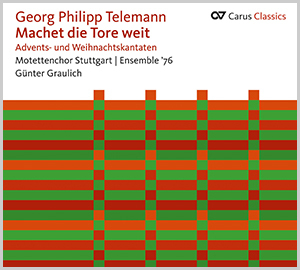
Machet die Tore weit. Advents- und Weihnachtskantaten (Carus Classics)
 Listen
(17)
Listen
(17)
- Coro "Machet die Tore weit"
- Aria "Jesu, komm in meine Seele"
- Recitativo "Ich will zum Einzug"
- Aria "Ich will beten"
- Chorale "Warum willst du"
- Nun komm, der Heiden Heiland - Coro e Recitativo "Nun komm, der Heiden Heiland"
- Nun komm, der Heiden Heiland - Aria "Komm, Jesu, komm"
- Nun komm, der Heiden Heiland - Recitativo "Siehe, ich stehe"
- Nun komm, der Heiden Heiland - Aria "Oeffne dich"
- Nun komm, der Heiden Heiland - Coro "Amen! Komm, du schoene"
- In dulci jubilo - Corale "In dulci jubilo"
- In dulci jubilo - Recitativo "Auf, auf, mein Geist"
- In dulci jubilo - Corale "Das ewge Licht"
- In dulci jubilo - Aria "O heilige Nacht"
- In dulci jubilo - Recitativo "Ich gehe nun"
- In dulci jubilo - Aria "Jesu, hier bei deiner Krippen"
- In dulci jubilo - Coro "Ehre sei Gott"
 Additional material
-
 Digital text (without sheet music) incl. printing licence, html file, singing text, english translationhtml file, singing text, english translation (Sample)1. Chorus
Let all the gates be raised,
2. Aria (Soprano)
and the world’s great doors be raised high,
that the King of all glory may enter.
Who is this marvelous King of all glory?
It is the Lord
strong and mighty in strife.
It is the Lord Sabaoth,
he is the King of all glory. Selah.
Ps 24:7–10Jesu, come and fill my spirit;
3. Recitative (Tenor)
let it be thy dwelling place.
Drive from it the dust of sin,
Glory, lust, and earthly gain;
grant it thy great light of grace.I gladly will prepare the way to cheer thee,
and cast the garments of blest modesty,
of true repentance, and true faith before thee.
...
-
Digital text (without sheet music) incl. printing licence, html file, singing text, originalhtml file, singing text, original (Sample)1. Chor
Machet die Tore weit
2. Arie (Sopran)
und die Türen in der Welt hoch,
dass der König der Ehren einziehe.
Wer ist derselbige König der Ehren?
Es ist der Herr,
stark und mächtig im Streit.
Es ist der Herr Zebaoth,
er ist der König der Ehren. Sela.
Ps 24,7–10Jesu, komm in meine Seele,
3. Rezitativ (Tenor)
lass sie deine Wohnung sein.
Treib aus ihr der Sünden Wust,
Ehre, Geiz und Fleischeslust,
gönn ihr deiner Gnaden Schein.Ich will zum Einzug gern die Bahn bereiten
und dir die Kleider einer heilgen Scheu
von wahrer Buß und Glauben unterbreiten.
Nur stehe mir mit deinem Geiste bei,
...
-
Digital text (without sheet music) incl. printing licence, html file, Introductory text, englishhtml file, Introductory text, english (Sample)Text from the CD Carus 83.333
Klaus Hofmann
Translation: E. D. Echols“But this I well know,” Telemann wrote in his autobiography of 1718, “that I have at all times treasured church music most, in that category have done research in the works of other composers and also have written the most works myself …” According to his report, the number of his own compositions must already then have been more than 500 church works, and probably more than 1,000 additional works were to follow in the almost fifty productive years that Telemann was yet to enjoy. Many of the compositions have been lost. Moreover, not all of the preserved works have been properly inspected; not even a tenth have been made available in new editions. Thus, despite the praiseworthy preliminary efforts of individual researchers, no complete evaluation of Telemann’s artistic achievement in this sector – nor, in particular, of his role and significance in the history of German Protestant church music next to and in the time of Bach – has yet appeared.
Telemann’s more than 1,500 church works are the product of a long and highly dynamic artistic life that stretched out over three-quarters of a century of active creativity. The most important stations of his life:
...
-
Digital text (without sheet music) incl. printing licence, html file, Introductory text, germanhtml file, Introductory text, german (Sample)Booklet-Text der CD Carus 83.333
Klaus Hofmann
»Dieses aber weiß [ich] wol«, schreibt Telemann in seiner 1718 verfassten Autobiographie, »daß ich allemahl die Kirchen-Music am meisten werth geschätzet / am meisten in andern Autoribus ihrentwegen geforschet / und auch das meiste darinnen ausgearbeitet habe …«. Nach seinem Bericht müssen es damals bereits mehr als 500 Kirchenkompositionen gewesen sein; und wohl mehr als 1000 sind in den fast fünfzig Schaffensjahren, die Telemann noch beschieden sein sollten, hinzugekommen. Vieles davon ist untergegangen. Doch auch das Erhaltene ist bislang nicht vollständig gesichtet, und nicht einmal ein Zehntel davon ist durch Neuausgaben erschlossen. So steht, trotz verdienstvoller Vorarbeiten einzelner Musikforscher, eine volle Würdigung der künstlerischen Leistung Telemanns auf diesem Gebiet, vor allem aber seiner Rolle und Bedeutung für die Geschichte der evangelischen Kirchenmusik um und neben Bach, noch aus.
Telemanns mehr als anderthalbtausend Kirchenkompositionen sind der Ertrag eines langen und bewegten Künstlerlebens, das ein Dreivierteljahrhundert schöpferischer Aktivität in sich schließt. Die wichtigsten Stationen dieses Lebens sind: Magdeburg, die Stadt, in der Telemann am 14. März
...
-
Digital text (without sheet music) incl. printing licence, html file, singing text, english translationhtml file, singing text, english translation (Sample)
1. Chorus and Recitative (Alto) Now come, the nations’ Saviour,
born of man as maid most pure;
let all peoples marvel then
that God has sent us his Son.
The Saviour comes among us,
in our own humble flesh and blood
our help to bring us,
and he adopts us now to be his own.
O blest and highest good,
what deeds of love hast thou not done?
What wilt thou not do daily to sustain us?
Thou mak’st each day thy light
of blessing shine upon us.2. Aria (Soprano) Come, Jesu, to thy congregation,
and grant a blest and good new year.
Inspire us all to bring thee honor,
uphold thy teaching as thy banner,
and bless thou all who enter here....
-
Digital text (without sheet music) incl. printing licence, html file, singing text, originalhtml file, singing text, original (Sample)
1. Chor und Rezitativ (Alt) Nun komm, der Heiden Heiland,
der Jungfrauen Kind erkannt,
dass sich wunder alle Welt,
Gott solch Geburt ihm bestellt.
Der Heiland ist gekommen,
hat unser armes Fleisch und Blut
an sich genommen
und nimmt uns selbst zu Blutsverwandten an.
O allerhöchstes Gut!
Was hast du nicht an uns getan!
Was tust du nicht noch täglich an den Deinen!
Du kommst und lässt dein Licht
mit vollem Segen scheinen.2. Arie (Sopran) Komm, Jesu, komm zu deiner Kirche
und gib ein selig neues Jahr!
Befördre deines Namens Ehre!
Erhalte die gesunde Lehre
und segne Kanzel und Altar!...
-
Digital text (without sheet music) incl. printing licence, html file, Introductory text, englishhtml file, Introductory text, english (Sample)Text from the CD Carus 83.333
Klaus Hofmann
Translation: E. D. Echols“But this I well know,” Telemann wrote in his autobiography of 1718, “that I have at all times treasured church music most, in that category have done research in the works of other composers and also have written the most works myself …” According to his report, the number of his own compositions must already then have been more than 500 church works, and probably more than 1,000 additional works were to follow in the almost fifty productive years that Telemann was yet to enjoy. Many of the compositions have been lost. Moreover, not all of the preserved works have been properly inspected; not even a tenth have been made available in new editions. Thus, despite the praiseworthy preliminary efforts of individual researchers, no complete evaluation of Telemann’s artistic achievement in this sector –
...
-
Digital text (without sheet music) incl. printing licence, html file, Introductory text, germanhtml file, Introductory text, german (Sample)Booklet-Text der CD Carus 83.333
Klaus Hofmann
»Dieses aber weiß [ich] wol«, schreibt Telemann in seiner 1718 verfassten Autobiographie, »daß ich allemahl die Kirchen-Music am meisten werth geschätzet / am meisten in andern Autoribus ihrentwegen geforschet / und auch das meiste darinnen ausgearbeitet habe …«. Nach seinem Bericht müssen es damals bereits mehr als 500 Kirchenkompositionen gewesen sein; und wohl mehr als 1000 sind in den fast fünfzig Schaffensjahren, die Telemann noch beschieden sein sollten, hinzugekommen. Vieles davon ist untergegangen. Doch auch das Erhaltene ist bislang nicht vollständig gesichtet, und nicht einmal ein Zehntel davon ist durch Neuausgaben erschlossen. So steht, trotz verdienstvoller Vorarbeiten einzelner Musikforscher, eine volle Würdigung der künstlerischen Leistung Telemanns auf diesem Gebiet, vor allem aber seiner Rolle und Bedeutung für die Geschichte
...


-
Composer
Georg Philipp Telemann
| 1681-1767Telemann's extremely rich compositional output, the fruits of three quarters of a century's work, encompasses almost all genres of music; in his vocal works it ranges from songs with basso continuo accompaniment to chamber and church cantatas, and to opera. In his own assessment, church music played a central role in his output; he alone probably composed over 1,600 church cantatas, as well as cantata-style funeral music settings (such as Du aber, Daniel, gehe hin), psalm settings (for example, Deus judicium tuum) and oratorios. Throughout his works Telemann showed himself to be a progressive composer, open to new trends and keen to experiment whilst exploring new directions; not without reason was he called a forerunner of classicism. However, his compositions constitute only a part of his importance to music history: as a music publisher, the author of publications for teaching, the director of middle-class music societies and initiator of public concerts, he made a considerable contribution to creating the preconditions for the support of the musically-educated middle classes in the ensuing era of music. Personal details
-
Preface writer
Klaus Hofmann
| 1939
-
Ensemble
Motettenchor Stuttgart
-
Ensemble
Ensemble '76 Stuttgart
The Ensemble Stuttgart (Ensemble '76) was founded by Wolfgang Rösch in 1976 and is made up of solo players, musicians from Stuttgart orchestras and music students. Its repertoire comprises pieces for chamber orchestra, including the Bach Brandenburg Concertos as well as symphonies by Haydn, Mozart and Schubert, and chamber music, including the sextets of Brahms and Tchaikovsky and the Mendelssohn Octet. In addition it plays contemporary pieces, some of which were written for this ensemble. The Ensemble Stuttgart gives concerts in Germany, France, Italy and Belgium, and has been involved in many CD and radio productions. Personal details
-
Conductor
Günter Graulich
| 1926The publisher, church musician and teacher Günter Graulich is one of the major personalities in German publishing of the post-war period. With his wife Waltraud he founded Carus-Verlag Stuttgart in 1972, which he built up from a 2-person family firm to a medium-sized business with around 60 employees. A trained church musician and Kantor for many years at the Matthäuskirche Stuttgart, he also directed the Motettenchor Stuttgart for 50 years. With his choir he made LP and CD recordings, and undertook numerous concert tours to other European countries and America. Personal details
-
Soloist - soprano
Barbara Ullrich
-
Soloist - alto
Heidi Rieß
-
Soloist - tenor
Aldo Baldin
| 1945-1994
-
Soloist - tenor
Oly Pfaff
-
Soloist - bass
Bruce Abel
-
Soloist - oboe
Dietmar Keller
-
Soloist - organ
Marieluise Mündlein-Mohr
Reviews on our website can only be submitted by customers with a registered user account. A check whether the rated products were actually purchased does not take place.
Frequent questions about this work
 There are no questions and answers available so far or you were unable to find an answer to your specific question about this work? Then click here and send your specific questions to our Customer Services!