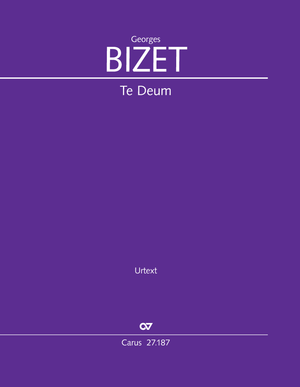
Te Deum
1858
As an acclaimed opera composer, Georges Bizet admitted that he had no real sensibility for sacred music. His Te Deum is nonetheless a truly fascinating and highly expressive work. From the majestic “Te Deum laudamus”, to the skillful choral fugue of “Fiat misericordia tua”, and the opening’s powerful recapitulation, the composition shows no trace of the difficulties that beset the young Bizet by his own admission before he finally completed the work in 1858.
In the extensive trilingual preface to this Urtext edition, editor Marc Rigaudière illuminates the circumstances surrounding the composition of the Te Deum, a work which occupies a singular position in Bizet’s œuvre. The edition is based on the composer’s autograph score — the work’s only surviving source.



-
Composer
Georges Bizet
| 1838-1875Georges Bizet (1838-1875) achieved one of the greatest successes in the history of the genre with his opera Carmen (1875). Although it was not particularly well received by audiences at first, contemporary composers such as Debussy, Tchaikovsky and Brahms recognised the qualities of the work, which was later reflected in its popularity. Today, the opera is one of the most popular in the repertoire. However, contemporary composers such as Debussy, Tchaikovsky and Brahms recognised the qualities of the work, which was later reflected in its popularity – today, the opera is one of the most performed worldwide. Apart from this opera, Bizet composed several other works despite his short life, including many songs, piano music and sacred music. Personal details
-
Editor
Marc Rigaudière
Marc Rigaudière is a professor of musicology at the University of Reims Champagne-Ardenne (URCA) and at the Center for Research and Higher Education in Cultural History (CERHiC) there. As early as 1993, Marc Rigaudière was the first prize-winner in the subject of musical analysis at the Paris Conservatoire (CNSMDP). This was followed by a doctorate from the University of Paris Sorbonne in 2002 and a habilitation in 2019. Marc Rigaudière has held teaching positions at various universities, including the conservatory in Metz and the Sorbonne in Paris. His main fields of research are music theory and musical analysis, among other things, he is concerned with Franco-German cultural transfer in the field of music theory. Since 2002, he has devoted himself to the scholarly editing of musical works in collaboration with Carus-Verlag. His complete list of publications can be found here: https://cv.hal.science/marc-rigaudiere Personal details
-
Vocal score arranger
Harry Schröder
| 1956-2022
Reviews
… ein relativ kurzes, aber intensives und spannendes Werk … mit vier Teilen einer Aufführungsdauer von knapp 20 Minuten. … Der Druck und die Aufmachung der Urtext-Ausgabe sind sehr gut.
Württembergische Blätter für Kirchenmusik, Sept/Okt 2024
…ein faszinierendes, ausdrucksstarkes Werk. … Die Edition beruht auf der einzigen erhaltenen Quelle, dem Autograph des Komponisten. Erstmals ist das Werk mit dem kompletten Material käuflich erhältlich.
Musik & Liturgie, 05/2024
Die mustergültige musikwissenschaftliche Aufarbeitung spiegelt sich in dem ausführlichen Vorwort und einem kritischen Bericht wider.
Andreas Sagstetter, Musica Sacra, 02/2024
Die Ausgabe ist ansprechend und in gewohnter Qualität.
Kirchenmusik im Bistum Limburg, 01/2024
Vorbildlich ist dagegen das breite Angebot dieser Ausgabe, zu der nun erstmals neben der klar gestalteten Partitur und dem gut spielbaren Klavierauszug auch das Orchestermaterial käuflich erworben werden kann.
Chorzeit, Juli/Aug 2023
Reviews on our website can only be submitted by customers with a registered user account. A check whether the rated products were actually purchased does not take place.
Frequent questions about this work
What instrument, if any, can replace the ophicleide?
With how many harps should the harp part be performed?
To which voice do “Dessus I” and “Dessus II” correspond?
How many timpani are needed?
With which work is the “Te deum” well combined?
 There are no questions and answers available so far or you were unable to find an answer to your specific question about this work? Then click here and send your specific questions to our Customer Services!