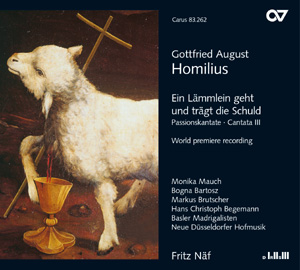
“He was without argument our greatest church composer”, wrote the lexicographer E. L. Gerber a few years after Homilius’ death in 1785. As a result of the destruction of the Kreuzkirche during the Seven Years War, the longtime Kreuzkantor, a pupil of Bach, performed his professional musical duties primarily at the Frauenkirche in Dresden.
The Passionskantate (Passion Cantata) was well received and widely disseminated during the 18th and 19th centuries: Thanks to its popularity it was published in 1775 by Breitkopf as a full score – a rare honor, accorded to only one other Passion in the 18th century (Graun’s Tod Jesu). The text describes the events of the Passion from a very personal point of view: The story focuses less on the actual events, then upon the feelings of the observers of these events. The subjective nature of the narrative is reflected in a very dramatically marked style of recitative, which presents a charming contrast to the expressive choral writing and the melodically accented arias.
Explore

 Listen
(21)
Listen
(21)
- Purchase the work as a CD or download.
- Choral "Ein Lämmlein geht"
- Chor "Siehe, das ist Gottes Lamm"
- Arie "Wie tödlich schrecken die Gerichte"
- Arie "Ich bete, zürnet nicht"
- Choral "Seine Liebe, sein Erbarmen"
- Arie "Nun sterb ich Sünder nicht"
- Chor "Daran ist erschienen"
- Arie & Chor "Nun wird mich, Gott, dein Donner fassen"
- Chor "Ach, Herr, unsere Missetaten"
- Arie "Umgürtet mit Gerechtigkeit"
- Chor "Israel, hoffe auf den Herrn"
- Choral "Ob bei uns ist der Sünden viel"
- Choral "Ich grüße dich am Kreuzesstamm"
- Arie "Bewaffne dich, Mächtger, mit Schrecken"
- Chor "Unsre Sünden und Missetaten"
- Arioso "Mir hast du Arbeit gemacht"
- Arioso "Ich tilge deine Übertretung"
- Arie "Getrost, mein Christ"
- Choral "Nun ich weiß, worauf ich bau"
- Arie "Am Kreuze stirbt er für die Sünden"
- Chor "Hier hängt das Opfer für die Sünden"
 Additional material
- Purchase additional material as a download product.
-
 Digital text (without sheet music) incl. printing licence, html file, singing text, english translationhtml file, singing text, english translation (Sample)Part One 1. Chorus
A little lamb goes bearing the guilt
2. Chorus
of the world and its children.
It goes patiently atoning
for the sins of all sinners.
It goes out, grows ill and weak,
bows its head to the slaughter,
denying itself all pleasures;
it takes upon itself shame, scorn and mockery,
fear, wounds, welts, Cross and death,
and says: This will I gladly suffer.Behold the Lamb of God,
3. Recitative (Tenor)
which taketh away the sin of the world.
John 1:29In the Father’s voice the Eternal One cried:
This is my beloved Son! The voice is silent!
In all his wrath, the Eternal One now cries from...
-
Digital text (without sheet music) incl. printing licence, html file, singing text, originalhtml file, singing text, original (Sample)Erster Teil 1. Choral
Ein Lämmlein geht und trägt die Schuld
2. Chor
der Welt und ihrer Kinder.
Es geht und büßet in Geduld
die Sünden aller Sünder.
Es geht dahin, wird matt und krank,
ergibt sich auf die Würgebank,
entzieht sich aller Freuden;
es nimmt an sich Schmach, Hohn und Spott,
Angst, Wunden, Striemen, Kreuz und Tod,
und spricht: Ich wills gern leiden.Siehe, das ist Gottes Lamm, welches der Welt Sünde trägt. Johannes 1,29
3. Rezitativ (Tenor)Mit väterlicher Stimme rief einst der Ewige: Dies ist mein lieber Sohn! Die Stimme schweigt! In seinem ganzen Grimme ruft nun der Ewige von seinem Thron: Mein Sohn soll sterben! Ein fürchterlicher Ton! Die Seligkeit
...
-
Digital text (without sheet music) incl. printing licence, html file, Introductory text, frenchhtml file, Introductory text, french (Sample)Texte du livret du CD Carus 83.262
Uwe Wolf
Traduction (abrégé): Sylvie CoquillatFils de pasteur, Gottfried August Homilius naît le 2 février 1714 à Rosenthal (Saxe). Il accomplit sa scolarité à l’école Sainte-Anne de Dresde où, bien qu’encore élève, il est déjà chargé de tenir l’orgue de temps en temps. En mai 1735, Homilius est immatriculé comme étudiant en droit à l’Université de Leipzig. Il travaille également comme musicien à Leipzig et remplace manifestement de temps à autre Johann Schneider, organiste de l’église Saint-Nicolas. Il prend part aux représentations des œuvres vocales de Johann Sebastian Bach. Selon Johann Adam Hiller, il appartient à Leipzig au cercle direct des élèves de Bach.
En 1742, Homilius endosse la fonction d’organiste de la nouvelle église Notre-Dame de Dresde. Dans cette fonction, il se taille une réputation de maître dans sa spécialité. En 1755 enfin, Homilius succède à Theodor Christian Reinhold au poste de cantor de la Croix et directeur de la musique des principales églises de Dresde, une fonction qu’il conserve jusqu’à sa mort, le 2 juin 1785. Mais le lieu d’action majeur du cantor de la Croix Homilius ne fut cependant pas l’église de la Croix
...
-
Digital text (without sheet music) incl. printing licence, html file, Introductory text, englishhtml file, Introductory text, english (Sample)Text from the CD Carus 83.262
Uwe Wolf
Translation (abridged): Peter PalmerThe son of a clergyman, Gottfried August Homilius was born in Rosenthal (Saxony) on 2 February 1714. His schooling was chiefly at the Annen-Schule in Dresden, where he occasionally performed the duties of organist while still a pupil. In May 1735 Homilius matriculated as a law student at the University of Leipzig. He was again active as a musician while in Leipzig and evidently deputized on occasion for Johann Schneider, the organist of the Nikolaikirche. In the process he also took part in the performance of Johann Sebastian Bach’s vocal works. According to Johann Adam Hiller, he belonged to Bach’s direct circle of pupils in Leipzig.
In 1742 Homilius took up the position of organist at the new Dresden Frauenkirche. In this capacity he acquired the reputation as a master of his art. In 1755 Homilius finally succeeded Theodor Christian Reinhold as Kreuzkantor and music director of the main Dresden churches – an office he occupied until his death on 2 June 1785. Notwithstanding his title, his activities were centered on the Frauenkirche rather than the Kreuzkirche, because this was destroyed by Prussian artillery in 1760 during the Seven Years War, and the edifice
...
-
Digital text (without sheet music) incl. printing licence, html file, Introductory text, germanhtml file, Introductory text, german (Sample)Booklet-Text der CD Carus 83.261
Uwe Wolf
Gottfried August Homilius wurde am 2. Februar 1714 in Rosenthal (Sachsen) als Sohn eines Pfarrers geboren und erhielt seine Schulausbildung überwiegend an der Annen-Schule in Dresden, wo er bereits als Schüler hin und wieder den Organistendienst übernahm. Im Mai 1735 immatrikulierte sich Homilius als Jura-Student an der Universität Leipzig. Auch in Leipzig war er musikalisch aktiv und vertrat offenbar zeitweilig den Nikolai-Organisten Johann Schneider. Dabei wirkte er auch an den Aufführungen der Vokalwerke Johann Sebastian Bachs mit. Laut Johann Adam Hiller zählte er in Leipzig zum direkten Schülerkreis Bachs.
1742 konnte Homilius das Amt des Organisten an der neuen Dresdner Frauenkirche übernehmen. In dieser Funktion erwarb er sich den Ruf eines hervorragenden Organisten. 1755 trat Homilius schließlich die Nachfolge Theodor Christian Reinholds als Kreuzkantor und Musikdirektor der Dresdner Hauptkirchen an, ein Amt, das er bis zu seinem Tod am 2. Juni 1785 innehatte. Hauptwirkungsstätte war für den Kreuzkantor Homilius jedoch nicht die Kreuz-, sondern die Frauenkirche, da die Kreuzkirche 1760 im Siebenjährigen Krieg durch preußische Artillerie zerstört und der Nachfolgebau erst nach
...
Purchase
Additional product information
Contents

-
Composer
Gottfried August Homilius
| 1714-1785Gottfried August Homilius, the son of a pastor, was born in Rosenthal (Saxony) on 2 February 1714. In May 1735 he enrolled as a law student at Leipzig University. Likewise, it was probably at this time that Homilius was a pupil of Johann Sebastian Bach; the latter fact had been attested to by Johann Adam Hiller. Apart from Bach, Homilius also had contact with Johann Schneider, a Bach pupil and organist at the Nicolaikirche, for whom he also substituted. After unsuccesfully applying for a post as organist in Bautzen, Homilius was appointed organist at the Dresden Frauenkirche in 1742. In 1755 Homilius succeeded Theodor Christlieb Reinhold as Kreuzkantor and music director of the three main churches in Dresden, a position that he occupied until his death on 2 June 1785. Personal details
-
Editor
Uwe Wolf
| 1961As a musicologist, Dr. Uwe Wolf is particularly at home in the 17th and 18th centuries. The focus of his work ranges from the time of Monteverdi and Schütz to Bach and the generation of Bach's sons and pupils through to Viennese Classicism. He has been head of the editorial department at Carus-Verlag since October 2011. Prior to this, he worked in Bach research for over 20 years. Personal details
-
Songwriter / Librettist
Ernst August Buschmann
Reviews
Der Chor ist in dieser Passionskantate ... nicht auf die biblischen Texte festgelegt. Er vertritt vielmehr die dem Passionsgeschehen folgende Christengemeinde und ist damit gegenüber den oratorischen Passionen deutlich aufgewertet. Große Chorszenen prägen die Passionskantate, mehrfach finden sich Mischformen aus Chor und Arie.
Singende Kirche, 54. Jahrgang, Heft 2 2007
Reviews on our website can only be submitted by customers with a registered user account. A check whether the rated products were actually purchased does not take place.
No feedback available for this product.
Frequent questions about this work
 There are no questions and answers available so far or you were unable to find an answer to your specific question about this work? Then click here and send your specific questions to our Customer Services!