

Christmas History
Historia der freuden- und gnadenreichen Geburt Gottes und Marien Sohnes Jesu Christi SWV 435, 1664
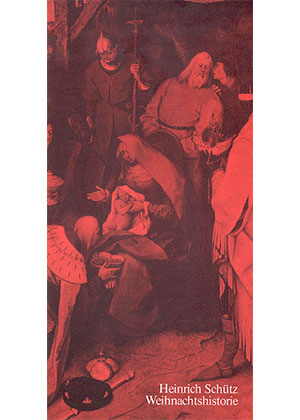
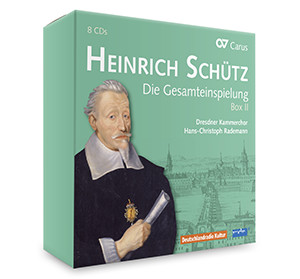
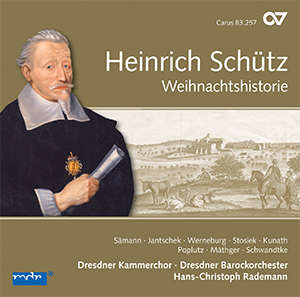
The Weihnachts-Historie SWV 435 by Heinrich Schütz is in the tradition of historia settings which, unlike the later oratorios, were largely based on biblical accounts. Amongst the Christmas Histories, found from the early 17th century onwards, the mature Schütz’s composition is rightly regarded as the most important. Both the impressive setting of the Gospel account and the Intermedia, characterized by various different scorings and instrumentation, lend the historia a dramatic pull, and allow the 40-minute composition to become an exceptionally varied experience for the listener.
Schütz was well aware of the high demand the Intermedia placed on the instrumental forces, and allowed only the Evangelist’s account to be printed in 1664, as the Intermedia should only be performed “by outstanding ensembles” in a “fitting manner”. These only survived in manuscript; as a result, the Introduction and the 5th Intermedium survive incomplete and were added by Paul Horn in the style of Schütz’s time for our edition.
Explore


 Listen
(16)
Listen
(16)
- Introduktion
- Die Geburt Jesu
- Der Engel zu den Hirten auf dem Felde (aus Vol. 10: Weihnachtshistorie)
- Die Menge der Engel
- Die Hirten auf dem Felde
- Die Anbetung der Hirten
- Die Weisen aus dem Morgenlande
- Die Hohenpriester und Schriftgelehrten
- Herodes
- Die Anbetung der Weisen aus dem Morgenlande
- Die Flucht nach Ägypten
- Die Flucht nach Ägypten II
- Kindermord des Herodes
- Rückkehr aus Ägypten (aus Vol. 10: Weihnachtshistorie)
- Rückkehr aus Ägypten II
- Conclusio
 Practise
-
 carus music, the Choir Coach
Üben mit carus music
carus music, the Choir Coach
Üben mit carus music
-
Practice aids
-
Practice aids voice part soprano
- Introduktion (Choir Coach)
- Introduktion (Choir Coach, Slow mode)
- Introduktion (Choir Coach, soprano 1)
- Introduktion (Choir Coach, Slow mode, soprano 1)
- Introduktion (Choir Coach, soprano 2)
- Introduktion (Choir Coach, Slow mode, soprano 2)
- Conclusio (Choir Coach)
- Conclusio (Choir Coach, Slow mode)
-
Practice aids voice part alto
- Introduktion (Choir Coach)
- Introduktion (Choir Coach, Slow mode)
- Die Menge der Engel (Choir Coach)
- Die Menge der Engel (Choir Coach, Slow mode)
- Die Hirten auf dem Felde (Choir Coach, Alto 1)
- Die Hirten auf dem Felde (Choir Coach, Slow mode, Alto 1)
- Die Hirten auf dem Felde (Choir Coach, Alto 2)
- Die Hirten auf dem Felde (Choir Coach, Slow mode, Alto 2)
- Die Hirten auf dem Felde (Choir Coach)
- Die Hirten auf dem Felde (Choir Coach, Slow mode)
- Conclusio (Choir Coach)
- Conclusio (Choir Coach, Slow mode)
-
Practice aids voice part tenore
- Introduktion (Choir Coach)
- Introduktion (Choir Coach, Slow mode)
- Die Menge der Engel (Choir Coach, Tenore 1)
- Die Menge der Engel (Choir Coach, Slow mode, Tenore 1)
- Die Menge der Engel (Choir Coach, Tenore 2)
- Die Menge der Engel (Choir Coach, Slow mode, Tenore 2)
- Die Hirten auf dem Felde (Choir Coach)
- Die Hirten auf dem Felde (Choir Coach, Slow mode)
- Die Weisen aus dem Morgenlande (Choir Coach, Tenore 1)
- Die Weisen aus dem Morgenlande (Choir Coach, Slow mode, Tenore 1)
- Die Weisen aus dem Morgenlande (Choir Coach, Tenore 2)
- Die Weisen aus dem Morgenlande (Choir Coach, Slow mode, Tenore 2)
- Die Weisen aus dem Morgenlande (Choir Coach)
- Die Weisen aus dem Morgenlande (Choir Coach, Slow mode)
- Conclusio (Choir Coach)
- Conclusio (Choir Coach, Slow mode)
-
Practice aids voice part basso
- Introduktion (Choir Coach)
- Introduktion (Choir Coach, Slow mode)
- Die Menge der Engel (Choir Coach)
- Die Menge der Engel (Choir Coach, Slow mode)
- Die Hohenpriester und Schriftgelehrten (Choir Coach, Basso 1)
- Die Hohenpriester und Schriftgelehrten (Choir Coach, Slow mode, Basso 1)
- Die Hohenpriester und Schriftgelehrten (Choir Coach, Basso 2)
- Die Hohenpriester und Schriftgelehrten (Choir Coach, Slow mode, Basso 2)
- Die Hohenpriester und Schriftgelehrten (Choir Coach)
- Die Hohenpriester und Schriftgelehrten (Choir Coach, Slow mode)
- Die Hohenpriester und Schriftgelehrten (Choir Coach)
- Die Hohenpriester und Schriftgelehrten (Choir Coach, Slow mode)
- Conclusio (Choir Coach)
- Conclusio (Choir Coach, Slow mode)
-
 Additional material
- Purchase additional material as a download product.
-
 Digital text (without sheet music) incl. printing licence, html file, singing text, english translationhtml file, singing text, english translation (Sample)Introduction (Coro)
The glad birth, of our Lord and Savior Jesus Christ, in the words of the holy Evangelists’ description, who wrote it down..
The birth of Jesus
Evangelist (Tenore)And behold, it came to pass in those days, that there went out a decree from Caesar Augustus, that all the world enroll for taxing. (And this taxing was the first; being made at the time when Cyrenius was governor of Syria.) And ev’ryone went that he might be taxed, unto the city of his birth. Among them there went up Joseph being of Galilee, and went from Nazareth, to Judaea, to the city of David, which is called Bethlehem; (because he was of the lineage and house of David:) that he might enroll for taxing, and with him Mary, his own espoused wife, being great with child. And, while they yet tarried there, it was time that she should be delivered. And she brought forth her first-born son, and wrapped him round in swaddling, and laid him in a lowly manger, for they could not find a room for them in the inn. And, in the same country where shepherds abiding in the fields, and keeping watch over their flock by night. And lo, the Lord’s own angel came upon them, and the glory of the Lord shone round about them: and they were sore afraid.
...
-
Digital text (without sheet music) incl. printing licence, html file, singing text, originalhtml file, singing text, original (Sample)Introduction (Coro)
Die Geburt unseres Herrn Jesu Christi, wie uns die von den heiligen Evangelisten beschrieben wird.
Jesu Geburt
Evangelist (Tenore)Es begab sich aber zu der selbigen Zeit, dass ein Gebot von dem Kaiser Augusto ausging, dass alle Welt geschätzet würde, und diese Schätzung war die erste und geschah zu der Zeit, da Cyrenius Landpfleger in Syrien war, und jedermann ging, dass er sich schätzen ließe, ein jeglicher in seine Stadt. Da machte sich auch auf Joseph aus Galiläa, aus der Stadt Nazareth, in das jüdische Land zu der Stadt Davids, die da heißet Bethlehem, darum dass er von dem Hause und Geschlechte Davids war, auf dass er sich schätzen ließe mit Maria, seinem vertrauten Weibe, die war schwanger. Und als sie daselbst waren, kam die Zeit, dass sie gebären sollte, und sie gebar ihren ersten Sohn und wickelt’ ihn in Windeln und legte ihn in eine Krippe, denn sie hatten sonst keinen Raum in der Herberge. Und es waren Hirten in derselbigen Gegend auf dem Felde, die hüteten des Nachts ihre Herde, und siehe, des Herren Engel trat zu ihnen, und die Klarheit des Herren leuchtet’ um sie und sie furchten sich sehr, und der Engel sprach zu
...
Purchase
Additional product information
Contents


-
Composer
Heinrich Schütz
| 1585-1672Heinrich Schütz is regarded as the first German musician of European stature. As a choirboy from 1599 at the court of Landgrave Moritz of Hessen-Kassel, he received a thorough education. In 1608 he began a law degree in Marburg, but broke this off in 1609 in order, with the support of the Landgrave, to study composition with Giovanni Gabrieli, organist at St Mark’s in Venice. In 1613 Schütz returned to Kassel, but two years later was enticed away by Elector Johann Georg I of Saxony to the Dresden court as “Organist und Director der Musica”, where he held the position of Hofkapellmeister (court Kapellmeister) from 1617 until his death. Schütz’s great cycles of vocal works marked the high point of his reputation in Germany and northern Europe. But these represent only part of Schütz’s output; individual works are represented in printed collections with works by other composers, others only survive in manuscript, and much has been lost. The Stuttgart Schütz Edition makes available Schütz’s complete oeuvre, and all works are also published in practical Urtext editions. Personal details
-
Editor
Günter Graulich
| 1926The publisher, church musician and teacher Günter Graulich is one of the major personalities in German publishing of the post-war period. With his wife Waltraud he founded Carus-Verlag Stuttgart in 1972, which he built up from a 2-person family firm to a medium-sized business with around 60 employees. A trained church musician and Kantor for many years at the Matthäuskirche Stuttgart, he also directed the Motettenchor Stuttgart for 50 years. With his choir he made LP and CD recordings, and undertook numerous concert tours to other European countries and America. Personal details
-
Continuo realization
Paul Horn
| 1922-2016Paul Horn war ein deutscher Kirchenmusiker, Organist, Komponist und Musikwissenschaftler. Er studierte Kirchenmusik und Orgel an der Evangelischen Kirchenmusikschule Esslingen am Neckar bei Hans-Arnold Metzger und Musikwissenschaft, Theologie und Geschichte an der Universität Tübingen. Seine berufliche Laufbahn begann als Kantor an der Evangelischen Michaelskirche in Stuttgart-Degerloch. 1954 wurde er Kantor an der Evangelischen Stadtkirche Ravensburg, eine Position, die er bis zu seiner Pensionierung innehatte. Als Musikwissenschaftler arbeitete Horn bis ins hohe Alter eng mit Carus zusammen. So stammen zahlreiche Carus-Klavierauszüge aus seiner Feder. Personal details
-
Translator
Derek McCulloch
-
Translator
David Johnston
Reviews
... Das Notenmaterial aus dem Carus-Verlag ist angenehm zu lesen, mit deutschem und englischem Text versehen und sehr übersichtlich angelegt.
Monika Fahrnberger, singende kirche, 3/2019
Reviews on our website can only be submitted by customers with a registered user account. A check whether the rated products were actually purchased does not take place.
No feedback available for this product.
Frequent questions about this work
Which version is the edition based on?
As in most of the other editions, the recitatives from the printed edition of 1664 are combined with the intermedii from the Uppsala manuscript. The opening chorus (missing apart from the continuo part) is included in a reconstruction by Paul Horn.
 There are no questions and answers available so far or you were unable to find an answer to your specific question about this work? Then click here and send your specific questions to our Customer Services!