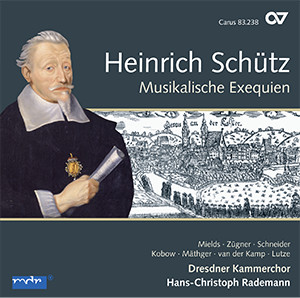
Heinrich Schuetz composed the Musikalische Exequien SWV 279-281 for the funeral of his patron Prince Heinrich Posthumus Reuß 1635/1636. The work comprises three parts which were to be sung at different points within the funeral service. The first and third parts in particular present choral singers with a challenge: solo movements alternate with choral movements, with almost every movement leading into the next without a break. There is certainly no time to consider which note comes next, or when!
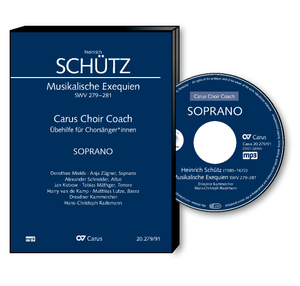
The Carus Choir Coach offers choir singers the unique opportunity to study and learn their own, individual choral parts within the context of the sound of the entire choir and orchestra. For every vocal range a download containing each choir part is available. The Carus Choir Coach is based on recorded interpretations by renowned artists who have performed the work from carefully prepared Carus Urtext editions. Each choir part is presented in three different versions:
- Original recording
- Coach: each part is accompanied by the piano, with the original recording sounding in the background
- Coach in slow mode: the tempo of the coach slows down to 70% of the original version – through this reduction passages can be learned more effectively.
Performers: Dorothee Mields, Anja Zügner (soprano), Alexander Schneider (alto), Jan Kobow, Tobias Mäthger (tenore), Harry van der Kamp, Matthias Lutze (basso) – Dresdner Kammerchor – Hans-Christoph Rademann
Explore
 Listen
(2)
Listen
(2)
- Lord, if I have thee only
- Lord, now dost thou grant thy true sevant
 Additional material
- Purchase additional material as a download product.
-
 Digital text (without sheet music) incl. printing licence, html file, Introductory text, englishhtml file, Introductory text, english (Sample)Text from the CD Carus 83.238
Oliver Geisler
Güldene SterbKunst – The “golden art” of dying Funeral music by Heinrich Schütz
Translation (abridged): Elizabeth RobinsonThe music of Heinrich Schütz is music which is close to life; a music which shares in the history and culture from which it emerged, and in which the experiences of “Sagittarius” (Schütz’s Latin name) himself have left unmistakable traces. This music is full of life – even when it celebrates death.
This does not mean that Schütz’s music should always be seen and heard against a background of suffering and death on a huge scale, as embodied in the raging of the Thirty Years’ War and the constant presence of deadly disease. On the contrary, it means that much of Schütz’s funeral music can be traced back to particular biographical events in his life. These are works which range from simple fourpart chorales to polychoral spatial music, and yet they always combine one thing: a particularly strong link between sensitivity to the text and sensuousness of sound, achieved by a simple musical message of consolation coupled with high expressivity. And all this with great personal sympathy. Schütz’s works, in which death and life, dying and
...
-
Digital text (without sheet music) incl. printing licence, html file, Introductory text, germanhtml file, Introductory text, german (Sample)Text from the CD Carus 83.238
Oliver Geisler
Güldene SterbKunst – Trauermusiken von Heinrich SchützDie Musik von Heinrich Schütz ist eine Musik nah am Leben. Eine Musik, die teilnimmt an der Geschichte und Kultur, aus der sie hervorgeht und in der die Erfahrungen des 'Saggittarius' selbst untrügliche Spuren hinterlassen haben. Diese Musik ist nah am Leben – gerade, wenn sie das Sterben besingt.
Das meint nicht nur, dass die Musik von Schütz immer auch vor dem Hintergrund massenhaften Leidens und Sterbens angesichts eines 30 Jahre wütenden Weltkrieges und der Allgegenwart tödlicher Krankheiten zu sehen und zu hören ist. Es meint vielmehr, dass sich zahlreiche Trauermusiken Schütz' auf konkrete biografische Ereignisse im Leben Schütz' zurückführen lassen. Es sind Werke, die vom schlichten vierstimmigen Choral bis zur mehrchörigen Raummusik reichen und doch stets eines verbindet: die besonders intensive Verbindung aus Wortsorgfalt und Klangsinnlichkeit, aus schlichter musikalischer Trostpredigt und hoher Expressivität. Und all das mit großer persönlicher Anteilnahme. Jene Schütz'schen Werke, in denen Tod und Leben, Sterben und Ewigkeit, Trauer und Trost musikalisch wie theologisch besonders eindringlich
...
Purchase
Additional product information
Contents


-
Composer
Heinrich Schütz
| 1585-1672Heinrich Schütz is regarded as the first German musician of European stature. As a choirboy from 1599 at the court of Landgrave Moritz of Hessen-Kassel, he received a thorough education. In 1608 he began a law degree in Marburg, but broke this off in 1609 in order, with the support of the Landgrave, to study composition with Giovanni Gabrieli, organist at St Mark’s in Venice. In 1613 Schütz returned to Kassel, but two years later was enticed away by Elector Johann Georg I of Saxony to the Dresden court as “Organist und Director der Musica”, where he held the position of Hofkapellmeister (court Kapellmeister) from 1617 until his death. Schütz’s great cycles of vocal works marked the high point of his reputation in Germany and northern Europe. But these represent only part of Schütz’s output; individual works are represented in printed collections with works by other composers, others only survive in manuscript, and much has been lost. The Stuttgart Schütz Edition makes available Schütz’s complete oeuvre, and all works are also published in practical Urtext editions. Personal details
Reviews on our website can only be submitted by customers with a registered user account. A check whether the rated products were actually purchased does not take place.
No feedback available for this product.
Frequent questions about this work
 There are no questions and answers available so far or you were unable to find an answer to your specific question about this work? Then click here and send your specific questions to our Customer Services!