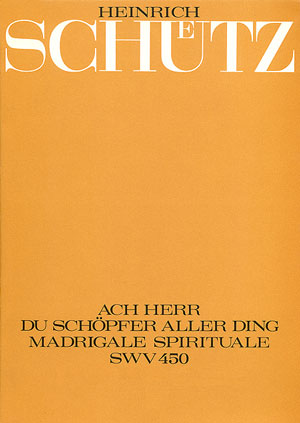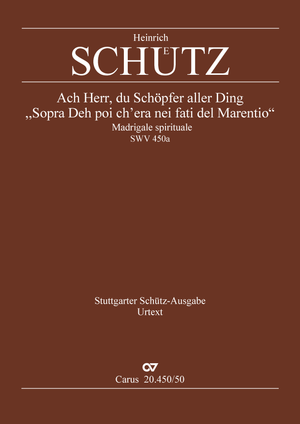
A sacred madrigal for three solo parts with basso continuo for Christmas time. Schütz composed this short piece in imitation of a secular Italian madrigal by Marenzio. In the source, Schütz’s work is lacking the soprano part. The editor Helmut Lauterwasser has reconstructed this with the help of the Marenzio madrigal. The work, first published in Vol. 19 of the Complete Edition, is published here as a separate edition with basso continuo realization.
Separate edition taken from Vol. 19 of the Stuttgart Schütz Edition (Complete Edition Carus 20.919).


Purchase
Additional product information
-
Composer
Heinrich Schütz
| 1585-1672Heinrich Schütz is regarded as the first German musician of European stature. As a choirboy from 1599 at the court of Landgrave Moritz of Hessen-Kassel, he received a thorough education. In 1608 he began a law degree in Marburg, but broke this off in 1609 in order, with the support of the Landgrave, to study composition with Giovanni Gabrieli, organist at St Mark’s in Venice. In 1613 Schütz returned to Kassel, but two years later was enticed away by Elector Johann Georg I of Saxony to the Dresden court as “Organist und Director der Musica”, where he held the position of Hofkapellmeister (court Kapellmeister) from 1617 until his death. Schütz’s great cycles of vocal works marked the high point of his reputation in Germany and northern Europe. But these represent only part of Schütz’s output; individual works are represented in printed collections with works by other composers, others only survive in manuscript, and much has been lost. The Stuttgart Schütz Edition makes available Schütz’s complete oeuvre, and all works are also published in practical Urtext editions. Personal details
-
Editor
Helmut Lauterwasser
-
Continuo realization
Paul Horn
| 1922-2016Paul Horn war ein deutscher Kirchenmusiker, Organist, Komponist und Musikwissenschaftler. Er studierte Kirchenmusik und Orgel an der Evangelischen Kirchenmusikschule Esslingen am Neckar bei Hans-Arnold Metzger und Musikwissenschaft, Theologie und Geschichte an der Universität Tübingen. Seine berufliche Laufbahn begann als Kantor an der Evangelischen Michaelskirche in Stuttgart-Degerloch. 1954 wurde er Kantor an der Evangelischen Stadtkirche Ravensburg, eine Position, die er bis zu seiner Pensionierung innehatte. Als Musikwissenschaftler arbeitete Horn bis ins hohe Alter eng mit Carus zusammen. So stammen zahlreiche Carus-Klavierauszüge aus seiner Feder. Personal details
Reviews on our website can only be submitted by customers with a registered user account. A check whether the rated products were actually purchased does not take place.
No feedback available for this product.
Frequent questions about this work
What is the difference between this and SWV 450, which has the same title?
SWV 450 is in five parts and SWV 450a in three, so the settings differ, but not only in their scoring.
In both works Schütz draws on the madrigal “Deh poi ch’era ne fati ch’io dovessi” by Marenzio – very freely in SWV 450, and by comparison, more closely in SWV 450a.
 There are no questions and answers available so far or you were unable to find an answer to your specific question about this work? Then click here and send your specific questions to our Customer Services!