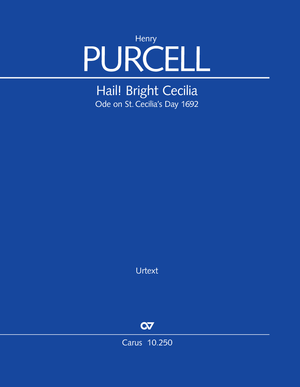
Hail! Bright Cecilia. Ode on St. Cecilia's Day 1692
Z 328, 1692
“Hail! bright Cecilia, hail to thee. Great patroness of us and harmony!” – this exclamation opens the final chorus of Henry Purcell’s eponymous Ode to St. Cecilia from 1692. A paean to the power of music, the work is one of the undoubted masterpieces of English choral odes of that time.
A resolution of the Musical Society of London in 1683 launched the great tradition of annual celebrations for St. Cecilia’s Day (November 22), featuring a church service followed by performances of specially composed music. Over the years, Purcell wrote several odes for the occasion, of which this example from 1692 is one of the most popular. Four decades later, Handel would also contribute to the celebrations with his Alexander’s Feast, HWV 75 (Carus 55.075), and his Ode for St. Cecilia’s Day, HWV 76 (Carus 55.076).
Purcell’s magnificent music, which features a huge range of tonal color and form, offers delightful parts for a variety of solo, ensemble, and choral settings. With its richly expressive palette, the Ode to St. Cecilia is an extremely rewarding work by the “Orpheus Britannicus”, as Purcell was admiringly called by contemporaries.
- Festive, rousing ode to music
- Highlight of the "choral ode" genre in the 17th century



Purchase
Additional product information
-
Composer
Henry Purcell
| 1659-1695Henry Purcell is considered the most important composer of the English High Baroque period. He gained his first musical experience as a singing boy in the Royal Chapel. In 1674 he became an organist at Westminster Abbey, three years later Composer of the Violins at Court, and in 1679 he finally became organist of Westminster Abbey himself. Purcell was promoted to organist of the Royal Chapel in 1683 and became the royal steward of instruments in 1683. This put an end to his political and social career and allowed him to concentrate on his musical work. From today's perspective, Henry Purcell appears to be the most important English stage composer of the era before George Frideric Handel. Personal details
-
Editor
Julia Rosemeyer
Reviews on our website can only be submitted by customers with a registered user account. A check whether the rated products were actually purchased does not take place.
No feedback available for this product.
Frequent questions about this work
Not all notes in the trumpet parts are playable on a natural trumpet. What kind of instrument is needed?
Purcell probably had slide trumpets. But the notes outside the natural scale are used extremely sparingly and can be bypassed (the edition includes a suggestion) or “forced” on the natural trumpet.
One movement calls for a bass recorder. Why is this instrument not listed at the scoring?
In movement 3, scored for alto, tenor, 2 recorders and continuo, Purcell’s autograph manuscript initially indicates that the continuo instrument be changed from “bass violin” to “bass flute”. However, these entries end after a few measures, and it is not known whether Purcell abandoned the idea (perhaps due to problems with the instrumental range) or whether he assumed that the performers would themselves continue the idea. While our edition makes a suggestion for these changes in the instrumental parts of the performance material, this can also be ignored, especially since it is not certain whether Purcell really performed the work in this way.
 There are no questions and answers available so far or you were unable to find an answer to your specific question about this work? Then click here and send your specific questions to our Customer Services!