A mighty fortress is our God
Cantata for Reformation Day. Reconstruction Klaus Hofmann BWV 80 (BWV3 80.3)
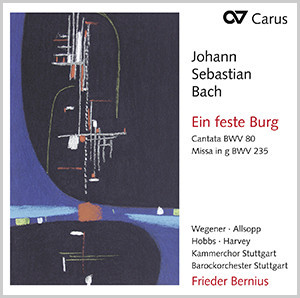
Bach’s Reformation cantata, based on what is probably Martin Luther’s most famous hymn, was composed in at least two stages of work, separated by a period of several years. The cantata Alles, was von Gott geboren was performed in March 1716, on Oculi Sunday (the third Sunday in Lent), far apart from Reformation Day. In the 1730s and 40s Bach reworked the cantata: amongst other things, he initially placed a simple chorale movement, later an expansive, motet-like chorale arrangement of the hymn Ein feste Burg ist unser Gott (A mighty fortress is our God) at the beginning, and created a magnificent Reformation cantata. It is this opening chorus which places particular demands on the choral singers: long phrases, sequences of eighth notes, where the notes need to sit securely so that they come across with lightness, and then the phenomenon which everyone in the choir is familiar with: never think with Bach that you know how it is going to continue – there is always something you had not anticipated!
Simply practice. Anytime. Everywhere.
Whether at home on your tablet or PC or on the road on your smartphone: with carus music, the Choir Coach, you always have your choral works with you to practice! With the carus music choir app, you can listen to your score together with a first-class recording on any device and easily practice your own choir part with a coach. With carus music, your concert preparation is easy, efficient and fun to master!
In this edition, the relevant part is highlighted by the sung voice instead of piano.
Performers: Sarah Wegener (soprano), David Allsopp (alto), Thomas Hobbs (tenore), Peter Harvey (basso) – Kammerchor Stuttgart, Barockorchester Stuttgart – Frieder Bernius
Explore
 Additional material
- Purchase additional material as a download product.
-
 Digital text (without sheet music) incl. printing licence, html file, singing text, english translationhtml file, singing text, english translation (Sample)
1. Choral A mighty fortress is our God,
a stronghold never failing.
He helps us when with troubles fraught
and freely grants his caring.
The evil enemy,
attacks us with glee
his weapons are cruel,
treachery would rule,
on earth is none beside him.2. Aria (Soprano e Basso) All those born of God are praising
and in victory rejoicing.
With all our strength is nothing done,
for soon we are defeated.
For us the right defense has come,
whom God himself selected.
Those who by the blood of Christ
...
-
Digital text (without sheet music) incl. printing licence, html file, singing text, originalhtml file, singing text, original (Sample)
1. Choral Ein feste Burg ist unser Gott,
ein gute Wehr und Waffen.
Er hilft uns frei aus aller Not,
die uns itzt hat betroffen.
Der alte böse Feind,
mit Ernst ers itzt meint;
groß Macht und viel List
sein grausam Rüstung ist,
auf Erd ist nicht seinsgleichen.2. Aria (Soprano e Basso) Alles, was von Gott geboren,
ist zum Siegen auserkoren.
Mit unser Macht ist nichts getan,
wir sind gar bald verloren.
Es streit’ vor uns der rechte Mann,
den Gott selbst hat erkoren.
Wer bei Christi Blutpanier
...
-
Digital text (without sheet music) incl. printing licence, html file, Introductory text, englishhtml file, Introductory text, english (Sample)Text from the CD Carus 83.282 Klaus Hofmann
Translation: (abridged): Elizabeth RobinsonNo hymn is as closely associated with the figure of Martin Luther and the Reformation as Ein feste Burg ist unser Gott. The hymn which Luther wrote in 1527, based on Psalm 46, became the confessional hymn of the Protestant movement soon after it was written. With his chorale cantata for Reformation Day, Johann Sebastian Bach paid a unique homage to the Lutheran hymn. It is the introductory chorale movement for chorus on the first verse of the hymn in particular which sets the work apart from the majority of Bach’s church cantatas. With its 114 breves, the movement has no equal in its form. The architectural concept, as it were, is unique. Here a four-part choral motet, in which all the lines of the hymn are treated individually in fugal form, is overarched by the outer orchestral parts with a canon on the same hymn melody.
...
-
Digital text (without sheet music) incl. printing licence, html file, Introductory text, germanhtml file, Introductory text, german (Sample)Booklet-Text der CD Carus 83.282 Klaus Hofmann
Kein Kirchenlied ist im allgemeinen Bewusstsein so eng mit der Person Martin Luthers, der Reformation und dem lutherischen Bekenntnis verbunden wie Ein feste Burg ist unser Gott. Das von Luther in einer Zeit innerer und äußerer Anfechtung um 1527 in Anlehnung an Psalm 46 („Gott ist unsre Zuversicht und Stärke“) geschaffene Lied wurde schon bald nach seiner Entstehung zum Bekenntnishymnus der protestantischen Bewegung. Und bis heute erklingt es in allen evangelischen Kirchen am Reformationsfest, das alljährlich am 31. Oktober im Gedenken an den legendären Wittenberger Thesenanschlag Martin Luthers im Jahre 1517 begangen wird.
Johann Sebastian Bach hat mit seiner Choralkantate zum Reformationsfest dem Luther’schen Hymnus ein einzigartiges Denkmal gesetzt. Dabei ist es vor allem der einleitende Choralchor über
...
Purchase
Additional product information
Contents

-
Composer
Johann Sebastian Bach
| 1685-1750Johann Sebastian Bach is one of the most important composers of Western music history. He came from a widely ramified musical dynasty, which produced numerous musicians and organists in the Thuringian-Saxon area.
Bach vocal
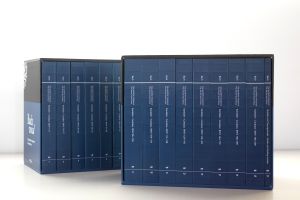
Ever since Carus-Verlag was founded in 1972, publishing the music of Johann Sebastian Bach has been a special focus for us. In the 2017 Reformation anniversary year we completed the Bach vocal project. Bach’s complete sacred vocal works are now available in modern “Urtext” editions, together with performance material. A complete edition of all the full scores is also available in a high quality box set.
Personal details
-
Songwriter / Librettist
Martin Luther
| 1483-1546
-
Choir
Kammerchor Stuttgart
The Kammerchor Stuttgart is regarded as one of the best ensembles of its kind. Over its fifty-year existence, Frieder Bernius has developed the choir into an exceptional ensemble acclaimed by audiences and press alike. This has led to invitations for the choir to perform at all the important European festivals. In Germany the chamber choir performs at festivals and in concert halls in repertoire ranging from the 17th to the 21st century. Frieder Bernius and his ensemble have received numerous accolades for their contribution to new music. The Kammerchor Stuttgart has made over 80 CDs and LPs, numerous of which have been awarded international recording prizes (including the Edison award, Diapason d’or, Gramophone Choice, Classical Internet Award, International Classical Music Award, and German Record Critics’ Award prizes). The International Federation for Choral Music has invited the ensemble to sing at the 1st, 4th and 10th World Symposia on Choral Music in Vienna, Sydney and Seoul. Regular tours of North America and Asia since 1988 and a South America tour reflect the Kammerchor Stuttgart’s international reputation. Since 1984 the top ensemble has also been invited to Israel biennially. Personal details
-
Orchestra
Barockorchester Stuttgart
The Barockorchester Stuttgart, which was founded by Bernius in 1985, specializes in 18th century music. The musicians are among the leading representatives of historical performance practice and perform exclusively on original instruments. The ensemble dedicates itself to a large extent to the revival of 18th century operas. It has performed at numerous international festivals, among others in Rome, Dresden and Göttingen. Personal details
-
Conductor
Frieder Bernius
| 1947Frieder Bernius’s work has earned great worldwide recognition. He is in demand internationally as a conductor and as a teacher. His principal artistic collaborators are the ensembles he founded himself, the Kammerchor Stuttgart, the Barockorchester Stuttgart, the Hofkapelle Stuttgart and the Klassische Philharmonie Stuttgart. As a guest conductor, he has collaborated repeatedly with, for example, the SWR Vokalensemble Stuttgart, the Deutsche Kammerphilharmonie Bremen, the Stuttgarter Kammerorchester and the Streicherakademie Bozen. Great stylistic versatility is Frieder Bernius’s hallmark. Whether he conducts vocal works by Monteverdi, Bach, Händel, Mozart, Beethoven, Fauré and Ligeti, stage music by Mendelssohn or symphonies by Haydn, Burgmüller and Schubert, his work always aims for a sound that is at once unmistakably personal and at the same time oriented towards the original period sound ideal. He devotes himself equally to the rediscovery of 18th century operas and to first performances of contemporary compositions. He is particularly interested in the musical history of southwestern Germany. Carus-Verlag has awarded Frieder Bernius a Golden CD for his complete recording of the sacred music of Felix Mendelssohn Bartholdy. The award was presented to him during the German Choir Festival in Stuttgart 2016. The sale of over 250,000 recordings, which has been acclaimed with a number of awards, has made a not insignificant contribution to what today is the obvious presence of Mendelssohn's complete œuvre in the concert repertoire. Personal details
-
Soloist - soprano
Sarah Wegener
-
Soloist - alto
David Allsopp
David Allsopp underwent the typical English training as a singer: he began as a choirboy in Rochester and was a choral scholar at King’s College, Cambridge. After completing his studies, he moved to Westminster Cathedral in London before venturing out on a freelance career. He works closely with groups such as Tenebrae, Polyphony, the Gabrieli Consort and Gallicantus. Thanks to his career path, he is just as familiar with the music of the Middle Ages, the Renaissance and the Baroque (especially Bach and Handel) as he is with the music of contemporary composers. Personal details
-
Soloist - tenor
Thomas Hobbs
In the course of his short career, the young English tenor Thomas Hobbs has already earned consider - able esteem. Still as a student, he was was awarded numerous prizes and scholarships. In addition to developing his solo career, Hobbs has sung in some of England’s leading vocal ensembles, such as The Cardinall’s Musick, The Tallis Scholars, I Fagiolini, and The Sixteen. In the genre of opera, he has performed Acis and other roles in Handel’s Acis and Galathea, Ferrando in Cosi fan tutte and, most recently, the title role in Britten’s Albert Herring at the Royal Academy Opera. During the 2010/11 season he made his debut at the English National Opera in Monteverdi’s Il ritorno d'Ulisse. Thomas Hobbs regularly gives Lieder recitals; his repertoire in cludes Vaughan- Williams’s On Wenlock Edge as well as Schubert’s Die schöne Müllerin and Schumann’s Liederkreis. He is also much in demand as a concert soloist. In 2009, he participated in the Academy of the Festival Aix-en-Provence and performed with the Camerata Salzburg under Louis Langrée. Personal details
-
Soloist - bass
Peter Harvey
Peter Harvey’s hundred or so recordings span eight centuries of music, with the High Baroque particularly well represented. He has performed and recorded all of J. S. Bach’s major vocal works and many of the cantatas. From the French Baroque, he has made many recordings of Campra, Lully, Lalande and others, including a recent solo disc with London Baroque of Rameau’s secular cantatas for bass voice. The Gabrieli Consort’s recording of Haydn’s Creation, on which Peter sings Adam, won the 2008 Gramophone Award. Peter directs the Magdalena Consort, specializing in the performance of the music of Bach with small ensembles. He is increasingly returning to the Lied repertoire, and has recently recorded Schubert’s Die Winterreise with pianist Gary Cooper. Personal details
Reviews on our website can only be submitted by customers with a registered user account. A check whether the rated products were actually purchased does not take place.
No feedback available for this product.
Frequent questions about this work
 There are no questions and answers available so far or you were unable to find an answer to your specific question about this work? Then click here and send your specific questions to our Customer Services!