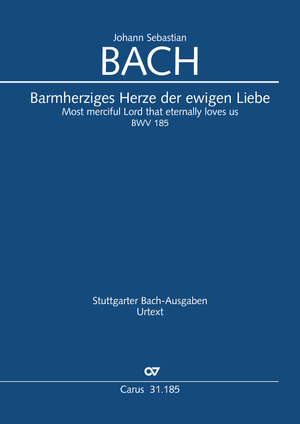
Most merciful Lord that eternally loves us
Cantata for the 4th Sunday after Trinity (Weimar version) BWV 185, 1715
A (rare) autograph date (7/14/1715) confirms that the cantata Barmherziges Herze der ewigen Liebe (Compassionate heart of eternal love) was composed in that year for the 4th Sunday after Trinity. Like many Weimar cantatas, this has the character of a chamber piece. In the opening duet, the two voices and bc are joined by an oboe, which plays the melody of the closing chorale (“Ich ruf zu dir, Herr Jesu Christ”). The complete ensemble only appears in the second aria and the chorale, while the third aria is performed with continuo. In the final chorale, an obbligato violin above the soprano extends the polyphonic texture into five parts. In Weimar, the oboes were tuned lower than the strings, so an oboe d’amore is required to perform the cantata at a unified pitch (the appropriate part is included). Bach performed the cantata again in Leipzig in 1723, now transposed from F-sharp minor to G minor.
Explore


Purchase
Additional product information
-
Composer
Johann Sebastian Bach
| 1685-1750Johann Sebastian Bach is one of the most important composers of Western music history. He came from a widely ramified musical dynasty, which produced numerous musicians and organists in the Thuringian-Saxon area.
Bach vocal
Ever since Carus-Verlag was founded in 1972, publishing the music of Johann Sebastian Bach has been a special focus for us. In the 2017 Reformation anniversary year we completed the Bach vocal project. Bach's complete sacred vocal works are now available in modern Urtext editions, together with performance material. A complete edition of all the full scores is also available in a high quality box set. Personal details
-
Editor
Reinhold Kubik
| 1942-2024
-
Songwriter / Librettist
Salomon Franck
| 1659-1725
-
Continuo realization
Paul Horn
| 1922-2016Paul Horn war ein deutscher Kirchenmusiker, Organist, Komponist und Musikwissenschaftler. Er studierte Kirchenmusik und Orgel an der Evangelischen Kirchenmusikschule Esslingen am Neckar bei Hans-Arnold Metzger und Musikwissenschaft, Theologie und Geschichte an der Universität Tübingen. Seine berufliche Laufbahn begann als Kantor an der Evangelischen Michaelskirche in Stuttgart-Degerloch. 1954 wurde er Kantor an der Evangelischen Stadtkirche Ravensburg, eine Position, die er bis zu seiner Pensionierung innehatte. Als Musikwissenschaftler arbeitete Horn bis ins hohe Alter eng mit Carus zusammen. So stammen zahlreiche Carus-Klavierauszüge aus seiner Feder. Personal details
-
Translator
Vernon Wicker
| 1934-2024
Reviews on our website can only be submitted by customers with a registered user account. A check whether the rated products were actually purchased does not take place.
No feedback available for this product.
Frequent questions about this work
 There are no questions and answers available so far or you were unable to find an answer to your specific question about this work? Then click here and send your specific questions to our Customer Services!