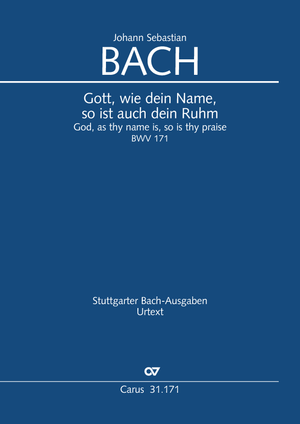
The cantata Gott, wie dein Name, so ist auch dein Ruhm BWV 171 (God, as Thy Name is, so is Thy Praise) was likely first performed in Leipzig’s main churches on New Year’s Day, 1729. It belongs to the so-called Picander cycle, a series of cantata texts written for Bach in 1728 by Christian Friedrich Henrici. However, it is believed Bach only set some of the texts to music.
In the fugal opening chorus (Ps. 48:10), the instrumental ensemble, with the exception of the trumpets, mostly doubles the choir. An independent theme from the first trumpets, building into an extended solo, adds brilliance to the choir. Bach later reused this movement in a revised form as Patrem omnipotentem in his Mass in B Minor.
The rest of the cantata continues to explore the name of Jesus, fitting for the New Year’s Day Gospel reading about the naming of Christ. The two arias, for tenor and soprano, are accompanied solely by violins and are separated by a secco recitative for alto. The bass has an accompanied recitative with oboes, leading into the closing chorale — a reuse of the beautifully crafted final chorale from Jesu, nun sei gepreiset BWV 41 featuring choral lines interspersed with trumpet and timpani interludes.
Explore


 Additional material
- Purchase additional material as a download product.
-
 Digital text (without sheet music) incl. printing licence, html file, singing text, english translationhtml file, singing text, english translation (Sample)1 Coro
God, as thy Name is, so, so is thy praise to where the earth doth end.
2 Aria (Tenore)Lord, as far as clouds in heaven
3 Recitativo (Alto)
spreads thy glory and thy Name.
Ev’ry creature drawing breath,
ev’ry soul from birth to death,
God Almighty magnifieth.Thou Name of Jesus, sweetest rest,
when I am sore oppressed!
Thou art my consolation,
why need I then fear trial or tribulation?
Thou art my banner fair, my tower high,
to thee I fly,
when evil foes are nigh.
Thou art my hope, my beacon bright,
my Helper, and my heart’s delight,
the precious gift to cheer
my life throughout the coming year....
-
Digital text (without sheet music) incl. printing licence, html file, singing text, originalhtml file, singing text, original (Sample)1 Coro
Gott, wie dein Name, so ist auch dein Ruhm bis an der Welt Ende.
2 Aria (Tenore)Herr, so weit die Wolken gehen,
3 Recitativo (Alto)
gehet deines Namens Ruhm.
Alles, was die Lippen rührt,
alles, was noch Odem führt,
wird dich in der Macht erhöhen.Du süßer Jesus-Name du,
in dir ist meine Ruh,
du bist mein Trost auf Erden,
wie kann denn mir
im Kreuze bange werden?
Du bist mein festes Schloss und mein Panier,
da lauf ich hin,
wenn ich verfolget bin.
Du bist mein Leben und mein Licht,
mein Ehre, meine Zuversicht,
mein Beistand in Gefahr...
Purchase
Additional product information
-
Composer
Johann Sebastian Bach
| 1685-1750Johann Sebastian Bach is one of the most important composers of Western music history. He came from a widely ramified musical dynasty, which produced numerous musicians and organists in the Thuringian-Saxon area.
Bach vocal
Ever since Carus-Verlag was founded in 1972, publishing the music of Johann Sebastian Bach has been a special focus for us. In the 2017 Reformation anniversary year we completed the Bach vocal project. Bach’s complete sacred vocal works are now available in modern “Urtext” editions, together with performance material. A complete edition of all the full scores is also available in a high quality box set.
Personal details
-
Editor
Ulrich Leisinger
-
Editor
Anja Morgenstern
-
Songwriter / Librettist
Christian Friedrich Henrici (Picander)
| 1700-1764
-
Translator
Henry Drinker
Reviews on our website can only be submitted by customers with a registered user account. A check whether the rated products were actually purchased does not take place.
No feedback available for this product.
Frequent questions about this work
 There are no questions and answers available so far or you were unable to find an answer to your specific question about this work? Then click here and send your specific questions to our Customer Services!