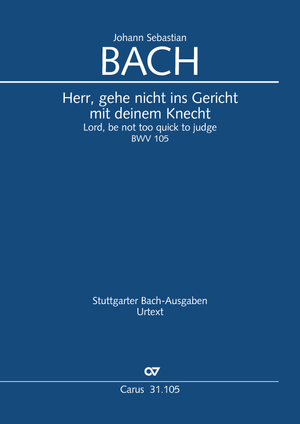
Lord, be not too quick to judge
Cantata for the 9th Sunday after Trinity BWV 105, 1723
During Bach’s first months in Leipzig, he composed the cantata Herr, gehe nicht ins Gericht mit deinem Knecht (Lord, be not too quick to judge), BWV 105, for the 9th Sunday after Trinity (25 July 1723). The opening chorus, based on two lines from Psalm 143, resembles a linked prelude and fugue, namely a freely conceived motet-like section with orchestral introduction and interludes leading to a chorale fugue based on the second line of the Psalm quotation. A simple secco leads into an original aria, “Wie zittern und wanken der Sünder Gedanken” (What fearful illusions are sinners’ dark visions). Both the silence of the continuo, which normally provides a solid foundation, and the close interweaving of the soprano and oboe around large intervals symbolize the “wavering” (“wanken”) of the sinner against an almost uninterrupted “trembling” (“zittern”) carpet of sixteenth notes on the high strings. Fantastic music! In the orchestral accompaniment to the final chorale, Bach brings back this trembling motive from the aria, although the mood now becomes calmer: From the third chorale line, the tremolo is noticeably slower, before disappearing completely at the end. The second aria presents a problem. Here, as in the opening movement, Bach adds a “corno” part to the 1st violin, which can only be realized on a slide instrument. But this “corno” can be safely omitted, as it is merely a simplified version of the violin part.
Explore
 View
View


 Additional material
- Purchase additional material as a download product.
-
 Digital text (without sheet music) incl. printing licence, html file, singing text, english translationhtml file, singing text, english translation (Sample)1 Coro
Lord, be not too quick to judge thy servant.
2 Recitativo (Alto)
For indeed no man is righteous in thy sight.My God, turn not away
3 Aria (Soprano)
when in humility and in contrition
I bow myself to thee:
I know how great thy anger is, how great my fault:
I know thou seest all transgression
and thou dost judge all things aright.
And truly I acknowledge my disdeed;
my faults I know I cannot hide.
Though shamed, I cannot veil them,
deny them, or conceal them.What fearful illusions are sinners’ dark visions!
Condemning, accusing, tormenting each other,
they still try to offer excuses together.
So guilty and anxious a spirit
brings on all the tortures that tear it....
-
Digital text (without sheet music) incl. printing licence, html file, singing text, originalhtml file, singing text, original (Sample)1 Coro
Herr, gehe nicht ins Gericht mit deinem Knecht.
2 Recitativo (Alto)
Denn vor dir wird kein Lebendiger gerecht.Mein Gott, verwirf mich nicht,
3 Aria (Soprano)
indem ich mich in Demut vor dir beuge,
von deinem Angesicht.
Ich weiß, wie groß dein Zorn und mein Verbrechen ist,
dass du zugleich ein schneller Zeuge
und ein gerechter Richter bist.
Ich lege dir ein frei Bekenntnis dar
und stürze mich nicht in Gefahr,
die Fehler meiner Seelen
zu leugnen, zu verhehlen!Wie zittern und wanken
der Sünder Gedanken,
indem sie sich untereinander verklagen
und wiederum sich zu entschuldigen wagen.
So wird ein geängstigt Gewissen...
Purchase
Additional product information
-
Composer
Johann Sebastian Bach
| 1685-1750Johann Sebastian Bach is one of the most important composers of Western music history. He came from a widely ramified musical dynasty, which produced numerous musicians and organists in the Thuringian-Saxon area.
Bach vocal
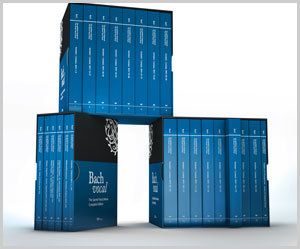
Ever since Carus-Verlag was founded in 1972, publishing the music of Johann Sebastian Bach has been a special focus for us. In the 2017 Reformation anniversary year we completed the Bach vocal project. Bach's complete sacred vocal works are now available in modern Urtext editions, together with performance material. A complete edition of all the full scores is also available in a high quality box set. Personal details
-
Editor
Reinhold Kubik
| 1942-2024
-
Continuo realization
Paul Horn
| 1922-2016Paul Horn war ein deutscher Kirchenmusiker, Organist, Komponist und Musikwissenschaftler. Er studierte Kirchenmusik und Orgel an der Evangelischen Kirchenmusikschule Esslingen am Neckar bei Hans-Arnold Metzger und Musikwissenschaft, Theologie und Geschichte an der Universität Tübingen. Seine berufliche Laufbahn begann als Kantor an der Evangelischen Michaelskirche in Stuttgart-Degerloch. 1954 wurde er Kantor an der Evangelischen Stadtkirche Ravensburg, eine Position, die er bis zu seiner Pensionierung innehatte. Als Musikwissenschaftler arbeitete Horn bis ins hohe Alter eng mit Carus zusammen. So stammen zahlreiche Carus-Klavierauszüge aus seiner Feder. Personal details
-
Translator
Jean Lunn
Reviews on our website can only be submitted by customers with a registered user account. A check whether the rated products were actually purchased does not take place.
No feedback available for this product.
Frequent questions about this work
 There are no questions and answers available so far or you were unable to find an answer to your specific question about this work? Then click here and send your specific questions to our Customer Services!