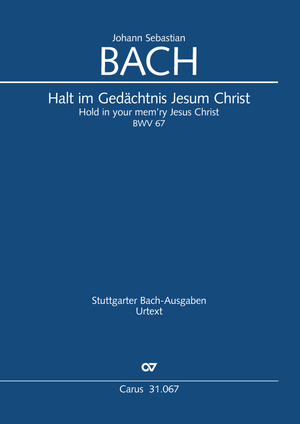
The cantata Halt im Gedächtnis Jesum Christ (Keep in remembrance Jesus Christ), BWV 67, written in 1724 for Quasimodigeniti (the second Sunday after Easter) takes as its theme the story of Doubting Thomas, understood to symbolize Christians with wavering belief. The five-part symmetrical opening chorus features strings, two oboes d’amore, and flute as well as a “corno da tirasi”, an obscure chromatic instrument that Bach only used in his first annual cycle at Leipzig. This is followed by a tenor aria and the Easter chorale “Erschienen ist der herrlich Tag”, framed by recitatives. The second recitative leads to an aria that dispenses with the standard da capo form. The three high voices, accompanied by strings, recite a strophic poem. Meanwhile, the bass solo, personifying Jesus, sings the greeting, “Friede sei mit Euch!” (peace be with you!) before, after, and in between each verse accompanied by the woodwinds. The cantata closes with the chorale “Du Friedefürst, Herr Jesu Christ”.
Explore
 View
View

 Additional material
- Purchase additional material as a download product.
-
 Digital text (without sheet music) incl. printing licence, html file, singing text, english translationhtml file, singing text, english translation (Sample)1 Coro
Hold in your mem’ry Jesus Christ,
2 Aria (Tenore)
who died and rose from the dead in glory.My Jesus now is risen,
3 Recitativo (Alto)
but why do I still fear?
By faith I see his victory,
but battle rages on in me,
my Help, O now appear!My Jesus, even though thou be my death
4 Choral
with hell’s afflictions and its torments,
O what grave dangers now
I fear in truth!
But thou hast granted us to bring thee
a song of praise, which now we sing thee:Behold the day of glorious life
when no one can rejoice enough:
for Christ, our Lord, the blessed day...
-
Digital text (without sheet music) incl. printing licence, html file, singing text, originalhtml file, singing text, original (Sample)1 Coro
Halt im Gedächtnis Jesum Christ,
2 Aria (Tenore)
der auferstanden ist von den Toten.Mein Jesus ist erstanden,
3 Recitativo (Alto)
allein, was schreckt mich noch?
Mein Glaube kennt des Heilands Sieg,
doch fühlt mein Herze Streit und Krieg,
mein Heil! erscheine doch!Mein Jesu, heißest du des Todes Gift
4 Choral
und eine Pestilenz der Hölle:
ach, dass mich noch Gefahr und Schrecken trifft!
Du legtest selbst auf unsre Zungen
ein Loblied, welches wir gesungen:Erschienen ist der herrlich Tag,
dran sich niemand gnug freuen mag:
Christ, unser Herr, heut triumphiert,
All sein Feind er gefangen führt....
Purchase
Additional product information
-
Composer
Johann Sebastian Bach
| 1685-1750Johann Sebastian Bach is one of the most important composers of Western music history. He came from a widely ramified musical dynasty, which produced numerous musicians and organists in the Thuringian-Saxon area.
Bach vocal
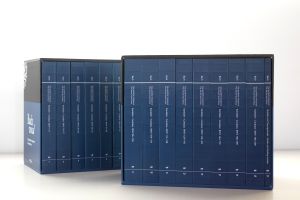
Ever since Carus-Verlag was founded in 1972, publishing the music of Johann Sebastian Bach has been a special focus for us. In the 2017 Reformation anniversary year we completed the Bach vocal project. Bach’s complete sacred vocal works are now available in modern “Urtext” editions, together with performance material. A complete edition of all the full scores is also available in a high quality box set.
Personal details
-
Editor
Reinhold Kubik
| 1942-2024
-
Continuo realization
Paul Horn
| 1922-2016Paul Horn war ein deutscher Kirchenmusiker, Organist, Komponist und Musikwissenschaftler. Er studierte Kirchenmusik und Orgel an der Evangelischen Kirchenmusikschule Esslingen am Neckar bei Hans-Arnold Metzger und Musikwissenschaft, Theologie und Geschichte an der Universität Tübingen. Seine berufliche Laufbahn begann als Kantor an der Evangelischen Michaelskirche in Stuttgart-Degerloch. 1954 wurde er Kantor an der Evangelischen Stadtkirche Ravensburg, eine Position, die er bis zu seiner Pensionierung innehatte. Als Musikwissenschaftler arbeitete Horn bis ins hohe Alter eng mit Carus zusammen. So stammen zahlreiche Carus-Klavierauszüge aus seiner Feder. Personal details
-
Translator
Jean Lunn
Reviews on our website can only be submitted by customers with a registered user account. A check whether the rated products were actually purchased does not take place.
No feedback available for this product.
Frequent questions about this work
 There are no questions and answers available so far or you were unable to find an answer to your specific question about this work? Then click here and send your specific questions to our Customer Services!