

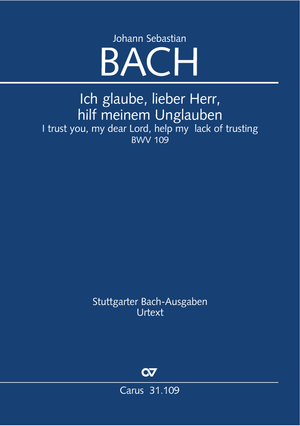
I trust you, my dear Lord, help my lack of trusting
Cantata for the 21st Sunday after Trinity BWV 109, 1723
The cantata Ich glaube, lieber Herr, hilf meinem Unglauben (I believe, dear Lord, help my unbelief), BWV 109, composed for the 21st Sunday after Trinity in 1723, presents a dialogue between faith and doubt. While the dense opening chorus, broken up by concertante elements, deals with the conflict between faith and doubt (a mood continued in the following recitative), the first aria (“Wie zweifelhaftig ist mein Hoffen”) is infused with a sense of doubt. By contast, the second recitative (“O fasse dich, du zweifeldnder Mut”) and aria (“Der Heiland kennet ja die seinen”) form a meditation on faith and conviction. A large-scale concluding chorale (“Wer hofft in Gott und dem vertraut”) with orchestral episodes brings the cantata to a hopeful close. In addition to strings and two oboes, this work features an enigmatic chromatic brass instruments found only in Bach’s first cantata year-cycle (slide trumpet?).
Explore
 View
View

 Additional material
- Purchase additional material as a download product.
-
 Digital text (without sheet music) incl. printing licence, html file, singing text, english translationhtml file, singing text, english translation (Sample)1 Coro
I trust you my dear Lord, help my lack of trusting!
2 Recitativo (Tenore)The hand of God has not yet been withdrawn,
3 Aria (Tenore)
I still can find his mercy.
O no! I fail for I am earthly
and therefore fear his hand will cast me down.
The Lord relents, his mercy does prevail.
O no! No help for those who fail.
He will, he must be coming soon to aid you,
to heal your need, to rescue.
O no! The fear within me still grows stronger.
O Lord, yet longer?How weak and doubtful is my hoping,
4 Recitativo (Alto)
and trembling still my fearful heart!
The smoking flax can hardly gleem,
how nearly breaking is the reed,
the pain of fear does not depart....
-
Digital text (without sheet music) incl. printing licence, html file, singing text, originalhtml file, singing text, original (Sample)1 Coro
Ich glaube, lieber Herr, hilf meinem Unglauben!
2 Recitativo (Tenore)Des Herren Hand ist ja noch nicht verkürzt,
3 Aria (Tenore)
mir kann geholfen werden.
Ach nein, ich sinke schon zur Erden
vor Sorge, dass sie mich zu Boden stürzt.
Der Höchste will, sein Vaterherze bricht.
Ach nein! er hört die Sünder nicht.
Er wird, er muss dir bald zu helfen eilen,
um deine Not zu heilen.
Ach nein, es bleibet mir um Trost sehr bange;
ach Herr, wie lange?Wie zweifelhaftig ist mein Hoffen,
4 Recitativo (Alto)
wie wanket mein geängstigt Herz!
Des Glaubens Docht glimmt kaum hervor,
es bricht dies fast zustoßne Rohr,
die Furcht macht stetig neuen Schmerz....
Purchase
Additional product information
-
Composer
Johann Sebastian Bach
| 1685-1750Johann Sebastian Bach is one of the most important composers of Western music history. He came from a widely ramified musical dynasty, which produced numerous musicians and organists in the Thuringian-Saxon area.
Bach vocal
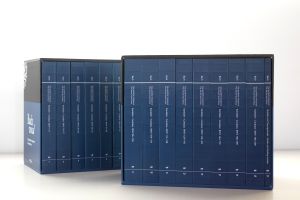
Ever since Carus-Verlag was founded in 1972, publishing the music of Johann Sebastian Bach has been a special focus for us. In the 2017 Reformation anniversary year we completed the Bach vocal project. Bach’s complete sacred vocal works are now available in modern “Urtext” editions, together with performance material. A complete edition of all the full scores is also available in a high quality box set.
Personal details
-
Editor
Reinhold Kubik
| 1942-2024
-
Continuo realization
Paul Horn
| 1922-2016Paul Horn war ein deutscher Kirchenmusiker, Organist, Komponist und Musikwissenschaftler. Er studierte Kirchenmusik und Orgel an der Evangelischen Kirchenmusikschule Esslingen am Neckar bei Hans-Arnold Metzger und Musikwissenschaft, Theologie und Geschichte an der Universität Tübingen. Seine berufliche Laufbahn begann als Kantor an der Evangelischen Michaelskirche in Stuttgart-Degerloch. 1954 wurde er Kantor an der Evangelischen Stadtkirche Ravensburg, eine Position, die er bis zu seiner Pensionierung innehatte. Als Musikwissenschaftler arbeitete Horn bis ins hohe Alter eng mit Carus zusammen. So stammen zahlreiche Carus-Klavierauszüge aus seiner Feder. Personal details
-
Translator
Jutta Wicker
Reviews on our website can only be submitted by customers with a registered user account. A check whether the rated products were actually purchased does not take place.
No feedback available for this product.
Frequent questions about this work
 There are no questions and answers available so far or you were unable to find an answer to your specific question about this work? Then click here and send your specific questions to our Customer Services!