

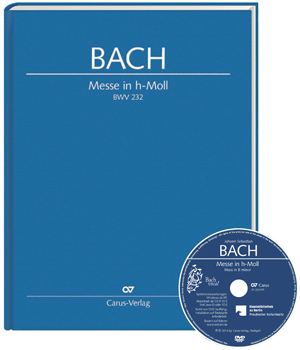
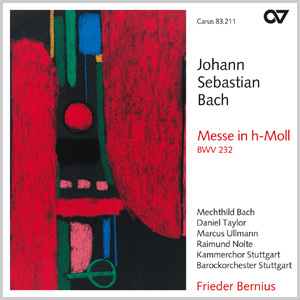
Bach’s Mass in B minor poses one of the really great challenges of the entire choral literature. The proportion of choir participation is very high and the choral settings are among the best that Bach composed: A performance of the Mass in B minor is one of the highlights of any “singer’s life.” However, the demands on the singer are certainly high, sometimes extremely virtuosic, and sometimes harmonically complex. And yet, Bach’s Mass in B minor is a work full of mystery. Even though questions about the occasion for which it was composed must remain unanswered, the Carus edition guides you securely through complicated questions regarding the “correct” version and offers an altogether consistent musical text.
The underlying recording was made using a historical tuning. It sounds approximately a semitone lower than our modern piano tuning.
Simply practice. Anytime. Everywhere.
Whether at home on your tablet or PC or on the road on your smartphone: with carus music, the Choir Coach, you always have your choral works with you to practice! With the carus music choir app, you can listen to your score together with a first-class recording on any device and easily practice your own choir part with a coach. With carus music, your concert preparation is easy, efficient and fun to master!
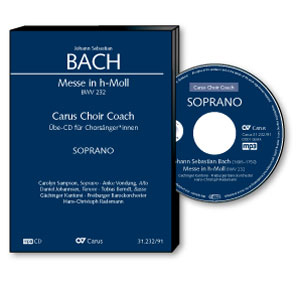
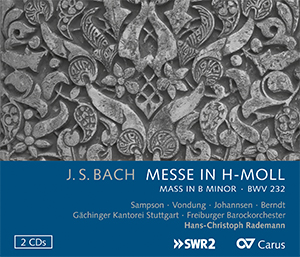
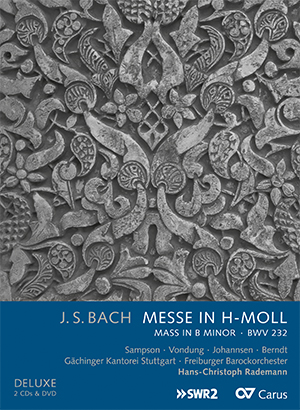
Performers: Carolyn Sampson (soprano), Anke Vondung (alto), Daniel Johannsen (tenore), Tobias Berndt (basso) – Gächinger Kantorei Stuttgart, Freiburger Barockorchester Consort – Hans-Christoph Rademann
Explore
 Listen
(27)
Listen
(27)
- Purchase the work as a CD or download.
- Kyrie eleison I
- Christe eleison
- Kyrie eleison II
- Gloria in excelsis Deo
- Et in terra pax
- Laudamus te
- Gratias agimus tibi
- Domine Deus
- Qui tollis
- Qui sedes
- Quoniam tu solus Sanctus
- Cum Sancto Spiritu
- Credo in unum Deum
- Patrem omnipotentem
- Et in unum Dominum
- Et incarnatus est
- Crucifixus
- Et resurrexit
- Et in Spiritum Sanctum
- Confiteor
- Et exspecto
- Sanctus / Pleni sunt
- Osanna
- Benedictus
- Osanna
- Agnus Dei
- Dona nobis pacem
 Practise
-
 carus music, the Choir Coach
Üben mit carus music
carus music, the Choir Coach
Üben mit carus music
-
Practice aids
-
Practice aids voice part soprano
- Kyrie eleison I (Choir Coach, soprano 1)
- Kyrie eleison I (Choir Coach, soprano 2)
- Kyrie eleison II (Choir Coach)
- Gloria in excelsis Deo (Choir Coach, soprano 1)
- Gloria in excelsis Deo (Choir Coach, soprano 2)
- Et in terra pax (Choir Coach, soprano 1)
- Et in terra pax (Choir Coach, soprano 2)
- Gratias agimus tibi (Choir Coach)
- Qui tollis (Choir Coach)
- Cum Sancto Spiritu (Choir Coach, soprano 1)
- Cum Sancto Spiritu (Choir Coach, soprano 2)
- Credo in unum Deum (Choir Coach, soprano 1)
- Credo in unum Deum (Choir Coach, soprano 2)
- Patrem omnipotentem (Choir Coach)
- Et incarnatus est (Choir Coach, soprano 1)
- Et incarnatus est (Choir Coach, soprano 2)
- Crucifixus (Choir Coach)
- Et resurrexit (Choir Coach, soprano 1)
- Et resurrexit (Choir Coach, soprano 2)
- Confiteor (Choir Coach, soprano 1)
- Confiteor (Choir Coach, soprano 2)
- Et exspecto (Choir Coach, soprano 1)
- Et exspecto (Choir Coach, soprano 2)
- Sanctus / Pleni sunt (Choir Coach, soprano 1)
- Sanctus / Pleni sunt (Choir Coach, soprano 2)
- Sanctus / Pleni sunt (Choir Coach, soprano 1)
- Sanctus / Pleni sunt (Choir Coach, soprano 2)
- Osanna (Choir Coach, soprano 1)
- Osanna (Choir Coach, soprano 2)
- Dona nobis pacem (Choir Coach)
- Kyrie eleison II (Choir Coach, Slow mode)
- Gloria in excelsis Deo (Choir Coach, Slow mode, soprano 1)
- Gloria in excelsis Deo (Choir Coach, Slow mode, soprano 2)
- Et in terra pax (Choir Coach, Slow mode, soprano 1)
- Et in terra pax (Choir Coach, Slow mode, soprano 2)
- Gratias agimus tibi (Choir Coach, Slow mode)
- Qui tollis (Choir Coach, Slow mode)
- Cum Sancto Spiritu (Choir Coach, Slow mode, soprano 1)
- Cum Sancto Spiritu (Choir Coach, Slow mode, soprano 2)
- Credo in unum Deum (Choir Coach, Slow mode, soprano 1)
- Credo in unum Deum (Choir Coach, Slow mode, soprano 2)
- Patrem omnipotentem (Choir Coach, Slow mode)
- Et resurrexit (Choir Coach, Slow mode, soprano 1)
- Et resurrexit (Choir Coach, Slow mode, soprano 2)
- Confiteor (Choir Coach, Slow mode, soprano 1)
- Confiteor (Choir Coach, Slow mode, soprano 2)
- Et exspecto (Choir Coach, Slow mode, soprano 1)
- Et exspecto (Choir Coach, Slow mode, soprano 2)
- Sanctus / Pleni sunt (Choir Coach, Slow mode, soprano 1)
- Sanctus / Pleni sunt (Choir Coach, Slow mode, soprano 2)
- Sanctus / Pleni sunt (Choir Coach, Slow mode, soprano 1)
- Sanctus / Pleni sunt (Choir Coach, Slow mode, soprano 2)
- Osanna (Choir Coach, Slow mode, soprano 1)
- Osanna (Choir Coach, Slow mode, soprano 2)
- Dona nobis pacem (Choir Coach, Slow mode)
-
Practice aids voice part alto
- Kyrie eleison I (Choir Coach)
- Kyrie eleison II (Choir Coach)
- Gloria in excelsis Deo (Choir Coach)
- Et in terra pax (Choir Coach)
- Gratias agimus tibi (Choir Coach)
- Qui tollis (Choir Coach)
- Cum Sancto Spiritu (Choir Coach)
- Credo in unum Deum (Choir Coach)
- Patrem omnipotentem (Choir Coach)
- Et incarnatus est (Choir Coach)
- Crucifixus (Choir Coach)
- Et resurrexit (Choir Coach)
- Confiteor (Choir Coach)
- Et exspecto (Choir Coach)
- Sanctus / Pleni sunt (Choir Coach, Alto 1)
- Sanctus / Pleni sunt (Choir Coach, Alto 2)
- Sanctus / Pleni sunt (Choir Coach, Alto 1)
- Sanctus / Pleni sunt (Choir Coach, Alto 2)
- Osanna (Choir Coach, Alto 1)
- Osanna (Choir Coach, Alto 2)
- Gloria in excelsis Deo (Choir Coach, Slow mode)
- Et in terra pax (Choir Coach, Slow mode)
- Gratias agimus tibi (Choir Coach, Slow mode)
- Qui tollis (Choir Coach, Slow mode)
- Cum Sancto Spiritu (Choir Coach, Slow mode)
- Credo in unum Deum (Choir Coach, Slow mode)
- Patrem omnipotentem (Choir Coach, Slow mode)
- Et resurrexit (Choir Coach, Slow mode)
- Confiteor (Choir Coach, Slow mode)
- Et exspecto (Choir Coach, Slow mode)
- Sanctus / Pleni sunt (Choir Coach, Slow mode, Alto 1)
- Sanctus / Pleni sunt (Choir Coach, Slow mode, Alto 2)
- Sanctus / Pleni sunt (Choir Coach, Slow mode, Alto 1)
- Sanctus / Pleni sunt (Choir Coach, Slow mode, Alto 2)
- Osanna (Choir Coach, Slow mode, Alto 1)
- Osanna (Choir Coach, Slow mode, Alto 2)
- Dona nobis pacem (Choir Coach, Slow mode)
-
Practice aids voice part tenore
- Kyrie eleison I (Choir Coach)
- Kyrie eleison II (Choir Coach)
- Gloria in excelsis Deo (Choir Coach)
- Et in terra pax (Choir Coach)
- Gratias agimus tibi (Choir Coach)
- Qui tollis (Choir Coach)
- Cum Sancto Spiritu (Choir Coach)
- Credo in unum Deum (Choir Coach)
- Patrem omnipotentem (Choir Coach)
- Et incarnatus est (Choir Coach)
- Crucifixus (Choir Coach)
- Et resurrexit (Choir Coach)
- Confiteor (Choir Coach)
- Et exspecto (Choir Coach)
- Sanctus / Pleni sunt (Choir Coach)
- Sanctus / Pleni sunt (Choir Coach)
- Osanna (Choir Coach, Tenore 1)
- Osanna (Choir Coach, Tenore 2)
- Kyrie eleison II (Choir Coach, Slow mode)
- Gloria in excelsis Deo (Choir Coach, Slow mode)
- Et in terra pax (Choir Coach, Slow mode)
- Gratias agimus tibi (Choir Coach, Slow mode)
- Qui tollis (Choir Coach, Slow mode)
- Cum Sancto Spiritu (Choir Coach, Slow mode)
- Credo in unum Deum (Choir Coach, Slow mode)
- Et resurrexit (Choir Coach, Slow mode)
- Confiteor (Choir Coach, Slow mode)
- Et exspecto (Choir Coach, Slow mode)
- Sanctus / Pleni sunt (Choir Coach, Slow mode)
- Sanctus / Pleni sunt (Choir Coach, Slow mode)
- Osanna (Choir Coach, Slow mode, Tenore 1)
- Osanna (Choir Coach, Slow mode, Tenore 2)
-
Practice aids voice part basso
- Kyrie eleison I (Choir Coach)
- Kyrie eleison II (Choir Coach)
- Gloria in excelsis Deo (Choir Coach)
- Gratias agimus tibi (Choir Coach)
- Qui tollis (Choir Coach)
- Cum Sancto Spiritu (Choir Coach)
- Credo in unum Deum (Choir Coach)
- Patrem omnipotentem (Choir Coach)
- Et incarnatus est (Choir Coach)
- Crucifixus (Choir Coach)
- Et resurrexit (Choir Coach)
- Confiteor (Choir Coach)
- Et exspecto (Choir Coach)
- Sanctus / Pleni sunt (Choir Coach)
- Sanctus / Pleni sunt (Choir Coach)
- Osanna (Choir Coach, Basso 1)
- Osanna (Choir Coach, Basso 2)
- Dona nobis pacem (Choir Coach)
- Kyrie eleison II (Choir Coach, Slow mode)
- Gloria in excelsis Deo (Choir Coach, Slow mode)
- Et in terra pax (Choir Coach, Slow mode)
- Gratias agimus tibi (Choir Coach, Slow mode)
- Qui tollis (Choir Coach, Slow mode)
- Cum Sancto Spiritu (Choir Coach, Slow mode)
- Credo in unum Deum (Choir Coach, Slow mode)
- Patrem omnipotentem (Choir Coach, Slow mode)
- Et resurrexit (Choir Coach, Slow mode)
- Confiteor (Choir Coach, Slow mode)
- Et exspecto (Choir Coach, Slow mode)
- Sanctus / Pleni sunt (Choir Coach, Slow mode)
- Sanctus / Pleni sunt (Choir Coach, Slow mode)
- Osanna (Choir Coach, Slow mode, Basso 1)
- Osanna (Choir Coach, Slow mode, Basso 2)
- Dona nobis pacem (Choir Coach, Slow mode)
-
 Additional material
- Purchase additional material as a download product.
-
 Digital text (without sheet music) incl. printing licence, html file, singing text, english translationhtml file, singing text, english translation (Sample)I. Missa Kyrie 1. Coro
Lord, have mercy on us.
2. Soprano & AltoChrist, have mercy on us.
3. CoroLord, have mercy on us.
Gloria 4a. CoroGlory be to God on high.
4b. CoroAnd on earth peace to men of good will.
5. SopranoWe praise thee; we bless thee; we adore thee; we glorify thee.
6. CoroWe give thee thanks for thy great glory.
7a. Soprano & TenoreLord God, heavenly King, God the almighty Father.
7b. Coro
O Lord, the only-begotten Son, Jesus Christ,
O Lord God, Lamb of God, Son of the Father....
-
Digital text (without sheet music) incl. printing licence, html file, singing text, german translationhtml file, singing text, german translation (Sample)
I. Missa
Kyrie
1. Coro Herr, erbarme dich unser.
2. Soprano & Alto Christus, erbarme dich unser.
3. Coro Herr, erbarme dich unser.
Gloria
4a. Coro Ehre sei Gott in der Höhe.
4b. Coro Und Friede auf Erden den Menschen, die guten Willens sind.
5. Soprano Wir loben dich, wir preisen dich,
wir beten dich an, wir rühmen dich.6. Coro Wir danken dir,
...
-
Digital text (without sheet music) incl. printing licence, html file, singing text, originalhtml file, singing text, original (Sample)
I. Missa
Kyrie
1. Coro Kyrie eleison.
2. Soprano & Alto Christe eleison.
3. Coro Kyrie eleison.
Gloria
4a. Coro Gloria in excelsis Deo.
4b. Coro Et in terra pax hominibus bonae voluntatis.
5. Soprano Laudamus te, benedicimus te, adoramus te, glorificamus te.
6. Coro Gratias agimus tibi propter magnam gloriam tuam.
7a. Soprano & Tenore Domine Deus, Rex caelestis,
...
-
Digital text (without sheet music) incl. printing licence, html file, Introductory text, englishhtml file, Introductory text, english (Sample)Text from the CD Carus 83.314
Ulrich Leisinger
Translation (abridged): J. Bradford Robinson, David KosvinerThe idea of an autonomous work of art that has governed discussions of art ever since the nineteenth century was alien to Johann Sebastian Bach and his contemporaries. Almost all of Bach’s compositions were written for external occasions, whether in fulfillment of his duties as concert- and chapel-master or to meet the needs of his lessons. Remarkably, however, he returned to some of his works again and again over long periods of time. Some of the alterations he made went far beyond what was necessary for a simple revival, suggesting that he was intent on putting these works into a “definitive”shape.
The circumstances surrounding the Mass in B minor BWV 232, to use the name we give it today (Carl Philipp Emanuel Bach called it “the great Catholic Mass” to distinguish it from his father’s Kyrie-Gloria Masses, BWV 233–236), are especially complex. Its genesis was spread over a period of more than fifteen years, and the work, though finished at the time of Bach’s death (on 28 July 1750), still awaited a final revision to put it into performable condition. Despite
...
-
Digital text (without sheet music) incl. printing licence, html file, Introductory text, germanhtml file, Introductory text, german (Sample)Booklet-Text der CD Carus 83.314
Ulrich Leisinger
Die Idee des autonomen Kunstwerks, die die Diskussion von Kunst seit dem 19. Jahrhundert bestimmt, war Johann Sebastian Bach und seinen Zeitgenossen fremd. Nahezu alle Kompositionen Bachs sind auf äußere Veranlassung hin entstanden, sei es aus seinen Dienstpflichten als Konzert- und Kapellmeister oder aus der Notwendigkeit des Unterrichts heraus. Bemerkenswert ist aber, dass er sich mit einigen seiner Werke über größere Zeiträume immer wieder auseinandergesetzt hat. Die Eingriffe, die er dabei vornahm, gingen zum Teil deutlich über das hinaus, was für eine bloße Wiederaufführung notwendig gewesen wäre, und lassen ein Bemühen erkennen, eine „endgültige“ Werkgestalt zu schaffen.
Besonders komplex sind die Verhältnisse bei der h-Moll-Messe BWV 232, wie wir sie heute nennen (Carl Philipp Emanuel Bach nannte sie in Abgrenzung von den Kyrie-Gloria-Messen BWV 233–236 „die große catholische Messe“), denn ihre Entstehungsgeschichte erstreckt sich über einen Zeitraum von mehr als 15 Jahren, und das Werk war zum Zeitpunkt des Todes von Johann Sebastian Bach am 28. Juli 1750 zwar
...
Purchase
Additional product information
Contents


-
Composer
Johann Sebastian Bach
| 1685-1750Johann Sebastian Bach is one of the most important composers of Western music history. He came from a widely ramified musical dynasty, which produced numerous musicians and organists in the Thuringian-Saxon area.
Bach vocal
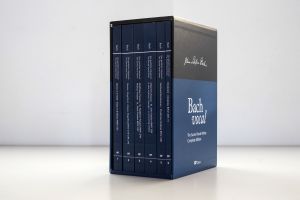
Ever since Carus-Verlag was founded in 1972, publishing the music of Johann Sebastian Bach has been a special focus for us. In the 2017 Reformation anniversary year we completed the Bach vocal project. Bach’s complete sacred vocal works are now available in modern “Urtext” editions, together with performance material. A complete edition of all the full scores is also available in a high quality box set.
Personal details
-
Choir
Gächinger Kantorei Stuttgart
Since August 2013, the Gächinger Kantorei Stuttgart has been under the artistic direction of Hans-Christoph Rademann, the director of the Internationale Bachakademie Stuttgart. Under the patronage of the Bachakademie, the choir plays a decisive role in a wide range of concerts, guest performances and recordings for both radio and CD. The center of the choir’s activities consists, in addition to its manifold activities in the MUSI KFEST UTT GART , of a large concert series with oratorio programs ranging from Schütz to commissioned contemporary works. The interpretation of vocal works by Johann Sebastian Bach has always been a special focus of the choir. The Gächinger Kantorei Stuttgart, which is named after a small village in the Swabian Alb and was founded by Helmuth Rilling in 1954, has ranked as one of the outstanding concert choirs of the world for decades. In addition to regular performances with its partner ensemble, the Bach-Collegium Stuttgart, the choir frequently works together with orchestras such as the Vienna Philharmonic, the New York Philharmonic and the Israel Philharmonic. It also has a particularly close relationship with the Stuttgart Radio Symphony Orchestra of the SWR. The choir is regularly conducted by guest conductors such as Masaaki Suzuki, Krzysztof Penderecki, Alexander Liebreich and Sir Roger Norrington. Guest performances have led the ensemble to, among others, China and Latin America, as well as to the large festivals Salzburg, Lucerne, Prague, New York, Paris, London, Vienna and Seoul. The choir has recorded hundreds of CDs which include Bach’s complete vocal works, diverse 18th century oratorios as well as several world premieres including works by Penderecki, Pärt and Rihm. Personal details
-
Orchestra
Freiburger Barockorchester Consort
-
Conductor
Hans-Christoph Rademann
| 1965Conductor Hans-Christoph Rademann is an immensely versatile artist with a broad repertoire who devotes himself with equal passion and expertise both to the performance and rediscovery of early music and to the first performances and cultivation of Contemporary Music. Born in Dresden and raised in the Erzgebirge mountains, he was influenced at an early age by the great Central German kantorial and musical tradition. He was a student at the traditional Kreuzgymnasium, a member of the famous Kreuzchor, and studied choral and orchestral conducting at the Carl Maria von Weber University of Music in Dresden. During his studies, he founded the Dresdner Kammerchor and formed it into a top international choir which is still under his direction today. Since 2013, Hans-Christoph Rademann has been the academy director of the International Bach Academy Stuttgart. He regularly collaborates with leading choirs and ensembles of the international music scene. From 1999 to 2004 he was chief conductor of the NDR Choir and from 2007 to 2015 chief conductor of the RIAS Chamber Choir. Guest conducting engagements have led and continue to lead him to the Nederlandse Bachvereniging, the Collegium Vocale Gent, the Akademie für Alte Musik, the Freiburger Barockorchester, the Deutsche Radiophilharmonie Saarbrücken Kaiserslautern, the Sinfonieorchester Basel, the Orchestre Philharmonique de Luxembourg, among others. Hans-Christoph Rademann has been awarded prizes and honors for his artistic work, including the Johann Walter Plaque of the Saxon Music Council (2014), the Saxon Constitutional Medal (2008), the Sponsorship Prize as well as the Art Prize of the state capital Dresden (1994 and 2014 respectively). He received the Preis der Deutschen Schallplattenkritik several times for his numerous CD recordings (most recently in 2016), as well as the Grand Prix du Disque (2002), the Diapason d’Or (2006 & 2011), the CHOC de l’année 2011 and the Best Baroque Vocal Award 2014. In 2016 he was awarded the European Church Music Prize of the city of Schwäbisch Gmünd. His exemplary interpretation and recording of the complete works of Heinrich Schütz with the Dresdner Kammerchor in the Stuttgart Carus-Verlag, which was completed in 2019, was awarded the newly endowed Heinrich Schütz Prize as well as the OPUS KLASSIK 2020 in the same year. Hans-Christoph Rademann is professor of choral conducting at the Carl Maria von Weber University of Music in Dresden. He is also artistic director of the Musikfest Erzgebirge, ambassador of the Erzgebirge and patron of the Christian Hospice Service Dresden. Personal details
-
Soloist - soprano
Carolyn Sampson
Equally at home on the concert and opera stages, Carolyn Sampson has enjoyed notable successes all over the world. In addition to engagements with, among others, the English National Opera, the Glyndebourne Festival, the Boston Early Music Festival, the Opéra de Paris, the Opéra de Lille, the Opéra de Montpellier as well as the Opéra National du Rhin, she has sung concerts, among others at the BBC Proms. In Europe her many appearances have included concerts with the Royal Concertgebouw Orchestra, The English Concert, Freiburg Baroque Orchestra, Symphony Orchestra of the Bayerischer Rundfunk, WDR Symphony Orchestra, Vienna Philharmonic, Orchestra dell’Accademia Nazionale di Santa Cecilia, and the Leipzig Gewandhaus Orchestra. In the US Carolyn Sampson has featured as soloist with San Francisco Symphony, Detroit Symphony Orchestra, St Paul Chamber Orchestra and Philadelphia Orchestra. Her many recordings include a highly-acclaimed CD of Stravinsky’s Les Noces and Mass. Her recording of Purcell songs was selected as Editor’s Choice in the December 2007 issue of Gramophone Magazine, as was her first recital CD, Fleurs, in May 2015. Personal details
-
Soloist - alto
Anke Vondung
Anke Vondung was born in Speyer and studied with Professor Rudolf Piernay at the Mannheim University of Music and Performing Arts. She was an ensemble member at the Tiroler Landestheater in Innsbruck from the 1999/2000 season until the end of the 2001/02 season where she sang the central roles of her voice type. This was followed by guest appearances, among others, at the Théâtre du Châtelet Paris, the Bayerische Staatsoper Munich, the Salzburg Festival and the Mozart Week Salzburg, the Opéra Bastille Paris, the Grand Théâtre de Genève, the Glyndebourne Festival, the Nederlandse Opera Amsterdam, the Staatsoper Berlin, the San Diego Opera, the Munich Opera Festival, the Flanders Festival as well as the Hamburg State Opera. She gave her debut at the Metropolitan Opera New York in October 2007 singing Cherubino in Le nozze di Figaro, where she later also sang in Mozart’s La clemenza di Tito. She was an ensemble member of the Saxon State Opera Dresden for the seasons from 2003/04 to 2005/06, and has remained closely connected with the opera house as a guest artist. As a concert and lied singer, Anke Vondung has performed with renowned orchestras under conductors such as James Conlon, Helmuth Rilling, Sir Roger Norrington, Philippe Herreweghe, Edo de Waart, Kent Nagano, Peter Schreier, Dietrich Fischer-Dieskau, James Levine, Marek Janowski, Alexander Shelley, Enoch zu Guttenberg, Hans-Christoph Rademann and Jeffrey Tate. Personal details
-
Soloist - tenor
Daniel Johannsen
The Austrian tenor Daniel Johannsen is one of the most sought-after Evangelists and Bach interpreters of his generation. After studying church music, he studied singing with Margit Klaushofer and Robert Holl in Vienna; he participated in master classes with Dietrich Fischer-Dieskau, Nicolai Gedda as well as Christa Ludwig, and he has been awarded prizes in the Bach, Schumann, Mozart, Hilde Zadek und Wigmore Hall competitions. Since his debut in 1998, he has performed as a concert, lied and opera singer – with works from all periods – in the large music centers of Europe, North America, Japan and the Middle East. Daniel Johannsen has performed at numerous festivals (Styriarte Graz, Salzburger Festspiele, Israel Festival, La Folle Journée, Bachfest Leipzig); he has performed under the direction of notable conductors such as Sir Neville Marriner, Trevor Pinnock, Bertrand de Billy and Enoch zu Guttenberg. Lied recitals form the main focus of his activity, and he has collaborated with pianists such as Graham Johnson, Charles Spencer und Helmut Deutsch. Numerous CDs, some of which have been awarded prizes, as well radio and television recordings attest to his artistic activities. Personal details
-
Soloist - bass
Tobias Berndt
Tobias Berndt began his musical education in the Dresden Kreuzchor. He studied with Christian Polster in Leipzig and continued his training with Rudolf Piernay in Mannheim. He also studied with Dietrich Fischer-Dieskau and Thomas Quasthoff. He was a laureate in numerous renowned singing competitions, winning – among others – the International Das Lied Competition in Berlin, the International Brahms Competition and the Cantilena Singing Competition. Tobias Berndt has also established himself abroad as an opera and concert singer. He has collaborated with conductors such as Philippe Herreweghe, Helmuth Rilling, Frieder Bernius, Teodor Currentzis, Marcus Creed, Hans-Christoph Rademann, Andrea Marcon, Marek Janowski and Sir Roger Norrington and has performed at the Berliner Philharmonie, the Tonhalle in Zurich, the Concertgebouw Amsterdam, the Leipzig Gewandhaus, the Tchaikovsky Concert Hall in Moscow, the Teatro Colon in Buenos Aires and at Lincoln Center in New York. He has also performed at important festivals such as the Prague Spring, the Rheingau Musik Festival, the Händel Festivals in Göttingen und Halle, the Bachfest Leipzig, the Oregon Bach Festival and the International Music Festival in Peking. An extensive discography attests to his versatile artistic activities. Personal details
Reviews on our website can only be submitted by customers with a registered user account. A check whether the rated products were actually purchased does not take place.
No feedback available for this product.
Frequent questions about this work
 There are no questions and answers available so far or you were unable to find an answer to your specific question about this work? Then click here and send your specific questions to our Customer Services!