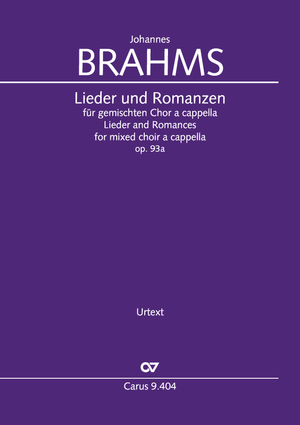
Lieder and Romances
for mixed choir a cappella op. 93a, 1883
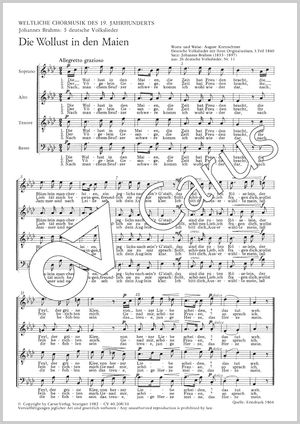
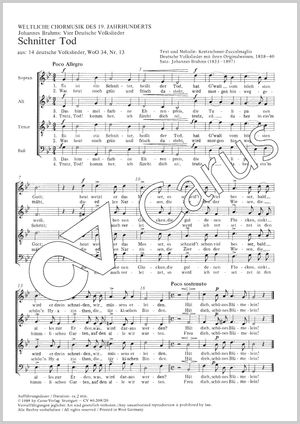
For his six Lieder and Romances (Op. 93a) from 1883, Brahms assembled a variety of texts: a well-known Rhenish folksong, two Serbian folksongs, as well as poems by Achim von Arnim, Friedrich Rückert, and Goethe. In 1864 Brahms had already arranged the folksong about the “bucklichten Fiedler” (hunchbacked fiddler); yet this time he did not use the traditional tune, instead supplying a melody of his own. The third stanza, depicting the witches’ dance on Walpurgis Night, with its bass fifths, sounds almost like a short instrumental piece. In the following song, “Das Mädchen,” in 7/4 time, the choir is joined by a soprano. The Serbian folksongs “Der Falke” and “Das Mädchen”, the restrained and melancholic “O süßer Mai” (Achim von Arnim), and “Fahr wohl” (Rückert) all reflect on the transience of life. The collection closes with “Beherzigung,” set to a text from a Singspiel by Goethe, for which Brahms chose the strict contrapuntal form of the group canon. Experiments in form, rhythm, and motivic development serve as the common thread running through an assortment of highly diverse compositions. In 1897, “Fahr wohl” was sung in front of the Musikverein as Brahms’ funeral cortège passed by the concert hall on its way to Vienna’s Central Cemetery.
All songs are also available as separate editions (printed and digitally).


 Listen
(3)
Listen
(3)
- O lovely May
- Farewell
- The hump-backed fiddler
Contents


-
Composer
Johannes Brahms
| 1833-1897Johannes Brahms' study of musical tradition was of crucial importance to his output: he combined church modes, canonic technique, Baroque style and diction, Bach's counterpoint and Beethoven's thematic-motivic work with the harmonic and expressive achievements of Romanticism to form his own distinctive style. In this respect his choral songs and vocal quartets (e.g. the “Liebeslieder Waltzes” and “New Liebeslieder Waltzes”), often to folk song texts, in which a musical microcosm unfolds, are examplary. His “Deutsches Requiem”, available from Carus in several different versions, constitutes one of the most fascinating confessions of faith in the history of music. Personal details
-
Editor
Uwe Wolf
| 1961As a musicologist, Dr. Uwe Wolf is particularly at home in the 17th and 18th centuries. The focus of his work ranges from the time of Monteverdi and Schütz to Bach and the generation of Bach's sons and pupils through to Viennese Classicism. He has been head of the editorial department at Carus-Verlag since October 2011. Prior to this, he worked in Bach research for over 20 years. Personal details
-
Songwriter / Librettist
Siegfried Kapper
| 1820-1879Siegfried Kapper was born in Smichov, Czechia, in 1820. A trained physician, he travelled extensively throughout Europe and wrote about his experiences, including during the revolution of 1848–49, in epic works and travelogues. He also penned opera libretti and several poems. Personal details
-
Songwriter / Librettist
Friedrich Rückert
| 1788-1866Friedrich Rückert, born 1788 in Schweinfurt, died 1866 near Coburg. Poet and translator. Professor of oriental philology in Erlangen. Personal details
-
Songwriter / Librettist
Ludwig Achim von Arnim
Ludwig Achim von Arnim is considered one of the most important representatives of Heidelberg Romanticism. His collection of folk songs, Des Knaben Wunderhorn, which he published together with Clemens Brentano, had a strong influence on the following generation, including Heine and Mörike. Between 1887 and 1891, Gustav Mahler composed piano songs and later orchestral songs, which greatly increased their popularity. But apart from this work, von Arnim also wrote for a wide variety of genres. Personal details
-
Songwriter / Librettist
Johann Wolfgang Goethe
| -1832Johann Wolfgang von Goethe is today a dazzling figure in world literature. He was born in Frankfurt am Main and initially studied law, but then followed his inclination towards poetry. With the drama Götz von Berlechingen and the epistolary novel The Sorrows of Young Werther, he made important contributions to the literary movement of Sturm und Drang.
From 1775 onwards, Goethe was employed at the court of Duke Carl August in Weimar. In addition to his work at court as a minister and director of the Weimar Court Theatre, he wrote his major works here, including the drama Faust, other novels and many poems, which are still a source of inspiration for musical adaptations today. His poems were a source of inspiration for composers, especially in the 19th century, such as Franz Schubert. Schubert alone set 52 of Goethe's works to music, the best known of which are probably the songs Gretchen am Spinnrade and Erlkönig. Goethe also became acquainted with several composers of the time. He was particularly enthusiastic about the young Felix Mendelssohn-Bartholdy, who also set Goethe's lines to music in the ballad Die erste Walpurgisnacht (The First Walpurgis Night). Personal details
-
Translator
J. P. Morgan
Reviews on our website can only be submitted by customers with a registered user account. A check whether the rated products were actually purchased does not take place.
Frequent questions about this work
 There are no questions and answers available so far or you were unable to find an answer to your specific question about this work? Then click here and send your specific questions to our Customer Services!