

Explore
 Listen
(3)
Listen
(3)
- 1. Allegro alla breve
- 2. Canon a due
- 3. Finale
Purchase
Additional product information
Contents
-
Composer
Josef Gabriel Rheinberger
| 1839-1901During the second half of the 19th century Rheinberger, who was born in 1839 in Vaduz (Liechtenstein), was a major figure of European stature. In demand as a teacher of composition and esteemed as a composer, this professor at the Munich Conservatoire and Bavarian Court Kapellmeister made his mark on a whole generation of musicians. The fact that many of his compositions were no longer performed after his death in 1901, despite their high musical qualities, was largely a result of external circumstances. The change of aesthetic orientation which began about the turn of the century led to a radical move away from the conservative-classical ideals to which Rheinberger – like Brahms – had felt himself committed. It was also a fact that Rheinberger never publicized his own works vigorously. The Josef-Rheinberger-Archiv and Carus published a complete edition of works by Josef Gabriel Rheinberger for the first time. The edition, concluded in 2009, has contributed significantly to the fact that the music of this composition teacher and Bavarian Court Kapellmeister from Munich can once again be heard around the world today. Personal details
-
Editor
Han Theill
Reviews
Josef Gabriel Rheinberger: Klaviermusik in Auswahl, Band 5
Josef Gabriel Rheinberger: Klaviermusik in Auswahl, Band 5
Macht man sich die Mühe, im Rheinberger’schen Schaffen ein wenig zu wühlen, stößt man auf so viel wunderbare Musik, dass man sich wie „Max” im „Freischütz” an die Stirn schlagen möchte und ausrufen: „War ich denn blind?”
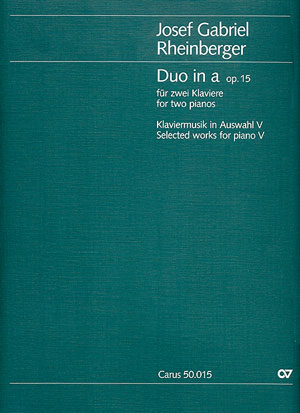
Das Duo für zwei Klaviere op. 15 etwa, ein zu Rheinbergers Lebzeiten außerordentlich populäres Stück, das Rheinberger ein Jahr nach seiner Hochzeit im Jahr 1867 zum gemeinsamen ehelichen Musizieren schrieb. Einen solchen Mittelsatz hätte nur er schreiben können: ein großer fließender melodischer Bogen, farbige Harmonien - und ein Kanon in der Quinte, der sich zwischen den beiden Oberstimmen ergibt. Ohne Kontrapunkt ging für den „Fugenseppel” eben auch in der Ehe nichts.
Hans-Dieter Grünefeld
Quelle: Piano 2/04
Reviews on our website can only be submitted by customers with a registered user account. A check whether the rated products were actually purchased does not take place.
No feedback available for this product.
Frequent questions about this work
 There are no questions and answers available so far or you were unable to find an answer to your specific question about this work? Then click here and send your specific questions to our Customer Services!