

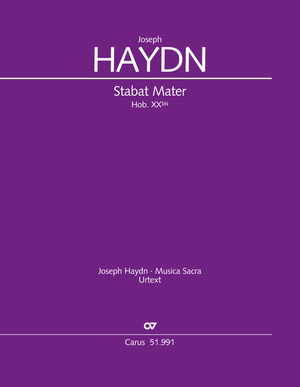
Joseph Haydn’s Stabat Mater, written in 1767, was the first church work the composer wrote after entering the service of Prince Esterházy in Eisenstadt. Unlike almost all his other sacred works, it soon became well-known and established Haydn’s reputation as the leading vocal composer of his day.
The piece contains a wealth of variety which presents the choir with various different challenges: in the first movement the sequences of eighth notes need to be sung both legatissimo and with rhythmic precision, and in the final chorus the long melismas can only develop into a "heavenly" sound if they are well rehearsed.
Simply practice. Anytime. Everywhere.
Whether at home on your tablet or PC or on the road on your smartphone: with carus music, the Choir Coach, you always have your choral works with you to practice! With the carus music choir app, you can listen to your score together with a first-class recording on any device and easily practice your own choir part with a coach. With carus music, your concert preparation is easy, efficient and fun to master!
In this edition, the relevant part is highlighted by the sung voice instead of piano.
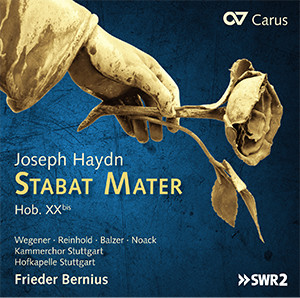
Performers: Sarah Wegener (soprano), Marie Henriette Reinhold (alto), Colin Balzer (tenore), Sebastian Noack (basso) – Kammerchor Stuttgart, Hofkapelle Stuttgart – Frieder Bernius
Explore
 Listen
(14)
Listen
(14)
- Purchase the work as a CD or download.
- Stabat Mater dolorosa
- O quam tristis et afflicta
- Quis est homo qui non fleret
- Quis non posset contristari
- Pro peccatis suae gentis
- Vidit suum dulcem natum
- Eja Mater, fons amoris
- Sancta Mater, istud agas
- Fac me vere, tecum flere
- Virgo virginum praeclara
- Flammis orci ne succendar
- Fac me cruce custodiri
- Quando corpus moriertur
- Paradisi Gloria
 Additional material
- Purchase additional material as a download product.
-
 Digital text (without sheet music) incl. printing licence, html file, singing text, english translationhtml file, singing text, english translation (Sample)
1. Stabat Mater dolorosa (Tenore solo, Coro) A weeping mother was standing
full of sorrow beside the cross,
while her Son was hanging on it.Through her grieving heart,
anguished and lamenting,
a sword had passed.2. O quam tristis et afflicta (Alto solo) Oh, how sad and afflicted
was that blessed Mother
of an only begotten Son!She mourned and grieved
and trembled as she saw
the suffering of her glorious Son.3. Quis est homo qui non fleret (Coro) Who is the man who would
not weep, seeing the mother
of Christ in such torment?4. Quis non posset contristari (Soprano solo) Who would not feel compassion,
...
-
Digital text (without sheet music) incl. printing licence, html file, singing text, german translationhtml file, singing text, german translation (Sample)
1. Stabat Mater dolorosa (Tenore solo, Coro) Christi Mutter stand mit Schmerzen
bei dem Kreuz und weint’ von Herzen,
als ihr lieber Sohn da hing.Durch die Seele voller Trauer,
seufzend unter Todesschauer,
jetzt das Schwert des Leidens ging.2. O quam tristis et afflicta (Alto solo) Welch ein Schmerz der Auserkornen,
da sie sah den Eingebornen,
wie er mit dem Tode rang!Angst und Trauer, Qual und Bangen,
alles Leid hielt sie umfangen,
das nur je ein Herz durchdrang.3. Quis est homo qui non fleret (Coro) Wer könnt ohne Tränen sehen
Christi Mutter also stehen
in so tiefen Jammers Not?4. Quis non posset contristari (Soprano solo) Wer nicht mit der Mutter weinen,
...
-
Digital text (without sheet music) incl. printing licence, html file, singing text, originalhtml file, singing text, original (Sample)
1. Stabat Mater dolorosa (Tenore solo, Coro) Stabat Mater dolorosa
juxta crucem lacrimosa,
dum pendebat Filius.Cujus animam gementem,
contristatam et dolentem
pertransivit gladius.2. O quam tristis et afflicta (Alto solo) O quam tristis et afflicta
fuit illa benedicta
Mater Unigeniti!Quae maerebat et dolebat,
et tremebat, cum videbat
nati poenas inclyti.3. Quis est homo qui non fleret (Coro) Quis est homo qui non fleret,
Christi Matrem si videret
in tanto supplicio?4. Quis non posset contristari (Soprano solo) Quis non posset contristari,
...
-
Digital text (without sheet music) incl. printing licence, html file, Introductory text, englishhtml file, Introductory text, english (Sample)Text from the CD Carus 83.281
Clemens Harasim
Translation (abridged): David KosvinerWhen, from 1766 onwards, Joseph Haydn was finally able to take over from his predecessor Gregor Joseph Werner the sole responsibility for church music at the Esterházy court – in addition to the direction of chamber and theater music – he devoted more time to the composition of sacred music. The first larger-scale sacred work to be composed in this context was the Stabat Mater, completed in 1767.
The world premiere of this work seems to have taken place on Good Friday, 17 April 1767 in the Eisenstadt court chapel within the framework of the oratorial Good Friday performances which were held there every year. In all probability Haydn had been invited to perform his work again in the Church of St. John of God Brothers in Vienna a year later, which was organized by no less a personage than Johann Adolph Hasse who had been in the service of the emperor since 1764. The first documented public performance took place in Vienna on 29 March 1771, in the Piarist church Maria Treu in the Josephstadt borough of Vienna. Once again, it formed part of a Good Friday Vesper service. According to the church chronicles, an impressive number of 60 musicians
...
-
Digital text (without sheet music) incl. printing licence, html file, Introductory text, germanhtml file, Introductory text, german (Sample)Booklet-Text der CD Carus 83.281
Clemens Harasim
Die Bedeutung Joseph Haydns als Komponist geistlicher Vokalmusik wird im heutigen Bewusstsein vor allem bestimmt durch die abendfüllenden Oratorien seines Spätwerks, Die Schöpfung und Die Jahreszeiten, sowie die ebenfalls als Oratorium bezeichnete nachträgliche Textierung seiner Karfreitagsmusik der Sieben letzten Worte unseres Erlösers am Kreuze. Im Bereich der liturgischen Kirchenmusik gelten vornehmlich seine großbesetzten Messen – ebenfalls der späteren Jahre – als Gipfelpunkt der Epoche und darüber hinaus. Angesichts dessen rückte Haydns erstes größeres Kirchenwerk, das bereits 1767 entstandene Stabat Mater, zu Unrecht in die „zweite Reihe“ seines Schaffens. Denn es war gerade dieses Werk, das Joseph Haydn nicht nur als „Kirchenkomponist“ bekannt machte, sondern das die wohl größte Verbreitung und die meisten Aufführungen im
...
Purchase
Additional product information
Contents


-
Composer
Joseph Haydn
| 1732-1809As Kapellmeister to Prince Esterházy, Haydn composed numerous instrumental works and various operas, as well as making important contributions to the genre of church music, including fourteen Latin masses, of which only twelve are authentic or complete; these are complemented by motets and offertories, two important Te Deum settings, two Salve Reginas, a Stabat Mater, and the different versions of the Sieben Worte des Erlösers am Kreuze. The masses were composed continually between 1749 and 1802, except for the years 1783–1795, and therefore constitute the genre with which Haydn was occupied over the longest period of time. The six (authentic or complete) masses composed before 1782 are stylistically very different, and as well as short Missae breves there are more extended masses with rich orchestral scoring; by contrast the six so-called late masses, written from 1796 onwards, form a comparatively homogeneous group of more extensive works scored for large forces. With his two great oratorios Die Schöpfung (The Creation) (1798) and Die Jahreszeiten (The Seasons) (1801) Haydn established the tradition of the German oratorio for middle-class music making. Personal details
-
Choir
Kammerchor Stuttgart
The Kammerchor Stuttgart is regarded as one of the best ensembles of its kind. Over its fifty-year existence, Frieder Bernius has developed the choir into an exceptional ensemble acclaimed by audiences and press alike. This has led to invitations for the choir to perform at all the important European festivals. In Germany the chamber choir performs at festivals and in concert halls in repertoire ranging from the 17th to the 21st century. Frieder Bernius and his ensemble have received numerous accolades for their contribution to new music. The Kammerchor Stuttgart has made over 80 CDs and LPs, numerous of which have been awarded international recording prizes (including the Edison award, Diapason d’or, Gramophone Choice, Classical Internet Award, International Classical Music Award, and German Record Critics’ Award prizes). The International Federation for Choral Music has invited the ensemble to sing at the 1st, 4th and 10th World Symposia on Choral Music in Vienna, Sydney and Seoul. Regular tours of North America and Asia since 1988 and a South America tour reflect the Kammerchor Stuttgart’s international reputation. Since 1984 the top ensemble has also been invited to Israel biennially. Personal details
-
Ensemble
Hofkapelle Stuttgart
The Hofkapelle Stuttgart, founded in 2006 by Frieder Bernius to complement the Barockorchester Stuttgart, concentrates on repertoire from the 19th century performed on authentic instruments. One of its main focusses is the rediscovery of music-historical treasures, particularly works from the south-west German region (by composers such as Kalliwoda, Knecht and Holzbauer). The Hofkapelle and Barockorchester Stuttgart regularly perform at international festivals (Rome, Salzburg, Göttingen, Dresden, etc.). CDs made by both groups have received many awards: the Missa Dei Patris by Jan Dismas Zelenka was nominated for the Cannes Classical Award, and the Incidental Music to Shakespeare’s Ein Sommernachtstraum [A Midsummer Night’s Dream] by Felix Mendelssohn Bartholdy was featured by Rondo magazine and awarded the Star of the Month prize by Fono Forum magazine. Mozart’s Requiem received the Diapason d’or de l’année 2003, Johann Gottlieb Naumann’s opera Aci e Galatea was named opera recording of the year in Opernwelt magazine and Bach’s Easter Oratorio included in the Quarterly Critics’ Choice of the German Record Critics’ Award. The group’s recording of Bach’s B Minor Mass was Editor’s Choice in Gramophone magazine. Personal details
-
Conductor
Frieder Bernius
| 1947Frieder Bernius’s work has earned great worldwide recognition. He is in demand internationally as a conductor and as a teacher. His principal artistic collaborators are the ensembles he founded himself, the Kammerchor Stuttgart, the Barockorchester Stuttgart, the Hofkapelle Stuttgart and the Klassische Philharmonie Stuttgart. As a guest conductor, he has collaborated repeatedly with, for example, the SWR Vokalensemble Stuttgart, the Deutsche Kammerphilharmonie Bremen, the Stuttgarter Kammerorchester and the Streicherakademie Bozen. Great stylistic versatility is Frieder Bernius’s hallmark. Whether he conducts vocal works by Monteverdi, Bach, Händel, Mozart, Beethoven, Fauré and Ligeti, stage music by Mendelssohn or symphonies by Haydn, Burgmüller and Schubert, his work always aims for a sound that is at once unmistakably personal and at the same time oriented towards the original period sound ideal. He devotes himself equally to the rediscovery of 18th century operas and to first performances of contemporary compositions. He is particularly interested in the musical history of southwestern Germany. Carus-Verlag has awarded Frieder Bernius a Golden CD for his complete recording of the sacred music of Felix Mendelssohn Bartholdy. The award was presented to him during the German Choir Festival in Stuttgart 2016. The sale of over 250,000 recordings, which has been acclaimed with a number of awards, has made a not insignificant contribution to what today is the obvious presence of Mendelssohn's complete œuvre in the concert repertoire. Personal details
-
Soloist - soprano
Sarah Wegener
-
Soloist - alto
Marie Henriette Reinhold
-
Soloist - tenor
Colin Balzer
Canadian born Colin Balzer studied singing with David Meek in Canada and Edith Wiens in Germany. He has participated in master classes given by Helmut Deutsch, Robert Tear, Elly Ameling, Brigitte Fassbaender and Christoph Prégardien. Colin Balzer has won a range of international prizes, and has embarked on a busy international concert schedule with a repertoire ranging from Monteverdi to Penderecki. He has been heard at Festivals in Baden-Baden, Aix-en-Provence and at the Early Music Festivals in Boston and Vancouver, and he regularly performs with various Canadian orchestras. He has also enjoyed considerable success as a lieder singer. He recorded his first CD, Hugo Wolf’s Italienisches Liederbuch, with Hartmut Höll. Personal details
-
Soloist - bass
Sebastian Noack
The baritone Sebastian Noack was born in Berlin and studied singing with Dietmar Hackel, Ingrid Figur and Dietrich Fischer-Dieskau. He became known after being awarded 1st prize at the Bundeswettbewerb Gesang; other prizes followed. Since then he has made a name for himself, particularly as a concert singer, performing under renowned conductors such as Frieder Bernius, Marcus Creed, Christoph Eschenbach, and Roy Goodman. His repertoire includes all of the significant oratorios from the Renaissance to the present time. On numerous tours he has travelled through all of Europe, the USA and Southeast Asia. He is a welcome guest at international festivals. Noack sings with the large broadcasting networks and well-known Baroque orchestras as well as with chamber music ensembles, e.g., the Sharoun Ensemble or Sabine Meyer’s Trio di Clarone. He has participated in CD productions under Philippe Herreweghe and Andreas Spering. Noack is particularly interested in lieder. Together with the pianist Manuel Lange, he founded the new concert series “Meisterlied im Musikinstrumenten-Museum”, for which – in addition to his own recitals – he has already been able to engage renowned guests. After having previ - ously performed concertante or semi-scenic operas, Noack made his stage debut in Donizetti’s Viva la Mamma at the Berlin State Opera in June 2009. He is a visit ing professor at the Hochschule für Musik Hanns Eisler in Berlin. Personal details
Reviews on our website can only be submitted by customers with a registered user account. A check whether the rated products were actually purchased does not take place.
No feedback available for this product.
Frequent questions about this work
 There are no questions and answers available so far or you were unable to find an answer to your specific question about this work? Then click here and send your specific questions to our Customer Services!