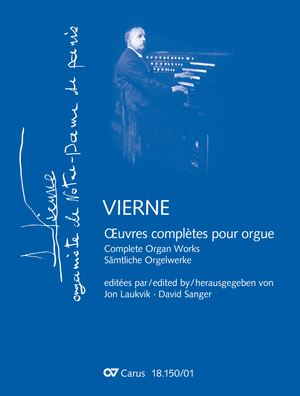
Complete Organ Works
The six symphonies represent the most important group of Vierne’s organ compositions. With these works he carried on the splendid French tradition of this genre bringing it to its peak. Vierne’s compositional models are clearly discernible: primarly Franck and Widor, but also Mendelssohn and Schumann. Along with the beautiful melodic ideas in his slow movements and the occasionally bizarre ideas in his scherzi and intermezzi, it is above all his chromaticism that characterizes Vierne’s style.
The complete edition of his organ works provides a musical text as accurate and authentic as possible: It corrects obvious misprints from the first editions, provides commentary on questionable passages and offers alternative solutions. It is based on the first editions, the composer’s manuscripts and lists of corrections from colleagues, pupils and present-day interpreters closely concerned with Vierne’s music.
All works are also available in separate editions.
 View
View

Contents


-
Composer
Louis Vierne
| 1870-1937Louis Vierne, who was from birth practically blind with cataracts, received his first piano instruction at the early age of six. His first moving encounter with the sound of a church organ also dates from this time. From October 1880 he studied with the blind piano teacher, Louis Specht, who taught at the Institution Nationale des Jeunes Aveugles (National Institute for Young Blind People) in Paris. When Vierne first heard César Franck (later his teacher at the Conservatoire for a short time) at the organ of Sainte-Clotilde, it was a profound experience for him: “I was left speechless and went into a kind of ecstasy.” Following the death of César Franck, it was Charles-Marie Widor who continued to further his development as an organist. In 1892 he appointed him as his assistant at the great Cavaillé-Coll organ in Saint-Sulpice. Although he was passed over several times when applying for positions as organist, in May 1900 he was unanimously elected by a prominent jury as organist of Notre Dame Cathedral, a position he held until the day he died. Travelling was a burden to him, but despite this in the 1920s he went on concert tours of Europe, Canada and the USA, where he was acclaimed as a composer and organist. He used these trips to collect contributions for the maintenance and rebuilding of his organ at Notre Dame. On 2 June 1937 Vierne presented an organ concert in Notre Dame together with Maurice Duruflé. As he was about to begin an improvisation he suffered a heart attack from which he died soon after. The funeral service was held in Notre Dame Cathedral on 5 June - his organ remained silent. // Complete Organ Works, see Carus 18.150 Personal details
-
Editor
Jon Laukvik
| 1952
-
Editor
David Sanger
| 1947-2010
Reviews
1815000
ein äußerst gewissenhaft redigierter Text ..., der keine Fragen oder Wünsche offen lässt...
Musica Sacra 1/2016
Nun haben gleich zwei deutsche Verlage Viernes Orgelwerk neu herausgegeben. [...] Der Stuttgarter Carus-Verlag hat seine Gesamtausgabe bereits abgeschlossen, auch hier finden sich im letzten Band die Improvisationen und Transkriptionen, unter anderem die auf einer großen Orgel sehr wirkungsvolle Bearbeitung des bekannten Prélude cis-Moll von Sergej Rachmaninow. [...] Die anderen drei Improvisationen, deren Übertragung durch Maurice Duruflé 1954 veröffentlicht worden sind, erscheinen bei Carus in einer Überarbeitung, die nun stärker den erhaltenen Tondokumenten entspricht. Die beiden Herausgeber [...] haben auch bei der Rachmaninow-Transkription diejenigen Töne ergänzt, die Vierne aufgrund des begrenzten Klaviaturumfangs weglassen musste. Diese Beispiele zeigen, dass bei der Carus-Ausgabe sehr gründlich gearbeitet wurde.
Markus Frank Hollingshaus, Ars Organi, 3/2011
Prachtvoll diese Ausgabe sämtlicher Orgelwerke des genialen Louis Vierne (1870-1973)! [...] PS: Parallel zu dieser wohlgelungenen Notenausgabe plant der Verlag eine Gesamteinspielung der Orgelwerke Viernes. Schon jetzt vormerken!
Württembergische Blätter für Kirchenmusik, 2/2009
Reviews on our website can only be submitted by customers with a registered user account. A check whether the rated products were actually purchased does not take place.
Frequent questions about this work
 There are no questions and answers available so far or you were unable to find an answer to your specific question about this work? Then click here and send your specific questions to our Customer Services!