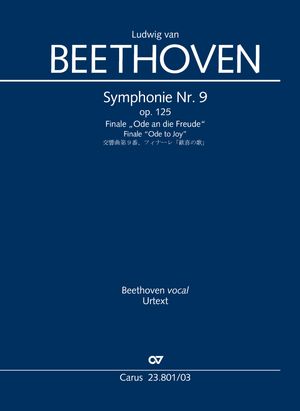
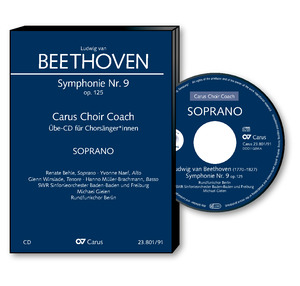
Beethoven’s “Ninth” was hotly debated amongst listeners and music critics at first. But his setting of Schiller’s “Ode to Joy” in the final movement is now sung by classical music fans and many others as a matter of course. However, the catchy theme is deceptive, and the choral writing is in fact much more difficult than it looks. Dizzy heights and frequent contrasting tempo changes demand absolutely everything from the choral singer: here, every detail has to work, for this movement is ultimately the crowning conclusion of the 70-minute symphony.
Simply practice. Anytime. Everywhere.
Whether at home on your tablet or PC or on the road on your smartphone: with carus music, the Choir Coach, you always have your choral works with you to practice! With our choir app, you can listen to your score together with a first-class recording on any device and easily practice your own choir part with a coach. With carus music, your concert preparation is easy, efficient and fun to master!
Performers: Renate Behle (soprano), Yvonne Naef (mezzo-soprano), Glenn Winslade (tenore), Hanno Müller-Brachmann (basso) – Rundfunkchor Berlin, SWR Sinfonieorchester Baden-Baden und Freiburg – Michael Gielen
Explore
 Practise
-
 carus music, the Choir Coach
Üben mit carus music
carus music, the Choir Coach
Üben mit carus music
-
Practice aids
-
Practice aids voice part alto
- Allegro assai (Choir Coach)
- Allegro assai (Choir Coach, Slow mode)
- Freude schöner Götterfunken (Choir Coach)
- Freude schöner Götterfunken (Choir Coach, Slow mode)
- Andante maestoso – Adagio ma non troppo ma divoto – Allegro energico e sempre ben marcato (Choir Coach)
- Andante maestoso – Adagio ma non troppo ma divoto – Allegro energico e sempre ben marcato (Choir Coach, Slow mode)
- Allegro ma non tanto (Choir Coach)
- Allegro ma non tanto (Choir Coach, Slow mode)
- Poco Allegro, stringendo il tempo, sempre più Allegro – Presto – Maestoso – Prestissimo (Choir Coach)
- Poco Allegro, stringendo il tempo, sempre più Allegro – Presto – Maestoso – Prestissimo (Choir Coach, Slow mode)
-
Practice aids voice part tenore
- Allegro assai (Choir Coach)
- Allegro assai (Choir Coach, Slow mode)
- Allegro assai vivace (alla Marcia) (Choir Coach)
- Allegro assai vivace (alla Marcia) (Choir Coach, Slow mode)
- Freude schöner Götterfunken (Choir Coach)
- Freude schöner Götterfunken (Choir Coach, Slow mode)
- Andante maestoso – Adagio ma non troppo ma divoto – Allegro energico e sempre ben marcato (Choir Coach)
- Andante maestoso – Adagio ma non troppo ma divoto – Allegro energico e sempre ben marcato (Choir Coach, Slow mode)
- Allegro ma non tanto (Choir Coach)
- Allegro ma non tanto (Choir Coach, Slow mode)
- Poco Allegro, stringendo il tempo, sempre più Allegro – Presto – Maestoso – Prestissimo (Choir Coach)
- Poco Allegro, stringendo il tempo, sempre più Allegro – Presto – Maestoso – Prestissimo (Choir Coach, Slow mode)
-
Practice aids voice part basso
- Allegro assai (Choir Coach)
- Allegro assai (Choir Coach, Slow mode)
- Allegro assai vivace (alla Marcia) (Choir Coach)
- Allegro assai vivace (alla Marcia) (Choir Coach, Slow mode)
- Freude schöner Götterfunken (Choir Coach)
- Freude schöner Götterfunken (Choir Coach, Slow mode)
- Andante maestoso – Adagio ma non troppo ma divoto – Allegro energico e sempre ben marcato (Choir Coach)
- Andante maestoso – Adagio ma non troppo ma divoto – Allegro energico e sempre ben marcato (Choir Coach, Slow mode)
- Allegro ma non tanto (Choir Coach)
- Allegro ma non tanto (Choir Coach, Slow mode)
- Poco Allegro, stringendo il tempo, sempre più Allegro – Presto – Maestoso – Prestissimo (Choir Coach)
- Poco Allegro, stringendo il tempo, sempre più Allegro – Presto – Maestoso – Prestissimo (Choir Coach, Slow mode)
-
Practice aids voice part soprano
- Allegro assai (Choir Coach)
- Allegro assai (Choir Coach, Slow mode)
- Freude schöner Götterfunken (Choir Coach)
- Freude schöner Götterfunken (Choir Coach, Slow mode)
- Andante maestoso – Adagio ma non troppo ma divoto – Allegro energico e sempre ben marcato (Choir Coach)
- Andante maestoso – Adagio ma non troppo ma divoto – Allegro energico e sempre ben marcato (Choir Coach, Slow mode)
- Allegro ma non tanto (Choir Coach)
- Allegro ma non tanto (Choir Coach, Slow mode)
- Poco Allegro, stringendo il tempo, sempre più Allegro – Presto – Maestoso – Prestissimo (Choir Coach)
- Poco Allegro, stringendo il tempo, sempre più Allegro – Presto – Maestoso – Prestissimo (Choir Coach, Slow mode)
-
 Additional material
- Purchase additional material as a download product.
-
 Digital text (without sheet music) incl. printing licence, html file, singing text, english translationhtml file, singing text, english translation (Sample)
(Oh friends, not these tones!
Rather, let us strike up more pleasant
and joyful ones!)Ode to Joy
Friedrich Schiller
Translation: John Sullivan DwightJoy, thou brightest heaven-lit spark,
daughter from the Elysian choir
on thy holy ground we walk,
reeling with ecstatic fire.
Thou canst bind in one again
all that custom tears apart;
all mankind are brothers, when
waves thy soft wing o’er the heart.Who the happy lot doth share,
friend to have, and friend to be –
who a lovely wife holds dear –
mingle in our Jubilee!
Yea – who calls one soul his own,
one on all earth’s ample round: –...
-
Digital text (without sheet music) incl. printing licence, html file, singing text, originalhtml file, singing text, original (Sample)
(O Freunde, nicht diese Töne!
Sondern lasst uns angenehmere
anstimmen und freudenvollere!)An die Freude
Friedrich Schiller
Freude, schöner Götterfunken,
Tochter aus Elysium,
wir betreten feuertrunken,
Himmlische, dein Heiligtum.
Deine Zauber binden wieder,
was die Mode streng geteilt;
alle Menschen werden Brüder,
wo dein sanfter Flügel weilt.Wem der große Wurf gelungen,
eines Freundes Freund zu sein,
wer ein holdes Weib errungen,
mische seinen Jubel ein!
Ja, wer auch nur eine Seele
sein nennt auf dem Erdenrund!
Und wer’s nie gekonnt, der stehle...
Purchase
Additional product information
Contents


-
Composer
Ludwig van Beethoven
| 1770-1827Ludwig van Beethoven was without doubt one of the most influential composers in the history of music. His works formed the culmination of many genres – particularly instrumental – of Viennese classicism, and laid the foundation for the following decades. But Beethoven’s vocal works set standards too: the late Missa Solemnis is one of the most impressive choral works of its time; but his earlier Mass in C also opens up new worlds of expression for the liturgical text, and set the benchmark for the further development in the composition of the mass. And with the final chorus of the Ninth Symphony, the setting of Schiller’s Ode to Joy, Beethoven created one of the most frequently-performed and best known choral pieces of all, writing a timeless musical memorial to himself. Personal details
-
Songwriter / Librettist
Friedrich Schiller
| 1759-1805
Reviews on our website can only be submitted by customers with a registered user account. A check whether the rated products were actually purchased does not take place.
No feedback available for this product.
Frequent questions about this work
 There are no questions and answers available so far or you were unable to find an answer to your specific question about this work? Then click here and send your specific questions to our Customer Services!