Already during lifetime, Ludwig van Beethoven became so revered that other musicians arranged his music – mostly the popular instrumental works – for choir. The composer may even have known some of these versions. After his death, there came a veritable tsunami of arrangements, reaching its peak in the 1830s.
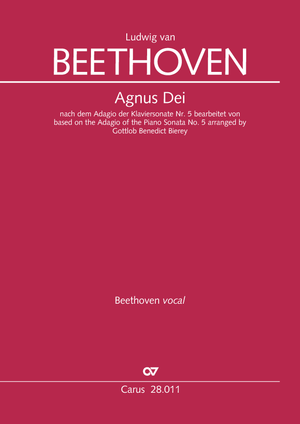
The present work by the composer and Kapellmeister Gottlob Benedict Bierey (1772-1840) dates from this period. He arranged the slow movement of the Piano Sonata No. 5 in C minor (Op. 10, No. 1) for voices and orchestra, adding the text of the Agnus Dei from the Latin Ordinary. If necessary, the solo parts can be sung by members of the chorus or a semi-chorus. For the solo parts the vocal score is needed.
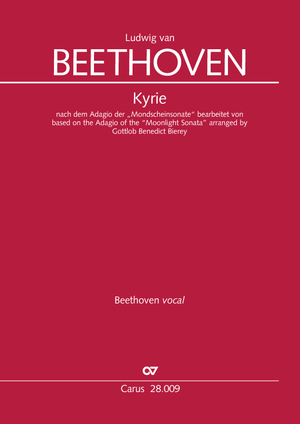
The piece is a wonderful companion piece to Bierey’s arrangement of the first movement of the “Moonlight Sonata”, which he orchestrated and underlaid with the text of the Kyrie from the Latin Ordinary (Carus 28.009).



Purchase
Additional product information
-
Composer
Ludwig van Beethoven
| 1770-1827Ludwig van Beethoven was without doubt one of the most influential composers in the history of music. His works formed the culmination of many genres – particularly instrumental – of Viennese classicism, and laid the foundation for the following decades. But Beethoven’s vocal works set standards too: the late Missa Solemnis is one of the most impressive choral works of its time; but his earlier Mass in C also opens up new worlds of expression for the liturgical text, and set the benchmark for the further development in the composition of the mass. And with the final chorus of the Ninth Symphony, the setting of Schiller’s Ode to Joy, Beethoven created one of the most frequently-performed and best known choral pieces of all, writing a timeless musical memorial to himself. Personal details
-
Editor
Sabine Bock
| 1971
-
Arranger
Gottlob Benedict Bierey
| 1772-1840Gottlob Benedict Bierey was born in Dresden on 25 July 1772. From 1807 to 1828, he was Kapellmeister at the Breslau Theatre, succeeding his predecessor Carl Maria von Weber in this position. He composed almost exclusively for the stage. In addition to his cantatas, choruses and songs, his operas and operettas were particularly popular during his lifetime. Personal details
Reviews on our website can only be submitted by customers with a registered user account. A check whether the rated products were actually purchased does not take place.
No feedback available for this product.
Frequent questions about this work
 There are no questions and answers available so far or you were unable to find an answer to your specific question about this work? Then click here and send your specific questions to our Customer Services!