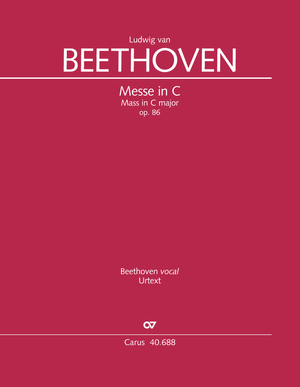
With its tonal language of subjective avowal, the first of Beethoven’s two masses opens up new worlds of expression for the liturgical texts of the Mass which point towards the future. Not to be considered a preliminary work to the Missa solemnis, it is an entirely independent work which set standards for the further development Mass settings in the 19th century. Its newness, of which the composer himself was fully aware (“I do not speak gladly of my Mass, or of myself, but I do believe that I have treated the text in a manner in which only few have treated it.”), paves a way to an hitherto unknown, contemporary avenue to faith which today is still current.
Carus presents this important work of church music history in a new critical edition by the Beethoven expert Ernst Herttrich.
Thanks to an arrangement by K. F. Müller (Carus 40.688/50), it is possible to perform the work in smaller settings.
Explore
 Listen
(6)
Listen
(6)
- Kyrie
- Gloria
- Credo
- Sanctus
- Benedictus
- Agnus Dei
 Practise
-
 carus music, the Choir Coach
Üben mit carus music
carus music, the Choir Coach
Üben mit carus music
-
Practice aids
-
Practice aids voice part soprano
- Kyrie (Choir Coach)
- Kyrie (Choir Coach, Slow mode)
- Gloria (Choir Coach)
- Gloria (Choir Coach, Slow mode)
- Credo (Choir Coach, Slow mode)
- Benedictus (Choir Coach)
- Benedictus (Choir Coach, Slow mode)
- Agnus Dei (Choir Coach)
- Agnus Dei (Choir Coach, Slow mode)
- Credo (Choir Coach)
- Sanctus (Choir Coach)
- Sanctus (Choir Coach, Slow mode)
-
Practice aids voice part alto
- Kyrie (Choir Coach)
- Kyrie (Choir Coach, Slow mode)
- Gloria (Choir Coach)
- Gloria (Choir Coach, Slow mode)
- Credo (Choir Coach)
- Credo (Choir Coach, Slow mode)
- Sanctus (Choir Coach)
- Sanctus (Choir Coach, Slow mode)
- Benedictus (Choir Coach)
- Benedictus (Choir Coach, Slow mode)
- Agnus Dei (Choir Coach)
- Agnus Dei (Choir Coach, Slow mode)
-
Practice aids voice part tenore
- Kyrie (Choir Coach)
- Kyrie (Choir Coach, Slow mode)
- Gloria (Choir Coach)
- Gloria (Choir Coach, Slow mode)
- Credo (Choir Coach)
- Credo (Choir Coach, Slow mode)
- Sanctus (Choir Coach)
- Sanctus (Choir Coach, Slow mode)
- Benedictus (Choir Coach)
- Benedictus (Choir Coach, Slow mode)
- Agnus Dei (Choir Coach)
- Agnus Dei (Choir Coach, Slow mode)
-
Practice aids voice part basso
- Kyrie (Choir Coach)
- Kyrie (Choir Coach, Slow mode)
- Gloria (Choir Coach)
- Gloria (Choir Coach, Slow mode)
- Credo (Choir Coach)
- Credo (Choir Coach, Slow mode)
- Sanctus (Choir Coach)
- Sanctus (Choir Coach, Slow mode)
- Benedictus (Choir Coach)
- Benedictus (Choir Coach, Slow mode)
- Agnus Dei (Choir Coach)
- Agnus Dei (Choir Coach, Slow mode)
-
 Additional material
- Purchase additional material as a download product.
-
 Digital text (without sheet music) incl. printing licence, html file, singing text, english translationhtml file, singing text, english translation (Sample)
Kyrie Lord, have mercy on us.
Christ, have mercy on us.
Lord, have mercy on us.Gloria Glory be to God on high
and on earth peace to men of good will.
We praise Thee; we bless Thee; we adore Thee; we glorify Thee.
We give Thee thanks for Thy great glory.
Lord God, heavenly King,
God the almighty Father.
O Lord, the only-begotten Son, Jesus Christ,
O Lord God, Lamb of God, Son of the Father.
Thou who takest away the sins of the world,
have mercy upon us.Thou who takest away the sins of the world,
receive our prayer.
Thou that sittest at the right hand of God the Father,
have mercy upon us....
-
Digital text (without sheet music) incl. printing licence, html file, singing text, german translationhtml file, singing text, german translation (Sample)
Kyrie Herr, erbarme dich unser.
Christus, erbarme dich unser.
Herr, erbarme dich unser.Gloria Ehre sei Gott in der Höhe
und Friede auf Erden den Menschen,
die guten Willens sind.
Wir loben Dich, wir preisen Dich, wir beten Dich an, wir rühmen Dich.
Wir danken Dir, denn groß ist Deine Herrlichkeit.
Herr und Gott, König des Himmels,
Gott, allmächtiger Vater.
Herr Jesus Christus, eingeborener Sohn,
Herr und Gott, Lamm Gottes, Sohn des Vaters.Du nimmst hinweg die Sünden der Welt,
erbarme Dich unser;
Du nimmst hinweg die Sünden der Welt,
nimm an unser Gebet.
Du sitzest zur Rechten des Vaters:
...
-
Digital text (without sheet music) incl. printing licence, html file, singing text, originalhtml file, singing text, original (Sample)
Kyrie Kyrie eleison.
Christe eleison.
Kyrie eleison.Gloria Gloria in excelsis Deo.
Et in terra pax hominibus bonae voluntatis.
Laudamus te, benedicimus te, adoramus te, glorificamus te.
Gratias agimus tibi propter magnam gloriam tuam.
Domine Deus, Rex coelestis,
Deus Pater omnipotens.
Domine Fili unigenite, Jesu Christe.
Domine Deus, Agnus Dei, Filius Patris.Qui tollis peccata mundi, miserere nobis.
Qui tollis peccata mundi, suscipe deprecationem nostram.
Qui sedes ad dexteram Patris, miserere nobis.Quoniam tu solus Sanctus,
tu solus Dominus, tu solus Altissimus, Jesu Christe.
Cum Sancto Spiritu, in gloria Dei Patris.
Amen....
-
Digital text (without sheet music) incl. printing licence, html file, Introductory text, englishhtml file, Introductory text, english (Sample)Text from the CD Carus 83.295
Ernst Herttrich
Translation (abridged): Elizabeth RobinsonIn the picture of Beethoven we have today, the composer’s religiosity does not necessarily come to the fore. Compared with his predecessors Haydn and Mozart, he wrote only very few sacred works. However, we should not forget that a whole series of Beethoven’s instrumental works – such as the String Quartet Op. 132 with its Dankgesang eines Genesenen an die Gottheit (Song of thanksgiving of a convalescent to God) and the 9th Symphony with its choral finale – also display religious dimensions. Beethoven was a deeply religious person who addressed religious themes intellectually as well as seeking and finding an emotional compensation in religion for what fate had dealt him.
Although the two masses he composed were both commissions, for Beethoven they represented at the same time a personal matter and an artistic
...
-
Digital text (without sheet music) incl. printing licence, html file, Introductory text, germanhtml file, Introductory text, german (Sample)Booklet-Text der CD Carus 83.295
Ernst Herttrich
Beethovens Religiosität ist im Bild, das man sich heute von diesem Komponisten macht, nicht unbedingt einer der Hauptaspekte. Verglichen mit seinen Vorgängern Haydn und Mozart hinterließ er nur recht wenige geistliche Werke – neben den beiden Messen nur noch das Oratorium Christus am Ölberge und die Gellert-Lieder. Man darf jedoch nicht vergessen, dass auch eine ganze Reihe von Beethovens Instrumentalwerken – etwa das Streichquartett Op. 132 mit seinem Dankgesang eines Genesenen an die Gottheit oder die 9. Symphonie mit ihrem Chorfinale – religiöse Dimensionen aufweist. Beethoven war ein religiös durchdrungener Mensch, der sich sowohl intellektuell mit religiösen Themen auseinandersetzte als auch emotional in der Religion einen Ausgleich für sein schweres Schicksal suchte und fand.
Die beiden Messen sind zwar als Auftragswerke entstanden, waren jedoch für Beethoven gleich zeitig
...
Purchase
Additional product information

-
Composer
Ludwig van Beethoven
| 1770-1827Ludwig van Beethoven was without doubt one of the most influential composers in the history of music. His works formed the culmination of many genres – particularly instrumental – of Viennese classicism, and laid the foundation for the following decades. But Beethoven’s vocal works set standards too: the late Missa Solemnis is one of the most impressive choral works of its time; but his earlier Mass in C also opens up new worlds of expression for the liturgical text, and set the benchmark for the further development in the composition of the mass. And with the final chorus of the Ninth Symphony, the setting of Schiller’s Ode to Joy, Beethoven created one of the most frequently-performed and best known choral pieces of all, writing a timeless musical memorial to himself. Personal details
Reviews on our website can only be submitted by customers with a registered user account. A check whether the rated products were actually purchased does not take place.
Ludwig van Beethoven: Mass in C major Vocal score digital (download), pdf file
Very solid edition of this "smaller sister" of Beethoven's Missa solemnis. The practice aids in...
Miriam writes
Very solid edition of this "smaller sister" of Beethoven's Missa solemnis. The practice aids in particular were a valuable help.
*This review was submitted in another language and has been translated for you.
Frequent questions about this work
 There are no questions and answers available so far or you were unable to find an answer to your specific question about this work? Then click here and send your specific questions to our Customer Services!