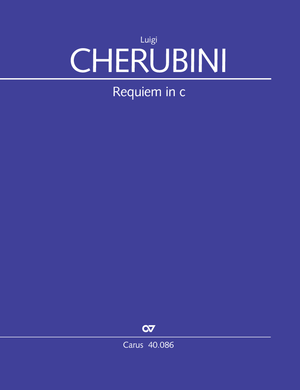
Ludwig van Beethoven regarded Luigi Cherubini (1760–1842) as the greatest composer of his epoch. Marking the 250th anniversary of his birth (14 September 2010), this new recording of the Requiem in C minor pays homage to the composer who is regarded equally as a “conservative revolutionary” and “prophet of the romantic”. The occasion for the work’s composition in 1817 was the funeral ceremony for Louis XVI, who had been executed in 1793 during the French Revolution. Cherubini dispensed with solo parts throughout, preferring an inwardness with strongly characterized text. Within a short period, the work became very well known; musicians such as Beethoven, at whose funeral it was performed, Schumann, and Brahms held it in extremely high regard.
Awarded the Pizzicato Supersonic Award
Awarded the Pizzicato Supersonic Award
Explore


 Listen
(8)
Listen
(8)
- Agnus Dei et Communio
- Introitus et Kyrie
- Graduale
- Tractus
- Sequentia
- Offertorium
- Sanctus et Benedictus
- Pie Jesu
 Practise
-
 carus music, the Choir Coach
Üben mit carus music
carus music, the Choir Coach
Üben mit carus music
-
Practice aids
-
Practice aids voice part soprano
- Introitus et Kyrie (Choir Coach)
- Introitus et Kyrie (Choir Coach, Slow mode)
- Sanctus et Benedictus (Choir Coach)
- Sanctus et Benedictus (Choir Coach, Slow mode)
- Pie Jesu (Choir Coach)
- Pie Jesu (Choir Coach, Slow mode)
- Agnus Dei et Communio (Choir Coach)
- Agnus Dei et Communio (Choir Coach, Slow mode)
- Graduale (Choir Coach)
- Graduale (Choir Coach, Slow mode)
- Sequentia (Choir Coach)
- Sequentia (Choir Coach, Slow mode)
- Domine Jesu Christe (Choir Coach)
- Domine Jesu Christe (Choir Coach, Slow mode)
- Quam olim Abrahae & Hostias (Choir Coach)
- Quam olim Abrahae & Hostias (Choir Coach, Slow mode)
-
Practice aids voice part alto
- Introitus et Kyrie (Choir Coach)
- Introitus et Kyrie (Choir Coach, Slow mode)
- Sanctus et Benedictus (Choir Coach)
- Sanctus et Benedictus (Choir Coach, Slow mode)
- Pie Jesu (Choir Coach)
- Pie Jesu (Choir Coach, Slow mode)
- Agnus Dei et Communio (Choir Coach)
- Agnus Dei et Communio (Choir Coach, Slow mode)
- Graduale (Choir Coach)
- Graduale (Choir Coach, Slow mode)
- Sequentia (Choir Coach)
- Sequentia (Choir Coach, Slow mode)
- Domine Jesu Christe (Choir Coach)
- Domine Jesu Christe (Choir Coach, Slow mode)
- Quam olim Abrahae & Hostias (Choir Coach)
- Quam olim Abrahae & Hostias (Choir Coach, Slow mode)
-
Practice aids voice part tenore
- Introitus et Kyrie (Choir Coach)
- Introitus et Kyrie (Choir Coach, Slow mode)
- Sanctus et Benedictus (Choir Coach)
- Sanctus et Benedictus (Choir Coach, Slow mode)
- Pie Jesu (Choir Coach)
- Pie Jesu (Choir Coach, Slow mode)
- Agnus Dei et Communio (Choir Coach)
- Agnus Dei et Communio (Choir Coach, Slow mode)
- Graduale (Choir Coach)
- Graduale (Choir Coach, Slow mode)
- Sequentia (Choir Coach)
- Sequentia (Choir Coach, Slow mode)
- Domine Jesu Christe (Choir Coach)
- Domine Jesu Christe (Choir Coach, Slow mode)
- Quam olim Abrahae & Hostias (Choir Coach)
- Quam olim Abrahae & Hostias (Choir Coach, Slow mode)
-
Practice aids voice part basso
- Introitus et Kyrie (Choir Coach)
- Introitus et Kyrie (Choir Coach, Slow mode)
- Sanctus et Benedictus (Choir Coach)
- Sanctus et Benedictus (Choir Coach, Slow mode)
- Pie Jesu (Choir Coach)
- Pie Jesu (Choir Coach, Slow mode)
- Agnus Dei et Communio (Choir Coach)
- Agnus Dei et Communio (Choir Coach, Slow mode)
- Graduale (Choir Coach)
- Graduale (Choir Coach, Slow mode)
- Sequentia (Choir Coach)
- Sequentia (Choir Coach, Slow mode)
- Domine Jesu Christe (Choir Coach)
- Domine Jesu Christe (Choir Coach, Slow mode)
- Quam olim Abrahae & Hostias (Choir Coach)
- Quam olim Abrahae & Hostias (Choir Coach, Slow mode)
-
 Additional material
- Purchase additional material as a download product.
-
 Digital text (without sheet music) incl. printing licence, html file, singing text, originalhtml file, singing text, original (Sample)
1. Introitus et Kyrie Requiem aeternam dona eis Domine:
et lux perpetua luceat eis.
Te decet hymnus Deus in Sion,
et tibi reddetur votum in Jerusalem:
exaudi orationem meam,
ad te omnis caro veniet.
Requiem aeternam dona eis, Domine:
et lux perpetua luceat eis.
Kyrie eleison.
Christe eleison.
Kyrie eleison.2. Graduale Requiem aeternam dona eis Domine:
et lux perpetua luceat eis.
In memoria aeterna erit justus:
ab auditione mala non timebit.3. Sequentia Dies irae, dies illa,
...
-
Digital text (without sheet music) incl. printing licence, html file, singing text, english translationhtml file, singing text, english translation (Sample)
1. Introitus et Kyrie Lord, grant them eternal rest,
and let the perpetual light shine upon them.
Thou shalt have praise in Zion, oh God,
and homage shall be paid to thee in Jerusalem.
Hear my prayer.
All flesh shall come before thee.
Lord, grant them eternal rest,
and let the perpetual light shine upon them.Lord, have mercy upon us.
Christ, have mercy upon us.
Lord, have mercy upon us.2. Graduale
Lord, grant them eternal rest, and let the perpetual light shine upon them.
He shall be justified in everlasting memory,
and shall not fear evil reports.3. Sequentia This day, this day of wrath
shall consume the world in ashes,
...
-
Digital text (without sheet music) incl. printing licence, html file, singing text, german translationhtml file, singing text, german translation (Sample)
1. Introitus et Kyrie Gib ihnen die ewige Ruhe, Herr,
und das ewige Licht leuchte ihnen.
Dir gebührt ein Lobgesang, Gott, in Zion,
und dir erfülle man sein Gelübde in Jerusalem.
Erhöre mein Gebet.
Zu dir komme alles Fleisch.
Gib ihnen die ewige Ruhe, Herr,
und das ewige Licht leuchte ihnen.Herr, erbarme dich.
Christus, erbarme dich.
Herr, erbarme dich.2. Graduale Gib ihnen die ewige Ruhe, Herr,
und das ewige Licht leuchte ihnen.
Im ewigen Gedenken wird sein der Gerechte
vom Verhör hat er nichts Schlimmes zu befürchten.3. Sequentia Tag der Rache, Tag der Sünden
wird das Weltall sich entzünden,
...
-
Digital text (without sheet music) incl. printing licence, html file, Introductory text, frenchhtml file, Introductory text, french (Sample)Texte du livret du CD Carus 83.227
Wolfgang Hochstein
Traduction (abrégée) : Sylvie CoquillatCherubini compose le Requiem en ut mineur en 1816 à Paris. En très peu de temps, l’œuvre atteint une très grande notoriété ; des musiciens comme Beethoven, pour les funérailles duquel il fut joué, Schumann et Brahms le tenaient en très haute estime.
Le Requiem en ut mineur fut écrit à l’occasion des funérailles solennelles de Louis XVI, qui avait été guillotiné en 1793, victime de la Révolution française. Une messe où fut donnée pour la première fois la composition de Cherubini eut lieu en sa mémoire le 21 janvier 1817 à l’église de Saint-Denis. La distribution est pour chœur mixte et grand orchestre, mais renonce cependant aux voix solistes et préfère à des effets virtuoses concertants une intériorité suivant le texte de très près. Dans une totale concentration sur l’essentiel, toute extériorité est évitée, cette constatation incluant aussi l’effrayant coup de tamtam au début de
...
-
Digital text (without sheet music) incl. printing licence, html file, Introductory text, englishhtml file, Introductory text, english (Sample)Text from the CD Carus 83.227
Wolfgang Hochstein
Translation (abridged) : Elizabeth RobinsonCherubini’s Requiem in C minor was composed in 1816 in Paris. Within a short period of time the work became very well known; musicians such as Beethoven, at whose funeral it was performed, Schumann, and Brahms held it in extremely high regard.
The occasion for the composition of the Requiem in C minor was the religious funeral ceremony for Louis XVI, who had been executed in 1793 as a victim of the French Revolution. A memorial service took place on 21 January 1817 in the church of St. Denis, at which Cherubini’s composition was performed for the first time. The work is scored for mixed choir and large orchestra, without solo parts, and instead of virtuoso-concertante effects, an inwardness, with a strong characterization of the text, prevails. By fully concentrating on the essential, purely formal gestures are avoided, though this also includes the startling
...
-
Digital text (without sheet music) incl. printing licence, html file, Introductory text, germanhtml file, Introductory text, german (Sample)Booklet-Text der CD Carus 83.227
Wolfgang Hochstein
Cherubinis Requiem in c-Moll entstand 1816 in Paris. Binnen kurzer Zeit erlangte das Werk einen hohen Bekanntheitsgrad; Musiker wie Beethoven, zu dessen Totenfeier es erklang, Schumann und Brahms haben es ganz außerordentlich geschätzt.
Anlass für die Entstehung des Requiems in c-Moll war die kirchliche Trauerfeier für Ludwig XVI., der 1793 als Opfer der Französischen Revolution hingerichtet worden war. Ihm zum Gedächtnis fand am 21. Januar 1817, dem Jahrestag seines Todes, in der Kirche von St. Denis ein Gottesdienst statt, bei dem die Komposition Cherubinis erstmals aufgeführt wurde. Das Werk ist mit gemischtem Chor und großem Orchester besetzt, verzichtet indes auf Solostimmen und lässt an die Stelle virtuoskonzertanter Wirkungen eine stark textgeprägte Verinnerlichung treten. In voller Konzentration auf das Wesentliche wird jede pure Äußerlichkeit vermieden,
...
Purchase
Additional product information
Contents


-
Composer
Luigi Cherubini
| 1760-1842Luigi Carlo Zenobio Salvatore Maria Cherubini (1760–1842) was an Italian composer. His main works include 15 Italian and 14 French operas. After the emergence of Rossini's operas, his works fell out of fashion for a long time, but have recently been rediscovered. Personal details
-
Preface writer
Wolfgang Hochstein
| 1950
-
Choir
Kammerchor Stuttgart
The Kammerchor Stuttgart is regarded as one of the best ensembles of its kind. Over its fifty-year existence, Frieder Bernius has developed the choir into an exceptional ensemble acclaimed by audiences and press alike. This has led to invitations for the choir to perform at all the important European festivals. In Germany the chamber choir performs at festivals and in concert halls in repertoire ranging from the 17th to the 21st century. Frieder Bernius and his ensemble have received numerous accolades for their contribution to new music. The Kammerchor Stuttgart has made over 80 CDs and LPs, numerous of which have been awarded international recording prizes (including the Edison award, Diapason d’or, Gramophone Choice, Classical Internet Award, International Classical Music Award, and German Record Critics’ Award prizes). The International Federation for Choral Music has invited the ensemble to sing at the 1st, 4th and 10th World Symposia on Choral Music in Vienna, Sydney and Seoul. Regular tours of North America and Asia since 1988 and a South America tour reflect the Kammerchor Stuttgart’s international reputation. Since 1984 the top ensemble has also been invited to Israel biennially. Personal details
-
Ensemble
Hofkapelle Stuttgart
The Hofkapelle Stuttgart, founded in 2006 by Frieder Bernius to complement the Barockorchester Stuttgart, concentrates on repertoire from the 19th century performed on authentic instruments. One of its main focusses is the rediscovery of music-historical treasures, particularly works from the south-west German region (by composers such as Kalliwoda, Knecht and Holzbauer). The Hofkapelle and Barockorchester Stuttgart regularly perform at international festivals (Rome, Salzburg, Göttingen, Dresden, etc.). CDs made by both groups have received many awards: the Missa Dei Patris by Jan Dismas Zelenka was nominated for the Cannes Classical Award, and the Incidental Music to Shakespeare’s Ein Sommernachtstraum [A Midsummer Night’s Dream] by Felix Mendelssohn Bartholdy was featured by Rondo magazine and awarded the Star of the Month prize by Fono Forum magazine. Mozart’s Requiem received the Diapason d’or de l’année 2003, Johann Gottlieb Naumann’s opera Aci e Galatea was named opera recording of the year in Opernwelt magazine and Bach’s Easter Oratorio included in the Quarterly Critics’ Choice of the German Record Critics’ Award. The group’s recording of Bach’s B Minor Mass was Editor’s Choice in Gramophone magazine. Personal details
-
Conductor
Frieder Bernius
| 1947Frieder Bernius’s work has earned great worldwide recognition. He is in demand internationally as a conductor and as a teacher. His principal artistic collaborators are the ensembles he founded himself, the Kammerchor Stuttgart, the Barockorchester Stuttgart, the Hofkapelle Stuttgart and the Klassische Philharmonie Stuttgart. As a guest conductor, he has collaborated repeatedly with, for example, the SWR Vokalensemble Stuttgart, the Deutsche Kammerphilharmonie Bremen, the Stuttgarter Kammerorchester and the Streicherakademie Bozen. Great stylistic versatility is Frieder Bernius’s hallmark. Whether he conducts vocal works by Monteverdi, Bach, Händel, Mozart, Beethoven, Fauré and Ligeti, stage music by Mendelssohn or symphonies by Haydn, Burgmüller and Schubert, his work always aims for a sound that is at once unmistakably personal and at the same time oriented towards the original period sound ideal. He devotes himself equally to the rediscovery of 18th century operas and to first performances of contemporary compositions. He is particularly interested in the musical history of southwestern Germany. Carus-Verlag has awarded Frieder Bernius a Golden CD for his complete recording of the sacred music of Felix Mendelssohn Bartholdy. The award was presented to him during the German Choir Festival in Stuttgart 2016. The sale of over 250,000 recordings, which has been acclaimed with a number of awards, has made a not insignificant contribution to what today is the obvious presence of Mendelssohn's complete œuvre in the concert repertoire. Personal details
Reviews

[...] The work makes a powerful impression, particularly given a performance as magisterial and as superbly controlled as Bernius's. [...] This is simply a magnificent performance featuring near-exemplary choral singing and period-instrument orchestral playing. [...]
(Brian Robins, Early Music Review, December 2010)
Mit der aktuellen Einspielung des Requiems in c [...] ist Frieder Bernius mit seinem Kammerchor und der Hofkapelle Stuttgart eine überzeugende Interpretation gelungen: Ein klarer Chorklang und ein prägnanter Orchestersatz sowie fließende Linien machen verständlich, was Zeitgenossen an diesem Werk schätzten.
(Almut Jedicke, Die Tonkunst, 1/2011)
The period orchestra plays extremely well and produces all the power one could ask for. The tam-tam crash at the beginning of the Dies irae is overwhelming, the brass plenty powerful, and the vibrato-less strings not only secure but also warm and refined. The chorus is also excellent having both body and clarity. Indeed, I cannot imagine a better account of the Requiem than this new one. [...]
(Leslie Wright, musicweb-international.com, 2/2011)
Frieder Bernius ist mal wieder der Klangmagier, der mit seinen phänomenalen Ensembles Kammerchor und Hofkappelle den Weg für einen unterschätzten Komponisten bereitet.
(Markus Dippold, Empfehlungen unserer Musikkritiker, Stuttgarter Zeitung, 4.12.2010
Diese Einspielung ist ein Paukenschlag sondergleichen, der sowohl von der Qualität des Komponisten bzw. seines Werks wie auch von der Güte der Interpreten ein beredtes Zeugnis ablegt. Erschienen bei Carus, darf diese Produktion als ein diskographischer Höhepunkt dieses Jahres gelten, nicht nur was das Chor-Repertoire anbelangt. [...] Eine Meisterleistung von allen Beteiligten.
(Tobias Pfleger, klassik.com, 15.11.2010)
Der exzellent disponierte Kammerchor Stuttgart und die vor allem in den hier so wichtigen Bläserstimmen vorzüglich artikulierende Hofkapelle Stuttgart werden dieser Musik in all ihren Facetten gerecht. [...] Bernius setzt [...] nicht auf oberflächliche Theatralik, sondern auf strenge Erhabenheit und stille Größe – Emotionen, in denen Cherubinis Musik zu sich selbst kommt. Eine maßstäbliche Einspielung!
(Stuttgarter Zeitung, 16.11.2010)
[...] Mit der leuchtenden Kraft des Chors und der eloquent-dynamischen Präzision des Orchesters trifft Bernius die Situationshaftigkeit der Einzelmomente so exakt wie die Spannung der quasi symphonischen Entwicklung. Unforcierte Dramatik und sensible Schattierung fügen sich zu einem von Schönheit und Expressivität erfüllten Klangbild - bis hin zum ergreifenden Ausklang im ewigen Licht, einem Kanon auf einem Ton. [...]
(Martin Mezger, Esslinger Zeitung, 30.10.–1.11.2010)
[...] Der Chor-zentrierte Cherubini-Klang, den Bernius entwickelt, spiegelt also durchaus das Notenbild wieder und schöpft ein Gutteil seiner Energie aus der differenzierten Behandlung der Singstimmen wie Artikulation, rhythmische Präzision und überlegte dynamische Abstufung. Alldas wird getragen von einem Instrumentalklangkörper, der sich dem Ideal historisch adäquater Aufführungspraxis verschrieben hat.
(Matthias Keller, BR-Klassik, 13.9.2010)
[...] Mit seinem durchweg exzellenten Kammerchor Stuttgart und der auf historischen Instrumenten spielenden dortigen Hofkapelle leuchtet Bernius bei seiner Neuaufnahme die Partitur minuziös aus. [...] Mit dieser so gelungenen Einspielung des c-Moll-Requiems gratuliert nun Stuttgart dem Jubilar zum runden Geburtstag.
(Johannes Adam, Badische Zeitung, 21. September 2010)
[...] Auf der SACD-Einspielung sind der Kammerchor und die Hofkapelle Stuttgart unter der Leitung von Frieder Bernius in einer bewegenden Interpretation zu hören. [...]
(musik&liturgie, 5/10)
Reviews on our website can only be submitted by customers with a registered user account. A check whether the rated products were actually purchased does not take place.
No feedback available for this product.
Frequent questions about this work
 There are no questions and answers available so far or you were unable to find an answer to your specific question about this work? Then click here and send your specific questions to our Customer Services!