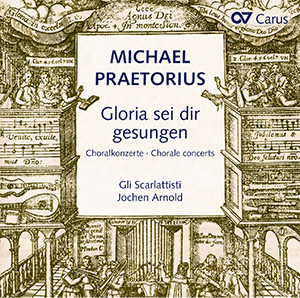
Gloria sei dir gesungen. Chorale concerts after hymns by Luther, Nicolai and others


 Listen
(14)
Listen
(14)
- How bright appears the morning star
- Komm, heiliger Geist, Herre Gott
- Out of the depth I cry to Thee
- Dear Christians, one and all, rejoice
- Dear Christians, one and all, rejoice
- Hallelujah. Christ is arisen
- My soul, now praise thy maker
- My soul, now praise thy maker
- From Heaven above to earth I come
- All glory be to God on high
- German Et in terra
- A mighty fortress is our God
- In peace and joy I now depart
- "Wake, arise!" the voice is calling
Contents

-
Composer
Michael Praetorius
| -1621Michael Praetorius (Schultheis) was born around 1571 in Creuzburg/Werra. His father Michael Schultheis had been a teacher alongside Johann Walter at the Latin school in Werra when he was young, and later studied theology with Martin Luther and Philipp Melanchton in Wittenberg. In the times of unrest following Luther’s death, he – as an orthodox Lutheran – was forced to change his place of residence several times; from 1569 to 1573, he was a pastor in Creuzburg. Praetorius initially also studied theology under the aegis of his brother Andreas, who held a professorship in Frankfurt/Oder. After the death of his brother in 1586, he accepted an organist’s post in order to secure his livelihood. In 1589 we find him as a student at the University of Helmstedt. In 1593, finally, he entered the service of Duke Heinrich Julius in nearby Wolfenbüttel, serving as court organist from 1594, and as court kapellmeister from 1604. The duke’s death in 1613 largely terminated Praetorius’s work at the court and in Wolfenbüttel. In the same year, Praetorius was “lent” to Dresden, where he remained until 1616. He was responsible for numerous “Festmusiken” (festive music events), some of which he organized together with Heinrich Schütz (who, from 1614 onwards, had likewise initially been “lent” to Dresden from Kassel). From 1616, Praetorius led the life of an itinerant organ expert, ensemble (re)organizer and organizer of musical festivities at numerous courts in North and Central Germany. In 1619, already marked by illness, he returned to settle in Wolfenbüttel, where he died on 15 February 1621. Personal details
-
Preface writer
Uwe Wolf
| 1961As a musicologist, Dr. Uwe Wolf is particularly at home in the 17th and 18th centuries. The focus of his work ranges from the time of Monteverdi and Schütz to Bach and the generation of Bach's sons and pupils through to Viennese Classicism. He has been head of the editorial department at Carus-Verlag since October 2011. Prior to this, he worked in Bach research for over 20 years. Personal details
-
Preface writer
Jochen Arnold
Jochen Arnold, born 1967 in Marbach/Neckar, studied Protestant theology in Tübingen and Rome and church music in Stuttgart (advanced diploma), where his teachers included Werner Jacob (organ), and Dieter Kurz and Helmut Wolf (conducting). He was a curate and Kantor in Reutlingen, obtained a doctorate at the University of Tübingen, qualified as a university lecturer in interdisciplinary subjects on the theology of Bach’s cantatas, and since 2008 hee has been a non-faculty lecturer at the University of Leipzig. In 2004 he became director of St Michael’s Monastery Hildesheim, part of the Protestant- Lutheran Regional Church of Hanover, with a special responsibility for the theology of services, liturgy in worship, teaching how to preach, and conducting. He has extensive concert experience as conductor of the ensemble Gli Scarlattisti with numerous radio and CD productions. His repertoire ranges from the medieval to the present. Jochen Arnold also conducts the Collegium Musicum Hildesheim and the chorus of the University of Hildesheim. He lectures in choral conducting and Protestant theology. Personal details
-
Ensemble
Capella Principale
The Capella Principale consists of musicians of various nationalities who have joined forces under Thorsten Bleich’s direction to perform early music projects on a regular basis. Their collaborations began with the performance in 1999 of the complete works of Carlo Farina for string ensemble and basso continuo. The members of the ensemble share a mutual interest in works ranging from early baroque to modern, and great importance is attached to the question of the appropriate instruments. Many of the players also perform with noted European Baroque orchestras. Personal details
-
Ensemble
Gli Scarlattisti
The vocal ensemble Gli Scarlattisti was founded in 1995 by Jochen M. Arnold. It comprises professional singers from Germany and Switzerland. The Scarlattisti are usually accompanied by a continuo group of four instrumentalists or the Baroque orchestra Capella Principale (Director: Thorsten Bleich). The group’s first recording was released in 1998, containing the Musikalische Exequien and three motets from the Geistliche Chormusik (1648) by Heinrich Schütz. This was followed by a recording of Monteverdi’s Vespers of the Blessed Virgin in the continuo version, as well as vesper psalms by Johann Rosenmüller (Vespro Veneziano) in 2001. A recording of Scarlatti’s ten-part setting of the Stabat Mater was released in 2006 together with Arnold’s Diptychon secundum Iohannem. This was fol lowed by an internationally-acclaimed CD of Latin and English cantatas and anthems by G. F. Handel under the title O praise the Lord on the Carus label, then in 2010 by a recording of the complete motets of J. S. Bach. The ensemble regularly undertakes concert tours, and in recent years has also taken part in radio broadcasts, performed at renowned concert series (Stuttgart, Nürnberg, Berlin, Celle, Frankfurt, Torgau, St. Gallen, among others) and participated in the Deut scher Evangelischer Kirchentag (German Protestant Church Congress) in Hanover and Cologne (TV). The repertoire of Gli Scarlattisti ranges from the Renaissance to the modern. One critic described the ensemble as the “crème de la crème of the early music scene in southern Germany.” Personal details
-
Conductor
Jochen Arnold
Jochen Arnold, born 1967 in Marbach/Neckar, studied Protestant theology in Tübingen and Rome and church music in Stuttgart (advanced diploma), where his teachers included Werner Jacob (organ), and Dieter Kurz and Helmut Wolf (conducting). He was a curate and Kantor in Reutlingen, obtained a doctorate at the University of Tübingen, qualified as a university lecturer in interdisciplinary subjects on the theology of Bach’s cantatas, and since 2008 hee has been a non-faculty lecturer at the University of Leipzig. In 2004 he became director of St Michael’s Monastery Hildesheim, part of the Protestant- Lutheran Regional Church of Hanover, with a special responsibility for the theology of services, liturgy in worship, teaching how to preach, and conducting. He has extensive concert experience as conductor of the ensemble Gli Scarlattisti with numerous radio and CD productions. His repertoire ranges from the medieval to the present. Jochen Arnold also conducts the Collegium Musicum Hildesheim and the chorus of the University of Hildesheim. He lectures in choral conducting and Protestant theology. Personal details
Reviews
Der virtuose Umgang der Ausführenden mit ihren Instrumenten machen Spaß beim Zuhören - eine tolle CD.
Württembergische Blätter für Kirchenmusik 4/2018
Een bijzonder mooie cd. Warm aanbevolen.
Michel, Stretto, 11.01.2018
...I found much to enjoy – not least being the value of hearing a whole recital of these rich and inventive polychoral settings.
David Stancliffe, Early Music Review, 29.06.2017
Een bijzonder mooie cd. Warm aanbevolen.
Michel Dutrieue, Stretto, 22.05.2017
Musiziert wird mit klarem, rundem und transparentem Klang, der gleichzeitig immer an der Deklamation der Sprache orientiert ist.
Burkhard Kinzler, Musik & Kirche, Mai/Juni 2017
Fest verankert in Stilistik und Klangfarben der historisch informierten Aufführungspraxis, überzeugen die Vokalsolisten mit ausgesprochen schlichtem, natürlich wirkendem Gesang.
Stuttgarter Zeitung, 09.05.2017
Prägend sind ausgesprochen schöne, schlanke Register, fein ineinander verblendet, zugleich charakteristisch geformt. Intoniert wird überzeugend frei; die sprach- und affektsensible Setzweise Praetorius‚ wird wunderbar aufgegriffen ...
Dr. Matthias Lange, klassik.com, 30.03.2017
Reviews on our website can only be submitted by customers with a registered user account. A check whether the rated products were actually purchased does not take place.
Frequent questions about this work
 There are no questions and answers available so far or you were unable to find an answer to your specific question about this work? Then click here and send your specific questions to our Customer Services!