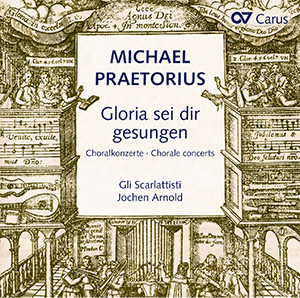
The collection “Polyhymnia Caduceatrix & Panegyrica” of 1619 is rightly regarded as the high point in Michael Praetorius’s output. It combines “Solennische Friedt- und Frewden-Concert:” which Praetorius as a travelling musician had composed largely for festive occasions. In these chorael concerti the highly modern, Italian style and the Protestant chorale combine and form a symbiosis which showed the way forward for the history of German music. The chorale settings draw on influences from Venetian polychoral music, use ritornelli and employ obbligato instruments in a way which is beyond compare, even in contemporary Italy. Here we see a quite different side of the master from the composer of “Es ist ein Ros entsprungen”. And above all, Praetorius always remains a practical musician who ensures that these breathtaking chorale concerti can also be effectively performed with smaller forces, sometimes considerably reduced ones.
In the chorale setting Wie schön leuchtet der Morgenstern Praetorius wrote for a five-part ensemble which is joined in some sections by a four-part capella. For the ensemble, Praetorius suggested both voices and instruments, which he uses in a sophisticated texture of sound, the instruments sometimes duplicating the voices and sometimes alternating with them.
Explore



 Listen
(1)
Listen
(1)
- How bright appears the morning star
Purchase
Additional product information
-
Composer
Michael Praetorius
| -1621Michael Praetorius (Schultheis) was born around 1571 in Creuzburg/Werra. His father Michael Schultheis had been a teacher alongside Johann Walter at the Latin school in Werra when he was young, and later studied theology with Martin Luther and Philipp Melanchton in Wittenberg. In the times of unrest following Luther’s death, he – as an orthodox Lutheran – was forced to change his place of residence several times; from 1569 to 1573, he was a pastor in Creuzburg. Praetorius initially also studied theology under the aegis of his brother Andreas, who held a professorship in Frankfurt/Oder. After the death of his brother in 1586, he accepted an organist’s post in order to secure his livelihood. In 1589 we find him as a student at the University of Helmstedt. In 1593, finally, he entered the service of Duke Heinrich Julius in nearby Wolfenbüttel, serving as court organist from 1594, and as court kapellmeister from 1604. The duke’s death in 1613 largely terminated Praetorius’s work at the court and in Wolfenbüttel. In the same year, Praetorius was “lent” to Dresden, where he remained until 1616. He was responsible for numerous “Festmusiken” (festive music events), some of which he organized together with Heinrich Schütz (who, from 1614 onwards, had likewise initially been “lent” to Dresden from Kassel). From 1616, Praetorius led the life of an itinerant organ expert, ensemble (re)organizer and organizer of musical festivities at numerous courts in North and Central Germany. In 1619, already marked by illness, he returned to settle in Wolfenbüttel, where he died on 15 February 1621. Personal details
-
Editor
Uwe Wolf
| 1961As a musicologist, Dr. Uwe Wolf is particularly at home in the 17th and 18th centuries. The focus of his work ranges from the time of Monteverdi and Schütz to Bach and the generation of Bach's sons and pupils through to Viennese Classicism. He has been head of the editorial department at Carus-Verlag since October 2011. Prior to this, he worked in Bach research for over 20 years. Personal details
Reviews on our website can only be submitted by customers with a registered user account. A check whether the rated products were actually purchased does not take place.
No feedback available for this product.
Frequent questions about this work
 There are no questions and answers available so far or you were unable to find an answer to your specific question about this work? Then click here and send your specific questions to our Customer Services!