Pietro Mascagni: Cavalleria rusticana - Sheet music for download | Carus-Verlag
Iris Editions

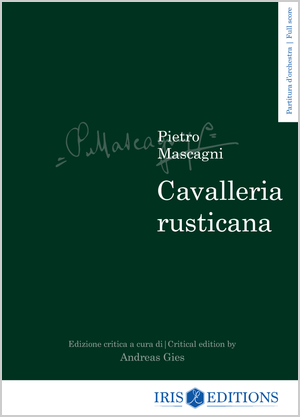
Pietro Mascagni Cavalleria rusticana

Melodramma in un atto 1890

Read and write feedback
This is the first scholarly critical edition of Pietro Mascagni’s famous debut opera Cavalleria rusticana, edited by Andreas Gies in 2021. The work, with which Mascagni won the prestigious Concorso Sonzogno opera competition in 1890, marked his international breakthrough as an opera composer. Some long unpublished and unperformed sections of the opera, cut by conductor Leopoldo Mugnone prior to the premiere, are included in an appendix, allowing Gies to offer fascinating insights into the genesis of the one-act opera. The critical report is printed in Italian and English.
Purchase
Full score, for hire Carus 97.401/00 320 pages, 25,2 x 35,0 cm, paperback
Vocal score, for hire Carus 97.401/03 260 pages, DIN A4, paperback
Set of parts, complete orchestral parts, for hire, also available in digital form Carus 97.401/19
  • 1 x Set of parts, harmony parts, for hire, piccolo 1, piccolo 2, flute 1, flute 2, oboe 1, oboe 2, clarinet 1, clarinet 2, bassoon 1 and 2, french horn 1 and 2, french horn 3 and 4, trumpet 1 and 2, trombone 1 and 2, trombone 3 / tuba, timpani, harp 1, harp 2, percussion, Tambourine, bells (97.401/09)
     
    16 x Individual part, violin 1, for hire (97.401/11)
     
    14 x Individual part, violin 2, for hire (97.401/12)
     
    12 x Individual part, viola, for hire (97.401/13)
     
    18 x Individual part, violoncello / double bass, for hire (97.401/14)
     
    1 x Set of parts, on stage, for hire (97.401/79)
     
Vocal score digital (download), pdf file, for hire Carus 97.401/03-010-000 260 pages, DIN A4, paperback
Full score digital (download), pdf file, for hire Carus 97.401/00-010-000 320 pages, 25,2 x 35,0 cm, paperback
Set of parts digital (download), zip file, pdf file, complete orchestral parts, for hire Carus 97.401/19-010-000
  • 1 x Set of parts digital (download), zip file, pdf file, harmony parts, for hire (97.401/09-010-000)
     
    16 x Individual part digital (download), pdf file, violin 1, for hire (97.401/11-010-000)
     
    14 x Individual part digital (download), pdf file, violin 2, for hire (97.401/12-010-000)
     
    12 x Individual part digital (download), pdf file, viola, for hire (97.401/13-010-000)
     
    18 x Individual part digital (download), pdf file, violoncello / double bass, for hire (97.401/14-010-000)
     
    1 x Set of parts digital (download), zip file, pdf file, on stage, for hire (97.401/79-010-000)
     
The setting: a Sicilian village. The peasant Turiddu becomes engaged to Lola before leaving for military service. Upon his return, he discovers that she has married the carter Alfio. Turiddu seeks comfort in an affair with Santuzza, whom he promises to marry. However, this doesn’t please the flirtatious Lola, who, with her husband away on business, begins to toy with her former fiancé. Santuzza, desperate to save her relationship, confronts Turiddu. Although denying any interest in Lola, he has clearly fallen under her spell once again. The conflict between the couple escalates: Turiddu violently rejects Santuzza, and her love is transformed into hate. When Alfio returns home, a bitter Santuzza tells him about the advances between Turiddu and Lola during his absence. Enraged, Alfio vows vengeance. He tracks down his rival among a large group of villagers, whom Turiddu has invited for some wine after church. Alfio refuses an offered glass – thereby, according to custom, challenging Turiddu to a duel. He accepts and, following Sicilian tradition, bites Alfio’s right ear during their embrace to show that he is willing to fight with knives to the death. Turiddu then asks his mother, Lucia (who is unaware of the impending duel) for her blessing, begging her to look after Santuzza should he not return. Santuzza and the villagers gather, everyone waiting fearfully. Suddenly, a woman screams from the distance: “Hanno ammazzato compare Turiddu!” (“They have murdered Turiddu!”). This cry brings the opera to a sudden close.
  • Targioni-Tozzetti was an Italian librettist. He was best known as a friend and colleague of Pietro Mascagni, for whom he wrote most of his opera libretti. His libretti were almost exclusively written in collaboration with Guido Menasci. Personal details
  • Guido Menasci was born in Livorno in 1867 and was a librettist. He wrote most of his libretti in collaboration with Giovanni Targioni-Tozzetti, including the libretto for Pietro Mascagni's Cavalleria rusticana. Personal details

Reviews on our website can only be submitted by customers with a registered user account. A check whether the rated products were actually purchased does not take place.

No feedback available for this product.

Frequent questions about this work

Pencil symbol There are no questions and answers available so far or you were unable to find an answer to your specific question about this work? Then click here and send your specific questions to our Customer Services!