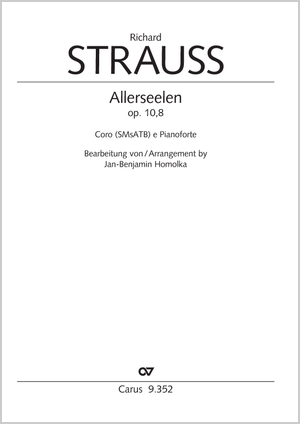
Allerseelen
op. 10,8, 1885
Richard Strauss composed Allerseelen ( “Stell auf den Tisch die duftenden Reseden”) for solo voice and piano in 1885 when, at the age of 21, he had just become the new court music director in Meiningen. Today it is one of his most popular songs. Strauss’s Op. 10 features a total of eight settings of texts from the collection Letzte Blätter (Last Leaves) by the Austrian poet Hermann von Gilm. This early opus paved the way for a rich lifelong output of nearly 200 art songs.
The song laments a past love that ended with the death of one of the lovers. The departed are remembered on All Souls’ Day (Allerseelen), when the memory of a time “as once in May” returns with an especially poignant yearning. Although Strauss wrote the song for solo tenor and piano, he performed it himself on multiple occasions with his wife, the soprano Pauline de Ahna.
Jan-Benjamin Homolka has carefully arranged the song for five-part chamber choir. The character of the original is fully preserved, not least because Homolka has kept the piano accompaniment intact and assigned the original vocal line to the soprano part. At the same time, he exploits the possibilities of the choir to interpret the sung text within the motivic and harmonic framework established by Strauss. In this way, Homolka brings to life the idea of a dialogue between two lovers as an expressive conversation between the female and male voices.
 View
View

-
Composer
Richard Strauss
| 1864-1949The son of musician Franz Joseph Strauss and his wife Josephine began composing at the age of six, and by his 18th birthday he had already written around 140 pieces, including almost 60 songs and over 40 piano works. His stellar career began in 1881 with his opus 1, the Festive March for large orchestra. In 1886, Strauss took up a position as third conductor at the Court Opera in his hometown of Munich. There he had time to deepen his repertoire. In the following four years, he composed numerous songs, including Ständchen op. 17,2, which was published by Carus-Verlag together with Von dunklem Schleier umsponnen op. 17,4 and Nicht im Schlafe hab ich das geträumt op. 48,1. In 1905 and many song compositions later, the already celebrated Richard Strauss also wrote a success story with an opera. The opera adaptation of Oscar Wild's Salome, whose text Strauss himself translated into German, is regarded by his fans as the epitome of modern opera music. Personal details
-
Songwriter / Librettist
Hermann von Glimm
| 1812-1864
-
Arranger
Jan-Benjamin Homolka
| 1987Jan-Benjamin Homolka received his musical training at the HMDK Stuttgart, where he studied school music with a specialisation in conducting, horn (Prof. Christian Lampert, Peter Hoefs) and music theory (Prof. Hubert Moßburger), as well as history at the University of Stuttgart. As a student, he was a scholarship holder of the German National Academic Foundation. Whilst still a student, his chamber orchestra version of Alexander Zemlinsky’s opera “Der Zwerg” was published. From 2018 to 2023, he taught music theory and instrumentation at the Mannheim University of Music.
Jan-Benjamin Homolka works as a conductor with numerous ensembles in the Stuttgart region. He is also a much sought-after arranger. He has received commissions for arrangements from, amongst others, the opera houses in Stuttgart, Aachen, Nancy and Dijon, the Evangelical Regional Church in Württemberg, the German National Youth Orchestra and the Hanke Brothers ensemble. Radio France produced radio broadcasts of his chamber versions of the operas “Der Zwerg” and “Der Traumgörge” in 2017 and 2020 respectively.
We have asked the composer 6 questions – read here in our blog: https://blog.carus-verlag.com/en/personalities/6-questions-for-jan-benjamin-homolka/
Personal details
Reviews on our website can only be submitted by customers with a registered user account. A check whether the rated products were actually purchased does not take place.
Frequent questions about this work
 There are no questions and answers available so far or you were unable to find an answer to your specific question about this work? Then click here and send your specific questions to our Customer Services!