

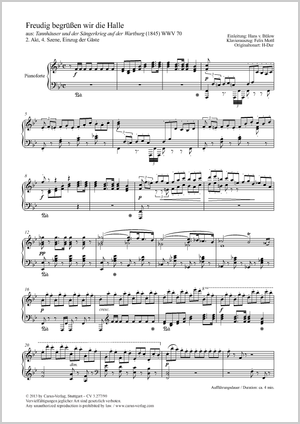
Freudig begrüßen wir die Halle
Einzug der Gäste, aus: Tannhäuser und der Sängerkrieg auf der Wartburg WWV 70, 1845
aus: Tannhäuser und der Sängerkrieg auf der Wartburg, 2. Akt, 4. Szene. Landgraf Herrmann von Thüringen hat zur Feier der Rückkehr des lange vermissten Minnesängers Heinrich von Ofterdingen, genannt Tannhäuser, zu einem großen Sängerfest geladen. Den wettstreitenden Sängern stellt der Landgraf die Aufgabe, die Liebe zu besingen. Dies führt schnell zur offenen Konfrontation zwischen den Minnesängern und Tannhäuser. Das Ideal der hohen Minne ist mit Tannhäusers Erfahrung leidenschaftlicher Liebe nicht vereinbar. Doch zunächst begrüßt ein großer Chor feierlich die Sängerhalle und lässt den Landgrafen hoch leben.
Explore


Purchase
Additional product information
-
Composer
Richard Wagner
| 1813-1883Born in 1813 in Leipzig, Richard Wagner grew up in a family very fond of theatre and he himself fell under its spell early. After failure in school and a mainly self-taught musical training (earliest compositions ~ 1830, Symphony in C 1832) 1833 initial employment as choir director in Wurzburg (completion of his first entire opera Die Feen). Start of years as a journeyman: Konigsberg, Riga, Paris, then as a court music director in Dresden, as a fugitive revolutionary in Zurich and finally as a protege of King Ludwig II. in Munich and Bayreuth, death in Venice in 1883. Personal details
-
Songwriter / Librettist
Richard Wagner
| 1813-1883Born in 1813 in Leipzig, Richard Wagner grew up in a family very fond of theatre and he himself fell under its spell early. After failure in school and a mainly self-taught musical training (earliest compositions ~ 1830, Symphony in C 1832) 1833 initial employment as choir director in Wurzburg (completion of his first entire opera Die Feen). Start of years as a journeyman: Konigsberg, Riga, Paris, then as a court music director in Dresden, as a fugitive revolutionary in Zurich and finally as a protege of King Ludwig II. in Munich and Bayreuth, death in Venice in 1883. Personal details
-
Vocal score arranger
Felix Mottl
| 1856-1911
-
Vocal score arranger
Hans von Bülow
| 1830-1894
Reviews on our website can only be submitted by customers with a registered user account. A check whether the rated products were actually purchased does not take place.
No feedback available for this product.
Frequent questions about this work
 There are no questions and answers available so far or you were unable to find an answer to your specific question about this work? Then click here and send your specific questions to our Customer Services!