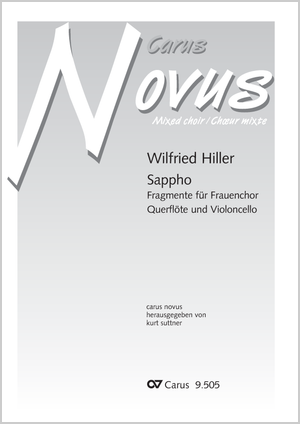
Sappho · Fragments for women’s chorus, flute and cello (1997) was commissioned by the “Arbeitskreis für Musik in der Jugend” for the project “KomponistInnen schreiben für Kinder und Jugendchöre.” Thus the use of flute and cello in this work for women’s choir is intended to assist intonation. According to Hiller the two instruments may also represent the aulos and lyre, the instruments which in classical antiquity accompanied the declamation of poems. He writes about the ancient Greek poetess: With her verses Sappho, who lived on the Aegean island of Lesbos, has for thousands of years inspired poets, visual artists and composers to create new works of art. In our time, for example, Aribert Reimann, Wilhelm Killmayer, Iannis Xenakis and Carl Orff have composed monuments in sound to her. The fragments of her verses which survive give rise to speculation about what is missing, to new interpretations, and to the idea of filling the gaps with music. What also fascinates me in Sappho’s texts are the glowing eroticism, their iridescent glitter, and their constant high tension. These poems must be sung, especially by women, to whom Sappho dedicated most of these beautiful lines.
Explore
 Listen
(7)
Listen
(7)
- Mitternacht
- Erinnerung
- Eifersucht
- Pierische Rosen
- Die zehnte Muse
- Kallisteia
- Kleis. Meine Tochter
Purchase
Additional product information
Contents
-
Composer
Wilfried Hiller
| 1941Wilfried Hiller studied composition (with Günter Bialas), opera production, percussion and timpani (with Ludwig Porth and Hanns Hölzl), and music theory at the Munich Musikhochschule. From 1967 Hiller was a percussionist in various orchestras. In 1968 he founded the Munich concert series "musik unserer zeit." During the following years he worked closely with his teacher Carl Orff until Orff's death. His many music theatre works have been greatly influenced by his collaboration with the actress Elisabeth Woska and by his inspiring friendship with Michael Ende. In 1993 he was appointed as a teacher of composition at the Richard Strauss conservatoire in Munich Personal details
-
Translator
Emil Staiger
-
Translator
Joachim Schinkel
-
Translator
Marion Giebel
-
Translator
Max Treu
Reviews on our website can only be submitted by customers with a registered user account. A check whether the rated products were actually purchased does not take place.
No feedback available for this product.
Frequent questions about this work
 There are no questions and answers available so far or you were unable to find an answer to your specific question about this work? Then click here and send your specific questions to our Customer Services!