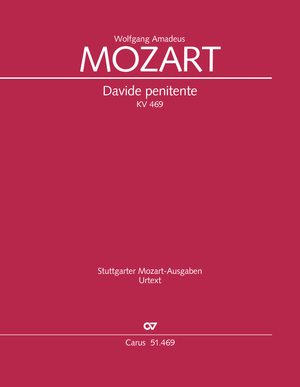
In March 1785, the Vienna Musicians’ Society, a pension fund for the widows and orphans of professional musicians, asked Mozart to compose a choral work for one of their benefit concerts. Mozart opted for a practical solution and recycled some of his unfinished Mass in C minor, K. 427, reworking it into the cantata Davide penitente.
Mozart added new Italian lyrics to the Kyrie and Gloria, following the style of biblical prayers of penance and repentance. The cantata was thus perfectly suited to the timing of the charity concert during Lent. Mozart also composed a tenor and a soprano aria for the new version. The unfinished mass was thus transformed into a work suitable for the Viennese concert scene.
Explore


Purchase
Additional product information
-
Composer
Wolfgang Amadeus Mozart
| 1756-1791As the son of the deputy Kapellmeister to the Salzburg Prince-Archbishop, Mozart was constantly surrounded by church music in his youth. On his travels Mozart became familiar with Italian church music, and later in Vienna he studied the works of Bach and Handel. After moving to Vienna he was faced with the new challenges of composing opera and piano concertos, and significantly the “C Minor Mass” KV 427, the greatest sacred work of the first Vienna years, remained unfinished. The last period of his life again shows a change of direction to church music: Mozart successfully applied to succeed the terminally ill Leopold Hoffmann as Kapellmeister at St Stephen's Cathedral, but he was unable to take up the position as he died before Hoffmann. A gem such as the “Ave verum” KV 618 and the incomplete Requiem KV 626 give us an idea of what Mozart might have achieved as a composer of sacred music if he had taken up this important position. Personal details
-
Editor
Wolfgang Gersthofer
-
Vocal score arranger
Paul Horn
| 1922-2016Paul Horn war ein deutscher Kirchenmusiker, Organist, Komponist und Musikwissenschaftler. Er studierte Kirchenmusik und Orgel an der Evangelischen Kirchenmusikschule Esslingen am Neckar bei Hans-Arnold Metzger und Musikwissenschaft, Theologie und Geschichte an der Universität Tübingen. Seine berufliche Laufbahn begann als Kantor an der Evangelischen Michaelskirche in Stuttgart-Degerloch. 1954 wurde er Kantor an der Evangelischen Stadtkirche Ravensburg, eine Position, die er bis zu seiner Pensionierung innehatte. Als Musikwissenschaftler arbeitete Horn bis ins hohe Alter eng mit Carus zusammen. So stammen zahlreiche Carus-Klavierauszüge aus seiner Feder. Personal details
Reviews
Der Davide penitente, eine lose Zusammenstellung italienischer Bußtexte, nach Art der Bußpsalmen (daher der später hinzugekommene Titel dieser Kantate), ist ein Parodiewerk der großen c-Moll-Messe. Mozart hat daraus das Kyrie und Gloria verwendet und eine Tenor- und Sopranarie hinzugefügt. Das Werk entstand 1785 für ein Benefizkonzert der Wiener Tonkünstlersozietät. Das knapp dreiviertelstündige Werk ist – nicht nur angesichts der bekannten Vorlage – namentlich für Passionskonzerte auch außerhalb des Mozartjahrs zu empfehlen.
Michael F. Runowski
Quelle: Forum Kirchenmusik 4/2007
Reviews on our website can only be submitted by customers with a registered user account. A check whether the rated products were actually purchased does not take place.
No feedback available for this product.
Frequent questions about this work
Is there an organ part for the cantata “Davide penitente”?
No. Unlike the “Mass in C minor,” K. 427, which Mozart drew upon for his cantata “Davide penitente,” there is no organ part for the latter. The composer had not intended to include one for this work, which premiered in a theater (the National Theater at the Hofburg
in Vienna). Against this background, the Critical Report accompanying our full score provides some guidance on the instrumentation of the instrumental bass.
 There are no questions and answers available so far or you were unable to find an answer to your specific question about this work? Then click here and send your specific questions to our Customer Services!