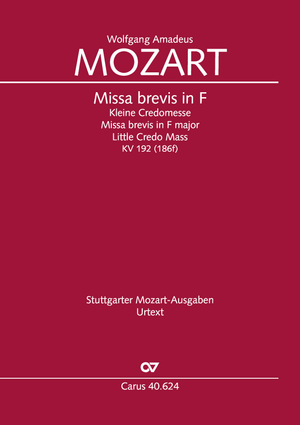
The “Missa brevis in F major” K. 192 can be regarded as a highlight of Mozart’s early masses. It is an accessible and charming work, nicknamed “Little Credo Mass” due to the Credo calls interspersed throughout the third movement.
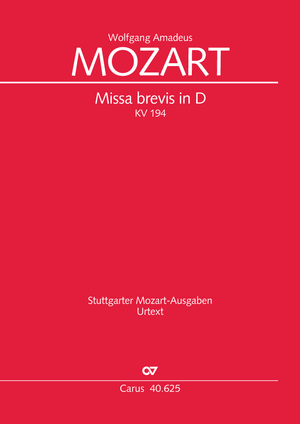
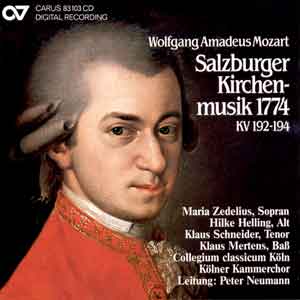
In the summer of 1774, Mozart wrote two masses in close proximity to each other, the “Missa brevis in F” K. 192 and the “Missa brevis in D” K. 194. In both compositions, Mozart attempted to combine traditional polyphonic techniques with a modern tonal language.
Explore

 Listen
(6)
Listen
(6)
- Kyrie
- Gloria
- Credo
- Sanctus
- Benedictus
- Agnus Dei
 Practise
-
Practice aids
-
Practice aids voice part soprano
- Kyrie (Choir Coach)
- Kyrie (Choir Coach, Slow mode)
-
Practice aids voice part alto
- Kyrie (Choir Coach)
- Kyrie (Choir Coach, Slow mode)
-
Practice aids voice part tenore
- Kyrie (Choir Coach)
- Kyrie (Choir Coach, Slow mode)
-
Practice aids voice part basso
- Kyrie (Choir Coach)
- Kyrie (Choir Coach, Slow mode)
-
 Additional material
- Purchase additional material as a download product.
-
 Digital text (without sheet music) incl. printing licence, html file, singing text, originalhtml file, singing text, original (Sample)Kyrie (Soli SA, Coro)
Kyrie eleison.
Gloria (Soli SATB, Coro)
Christe eleison.
Kyrie eleison.[Gloria in excelsis Deo]
Et in terra pax hominibus bonae voluntatis.
Laudamus te. Benedicimus te.
Adoramus te. Glorificamus te.
Gratias agimus tibi propter magnam gloriam tuam.
Domine Deus, Rex caelestis,
Deus Pater omnipotens.
Domine Fili unigenite, Jesu Christe.
Domine Deus, Agnus Dei, Filius Patris.
Qui tollis peccata mundi,
miserere nobis.
Qui tollis peccata mundi,
suscipe deprecationem nostram.
Qui sedes ad dexteram Patris,
miserere nobis....
-
Digital text (without sheet music) incl. printing licence, html file, Introductory text, englishhtml file, Introductory text, english (Sample) Abridged foreword of the Edition Carus 40.624
Jochen Reutter
Translation: John CoombsDuring the summer of 1774 W. A. Mozart wrote two Masses within a few weeks: the Missa brevis in F major, K. 192 (186f), and the Missa brevis in D major, K. 194 (186h). A feature common to both compositions as well as to the Dixit et Magnificat K. 193 (186g), written at about the same time, and the "Trinitatis" Mass K. 167 of the previous year, is a more or less strongly evident tendency towards contrapuntal writing. However, while the Dixit et Magnificat and the "Trinitatis" Mass approach the late-baroque style, in these two brevis Masses Mozart sought to combine traditional polyphonic techniques with a more modern musical language.
The Missa brevis in F major was completed on the 24th June 1774, as is stated on the autograph score. It is clear from an authentic set of performing parts, containing markings in Mozart's hand, that this work was intended for Salzburg Cathedral. In accordance with the modest requirements of a missa brevis, the orchestra consists only of two violins, bass and organ, the so-called "church trio." They were augmented, as the local performing practice demanded,...
-
Digital text (without sheet music) incl. printing licence, html file, Introductory text, germanhtml file, Introductory text, german (Sample)Gekürztes Vorwort der Ausgabe Carus 40.624
Jochen Reutter
Im Sommer 1774 schrieb W. A. Mozart in unmittelbarer zeitlicher Nachbarschaft zwei Messen, die Missa brevis in F KV 192 (186f) und die Missa brevis in D KV 194 (186h). Beiden Kompositionen eigen ist wie dem etwa gleichzeitig entstandenen Dixit et Magnificat KV 193 (186g) und der aus dem Vorjahr stammenden Trinitatismesse KV 167 eine jeweils mehr oder weniger stark ausgeprägte Neigung zur kontrapunktischen Schreibweise. Während sich jedoch Dixit et Magnificat und die Trinitatismesse dem spätbarocken Stil nähern, sucht Mozart in den beiden brevis-Messen die althergebrachten polyphonen Techniken mit einer moderneren Tonsprache zu verbinden.
Die Missa brevis in F wurde, so das Datum auf der autographen Partitur, am 24. Juni 1774 beendet. Sie war, wie eine authentische Stimmenabschrift mit eigenhändigen Eintragungen Mozarts bezeugt, für den Salzburger Dom bestimmt. Dem bescheideneren Anspruch einer Missa brevis gemäß ist das Orchester nur mit zwei Violinen, Bass und Orgel, dem sog. "Kirchentrio", besetzt. Hinzu kommen der lokalen Aufführungspraxis entsprechend...
Purchase
Additional product information
Contents
-
Composer
Wolfgang Amadeus Mozart
| 1756-1791As the son of the deputy Kapellmeister to the Salzburg Prince-Archbishop, Mozart was constantly surrounded by church music in his youth. On his travels Mozart became familiar with Italian church music, and later in Vienna he studied the works of Bach and Handel. After moving to Vienna he was faced with the new challenges of composing opera and piano concertos, and significantly the “C Minor Mass” KV 427, the greatest sacred work of the first Vienna years, remained unfinished. The last period of his life again shows a change of direction to church music: Mozart successfully applied to succeed the terminally ill Leopold Hoffmann as Kapellmeister at St Stephen's Cathedral, but he was unable to take up the position as he died before Hoffmann. A gem such as the “Ave verum” KV 618 and the incomplete Requiem KV 626 give us an idea of what Mozart might have achieved as a composer of sacred music if he had taken up this important position. Personal details
-
Vocal score arranger
Paul Horn
| 1922-2016Paul Horn war ein deutscher Kirchenmusiker, Organist, Komponist und Musikwissenschaftler. Er studierte Kirchenmusik und Orgel an der Evangelischen Kirchenmusikschule Esslingen am Neckar bei Hans-Arnold Metzger und Musikwissenschaft, Theologie und Geschichte an der Universität Tübingen. Seine berufliche Laufbahn begann als Kantor an der Evangelischen Michaelskirche in Stuttgart-Degerloch. 1954 wurde er Kantor an der Evangelischen Stadtkirche Ravensburg, eine Position, die er bis zu seiner Pensionierung innehatte. Als Musikwissenschaftler arbeitete Horn bis ins hohe Alter eng mit Carus zusammen. So stammen zahlreiche Carus-Klavierauszüge aus seiner Feder. Personal details
-
Preface writer
Wolfgang Horn
| 1956-2019
Reviews on our website can only be submitted by customers with a registered user account. A check whether the rated products were actually purchased does not take place.
No feedback available for this product.
Frequent questions about this work
 There are no questions and answers available so far or you were unable to find an answer to your specific question about this work? Then click here and send your specific questions to our Customer Services!