

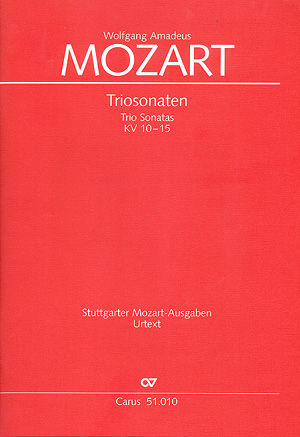
Trio Sonatas K 10-15
Since their publication in the New Mozart Edition, Mozart's sonatas K. 10–15 count as piano trios. Furthermore, the title of the first edition, published by father and son Mozart in 1765 reads "Six Sonates pour le Clavecin qui puevent se jouer avec l'accompagnement de Violon ou Flaute Traversiere”. In other words, these pieces are harpsichord sonatas that may be accompanied at will by a violin or a transverse flute. In a partial press run of the first edition a cello part was included.
Our new edition is the first to take these conflicting formats into account by presenting two separate versions, one being the unaltered harpsichord part, the other a full score with separate instrumental parts for violin/flute and cello. The harpsichord part (CV 51.010/10) is indeed capable of standing by itself and requires no instrumental expansion. The melody instrument, in contrast, merely function as an accompaniment or contribute brief interjections, or, in the case of the cello, reinforce the left hand of the keyboard. In other words, K. 10–15 are not only Mozart's earliest piano trios, they are also his earliest keyboard sonatas to survive intact.
Explore


Purchase
Additional product information
Contents

-
Composer
Wolfgang Amadeus Mozart
| 1756-1791As the son of the deputy Kapellmeister to the Salzburg Prince-Archbishop, Mozart was constantly surrounded by church music in his youth. On his travels Mozart became familiar with Italian church music, and later in Vienna he studied the works of Bach and Handel. After moving to Vienna he was faced with the new challenges of composing opera and piano concertos, and significantly the “C Minor Mass” KV 427, the greatest sacred work of the first Vienna years, remained unfinished. The last period of his life again shows a change of direction to church music: Mozart successfully applied to succeed the terminally ill Leopold Hoffmann as Kapellmeister at St Stephen's Cathedral, but he was unable to take up the position as he died before Hoffmann. A gem such as the “Ave verum” KV 618 and the incomplete Requiem KV 626 give us an idea of what Mozart might have achieved as a composer of sacred music if he had taken up this important position. Personal details
-
Editor
Siegbert Rampe
| 1964-2025
Reviews on our website can only be submitted by customers with a registered user account. A check whether the rated products were actually purchased does not take place.
No feedback available for this product.
Frequent questions about this work
 There are no questions and answers available so far or you were unable to find an answer to your specific question about this work? Then click here and send your specific questions to our Customer Services!