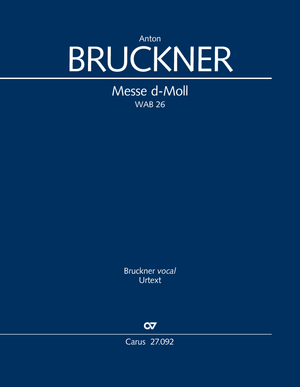
Mass in D minor
WAB 26
Anton Bruckner composed his Mass in D minor in 1864 in just four months. It was not ready in time for the Kaiser Franz Joseph I’s birthday, as planned, but was first performed on 20 November at the Feast of St Cecilia in Linz Cathedral – with great success.
The mass is one of the first works by Bruckner to be written in his characteristic symphonic style. It was revised several times and first published in 1892. This edition is based on a critical evaluation of all the relevant sources, and offers an improved musical text.
Here you can find suggestions for intonations to Gloria and Credo: PDF
 View
View

 Additional material
- Purchase additional material as a download product.
-
 Digital text (without sheet music) incl. printing licence, html file, Introductory text, germanhtml file, Introductory text, german (Sample)Unbenanntes Dokument Vorwort der Ausgabe Carus 27.092/03
Knud Breyer
Die 1864 komponierte Messe d-Moll (WAB 26) gehört zu den ersten Werken Anton Bruckners, die nach seiner Lehrzeit bei Otto Kitzler (1834–1915) und während der Bekanntschaft mit dem Kapellmeister und Komponisten Ignaz Dorn (1839–1872) entstanden, also von Parteigängern der sogenannten „Neudeutschen Schule“ beeinflusst waren. Während die 1854 komponierte Missa solemnis noch bis hin zu Themenzitaten ganz der Messtradition Ludwig van Beethovens, Wolfgang Amadeus Mozarts und Joseph Haydns verhaftet war, schlägt die d-Moll-Messe einen neuen Ton an, der bereits den späteren Sinfoniker erkennen lässt. Ein Initialerlebnis für Bruckners Neuorientierung war 1863 der Besuch der Linzer Erstaufführung des Tannhäuser von Richard Wagner unter der Leitung von Kitzler.
Entstehung und AufführungenDie Anfänge der Arbeit an der Messe d-Moll können auf Mai 1864 datiert werden. Vermutlich plante Bruckner ursprünglich, die Messe zum Geburtstag von Kaiser Franz Joseph I. am 18. August präsentieren zu können. Das Vorhaben, die Komposition in nur drei
...
-
Digital text (without sheet music) incl. printing licence, html file, Introductory text, englishhtml file, Introductory text, english (Sample)Unbenanntes Dokument Foreword of the Edition Carus 27.092/03
Knud Breyer
Translation: Gudrun and David Kosviner
The Mass in D minor (WAB 26), composed in 1864, is one of Anton Bruckner’s first works to be written after his apprenticeship with Otto Kitzler (1834–1915) and during his acquaintance with the Kapellmeister and composer Ignaz Dorn (1839–1872), and thus influenced by partisans of the so-called “New German School.” While the Missa solemnis, composed in 1854, was still entirely rooted in the mass tradition of Ludwig van Beethoven, Wolfgang Amadeus Mozart and Joseph Haydn, right down to thematic quotations, the D minor Mass strikes a new note that already reveals the later symphonic composer. An initial experience for Bruckner’s reorientation was his visit to the Linz premiere of Richard Wagner’s Tannhäuser in 1863, conducted by Kitzler.
Origins and PerformancesThe beginnings of the work on the Mass in D minor can be dated to May 1864. Presumably, Bruckner originally planned to be able to present the mass on the birthday of Emperor Franz Joseph I on 18 August. However, the plan to
...
-
Composer
Anton Bruckner
| 1824-1896Anton Bruckner was born in Ansfelden (Austria) in 1824 and did not have a particularly easy life. The Austrian composer came from a simple, rural background and was plagued by self-doubt throughout his life. After the death of his father, he was accepted as a choirboy at St Florian's Abbey at the age of 13. After several years as a school assistant and self-taught organ and piano studies, he initially worked as an organist in St Florian. In 1855 he was appointed cathedral organist in Linz. After an introduction to music theory and instrumentation by Simon Sechter and Otto Kitzler, Bruckner discovered Richard Wagner as an artistic role model, whom he admired throughout his life and also visited several times in Bayreuth.
In 1868 Anton Bruckner became professor of basso continuo, counterpoint and organ at the Vienna Conservatory, ten years later court organist. In 1891 he was awarded an honorary doctorate from the University of Vienna. He was regarded as an important organ virtuoso of his time, but his compositional recognition was a long time coming. It was not until the Symphony No. 7 in E major, composed between 1881 and 1883, with the famous Adagio, which was written under the impression of Wagner's death, that he received the recognition he had hoped for, even if he did not want to accept it in view of his tendency towards scepticism and self-criticism.
Anton Bruckner was a solitary composer who did not want to follow any school or doctrine. He wrote both sacred and secular works in all their facets. In addition to numerous motets, Bruckner composed three masses, the Missa Solemnis in B flat minor (1854) and the Te Deum (1881-84; CV 27.190/00), which is available from Carus-Verlag. As a symphonist, he wrote a total of nine symphonies and many symphonic studies from 1863 onwards, whereby he tended to revise finished versions several times. Bruckner's orchestral works were long considered unplayable, but for the tonal language of their time they were merely unusually bold sound monuments on the border between late Romanticism and Modernism, uniting traditions from Beethoven to Wagner and folk music.
Personal details
-
Editor
Knud Breyer
Reviews
Die Ausgabe des Carus-Verlages folgt im Wesentlichen dem Erstdruck als Hauptquelle. Sie ist wie immer vorbildlich hinsichtlich des hervorragenden Schriftbilds, eines umfangreichen, sehr informativen Vorworts und eines Kritischen Berichts im Anhang.
Württembergisches Blätter für Kirchenmusik, 2/2023, März/April, 90. Jahrgang
Die vorliegende Ausgabe beruht auf der kritischen Sichtung aller relevanten Quellen und liefert einen verbesserten Notentext.
Kirchenmusikalischen Mitteilungen, Nr. 150, Nov 2022
Die Urfassung sieht die Mitwirkung der Orgel vor, im Redoutensall gab es aber keine, weswegen Bruckner die Orgelstimme an wichtigen Stellen auf Holzbläser verteilte. Damit war bereits eine erste Quelle für Missverständnisse geschaffen; weitere folgten bedingt durch den Komponisten. So ist eine Neuedition durchaus begründet, welche die ineinanderlaufenden Fäden beschreibt und auflöst.
CHORaktuell, Juni 2022
Reviews on our website can only be submitted by customers with a registered user account. A check whether the rated products were actually purchased does not take place.
Frequent questions about this work
 There are no questions and answers available so far or you were unable to find an answer to your specific question about this work? Then click here and send your specific questions to our Customer Services!