

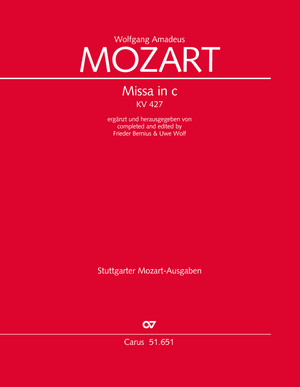
Missa in c (Bernius/Wolf version)
completed and edited by Frieder Bernius & Uwe Wolf KV 427
The Missa in c K. 427 by Wolfgang Amadeus Mozart is a fascinating work. But to speak of “the” Mass is inaccurate, for basically it is no more than a musical torso, full of enigmas and problems, yet full of magnificent music.
It is hardly surprising that attempts have been made to create a performable version of Mozart's fragment since the 19th century. Depending on the date of reconstruction and background of the arranger, these attempts sound quite different, and often the individual style of the respective arranger can be clearly discerned. Frieder Bernius and Uwe Wolf have published an edition of the Mozart mass which attempts to produce a performing version whilst maintaining the greatest respect for the available material, and without obscuring Mozart's musical manuscript with their own contributions. The joint version by Wolf, a renowned musicologist, and Bernius, an expert in historically-informed performance practice, is based on a thorough knowledge of Mozart's compositions, his notational habits, and church music practice of his day. At the same time, it fully meets the requirements of today's performance practice.
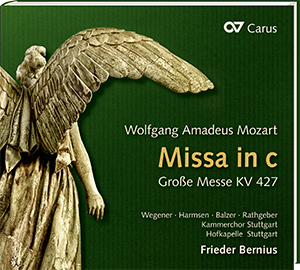
As well as the paperback full score, we are publishing a high-quality clothbound full score including a Facsimile Supplement with selected reproductions of the sources. A first recording of this version, with the Kammerchor Stuttgart and the Barockorchester Stuttgart conducted by Frieder Bernius, is also available.
Explore
 View
View


 Listen
(13)
Listen
(13)
 Practise
-
 carus music, the Choir Coach
Üben mit carus music
carus music, the Choir Coach
Üben mit carus music
-
Practice aids
-
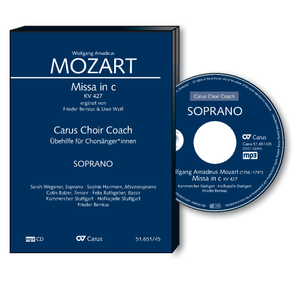
Practice aids voice part soprano
- Kyrie (Choir Coach)
- Kyrie (Choir Coach, Slow mode)
- Gloria (Choir Coach)
- Gloria (Choir Coach, Slow mode)
- Gratias (Choir Coach, soprano 1)
- Gratias (Choir Coach, soprano 2)
- Gratias (Choir Coach, Slow mode, soprano 1)
- Gratias (Choir Coach, Slow mode, soprano 2)
- Qui tollis (Choir Coach, soprano 1)
- Qui tollis (Choir Coach, soprano 2)
- Qui tollis (Choir Coach, Slow mode, soprano 1)
- Qui tollis (Choir Coach, Slow mode, soprano 2)
- Jesu Christe, Cum Sancto Spiritu (Choir Coach)
- Jesu Christe, Cum Sancto Spiritu (Choir Coach, Slow mode)
- Credo (Choir Coach, soprano 1)
- Credo (Choir Coach, soprano 2)
- Credo (Choir Coach, Slow mode, soprano 1)
- Credo (Choir Coach, Slow mode, soprano 2)
- Sanctus, Hosanna (Choir Coach, soprano 1)
- Sanctus, Hosanna (Choir Coach, soprano 2)
- Sanctus, Hosanna (Choir Coach, Slow mode, soprano 1)
- Sanctus, Hosanna (Choir Coach, Slow mode, soprano 2)
- Benedictus, Hosanna (Choir Coach, soprano 1)
- Benedictus, Hosanna (Choir Coach, soprano 2)
- Benedictus, Hosanna (Choir Coach, Slow mode, soprano 1)
- Benedictus, Hosanna (Choir Coach, Slow mode, soprano 2)
-
Practice aids voice part alto
- Kyrie (Choir Coach)
- Kyrie (Choir Coach, Slow mode)
- Gloria (Choir Coach)
- Gloria (Choir Coach, Slow mode)
- Gratias (Choir Coach)
- Gratias (Choir Coach, Slow mode)
- Qui tollis (Choir Coach, Alto 1)
- Qui tollis (Choir Coach, Alto 2)
- Qui tollis (Choir Coach, Slow mode, Alto 1)
- Qui tollis (Choir Coach, Slow mode, Alto 2)
- Jesu Christe, Cum Sancto Spiritu (Choir Coach)
- Jesu Christe, Cum Sancto Spiritu (Choir Coach, Slow mode)
- Credo (Choir Coach)
- Credo (Choir Coach, Slow mode)
- Sanctus, Hosanna (Choir Coach, Alto 1)
- Sanctus, Hosanna (Choir Coach, Alto 2)
- Sanctus, Hosanna (Choir Coach, Slow mode, Alto 1)
- Sanctus, Hosanna (Choir Coach, Slow mode, Alto 2)
- Benedictus, Hosanna (Choir Coach, Alto 1)
- Benedictus, Hosanna (Choir Coach, Slow mode, Alto 1)
- Benedictus, Hosanna (Choir Coach, Alto 2)
- Benedictus, Hosanna (Choir Coach, Slow mode, Alto 2)
-
Practice aids voice part tenore
- Kyrie (Choir Coach)
- Kyrie (Choir Coach, Slow mode)
- Gloria (Choir Coach)
- Gloria (Choir Coach, Slow mode)
- Gratias (Choir Coach)
- Gratias (Choir Coach, Slow mode)
- Qui tollis (Choir Coach, Tenore 1)
- Qui tollis (Choir Coach, Tenore 2)
- Qui tollis (Choir Coach, Slow mode, Tenore 1)
- Qui tollis (Choir Coach, Slow mode, Tenore 2)
- Jesu Christe, Cum Sancto Spiritu (Choir Coach)
- Jesu Christe, Cum Sancto Spiritu (Choir Coach, Slow mode)
- Credo (Choir Coach)
- Credo (Choir Coach, Slow mode)
- Sanctus, Hosanna (Choir Coach, Tenore 1)
- Sanctus, Hosanna (Choir Coach, Tenore 2)
- Sanctus, Hosanna (Choir Coach, Slow mode, Tenore 1)
- Sanctus, Hosanna (Choir Coach, Slow mode, Tenore 2)
- Benedictus, Hosanna (Choir Coach, Tenore 1)
- Benedictus, Hosanna (Choir Coach, Tenore 2)
- Benedictus, Hosanna (Choir Coach, Slow mode, Tenore 1)
- Benedictus, Hosanna (Choir Coach, Slow mode, Tenore 2)
-
Practice aids voice part basso
- Kyrie (Choir Coach)
- Kyrie (Choir Coach, Slow mode)
- Gloria (Choir Coach)
- Gloria (Choir Coach, Slow mode)
- Gratias (Choir Coach)
- Gratias (Choir Coach, Slow mode)
- Qui tollis (Choir Coach, Basso 1)
- Qui tollis (Choir Coach, Basso 2)
- Qui tollis (Choir Coach, Slow mode, Basso 1)
- Qui tollis (Choir Coach, Slow mode, Basso 2)
- Jesu Christe, Cum Sancto Spiritu (Choir Coach)
- Jesu Christe, Cum Sancto Spiritu (Choir Coach, Slow mode)
- Credo (Choir Coach)
- Credo (Choir Coach, Slow mode)
- Sanctus, Hosanna (Choir Coach, Basso 1)
- Sanctus, Hosanna (Choir Coach, Basso 2)
- Sanctus, Hosanna (Choir Coach, Slow mode, Basso 1)
- Sanctus, Hosanna (Choir Coach, Slow mode, Basso 2)
- Benedictus, Hosanna (Choir Coach, Basso 1)
- Benedictus, Hosanna (Choir Coach, Basso 2)
- Benedictus, Hosanna (Choir Coach, Slow mode, Basso 1)
- Benedictus, Hosanna (Choir Coach, Slow mode, Basso 2)
-
 Additional material
- Purchase additional material as a download product.
-
 Digital text (without sheet music) incl. printing licence, html file, singing text, english translationhtml file, singing text, english translation (Sample)Kyrie 1. Kyrie (Solo S, Coro SATB)
Lord, have mercy on us.
Gloria 2. Gloria (Coro SATB)
Christ, have mercy on us.
Lord, have mercy on us.Glory be to God on high.
3. Laudamus te (Solo S)
And on earth peace to men of good will.We praise thee; we bless thee; we adore thee; we glorify thee.
4. Gratias (Coro SSATB)We give thee thanks for thy great glory.
...
-
Digital text (without sheet music) incl. printing licence, html file, singing text, german translationhtml file, singing text, german translation (Sample)Kyrie 1. Kyrie (Solo S, Coro SATB)
Herr, erbarme dich unser.
Gloria 2. Gloria (Coro SATB)
Christus, erbarme dich unser.
Herr, erbarme dich unser.Ehre sei Gott in der Höhe.
3. Laudamus te (Solo S)
Und Friede auf Erden den Menschen, die guten Willens sind.Wir loben dich, wir preisen dich, wir beten dich an, wir rühmen dich.
4. Gratias (Coro SSATB)Wir danken dir, denn groß ist deine Herrlichkeit.
...
-
Digital text (without sheet music) incl. printing licence, html file, singing text, originalhtml file, singing text, original (Sample)Kyrie 1. Kyrie (Solo S, Coro SATB)
Kyrie eleison.
Gloria 2. Gloria (Coro SATB)
Christe eleison.
Kyrie eleison.Gloria in excelsis Deo.
3. Laudamus te (Solo S)
Et in terra pax hominibus bonae voluntatis.Laudamus te. Benedicimus te. Adoramus te. Glorificamus te.
4. Gratias (Coro SSATB)Gratias agimus tibi propter magnam gloriam tuam.
...
-
Digital text (without sheet music) incl. printing licence, html file, Introductory text, englishhtml file, Introductory text, english (Sample)Text from the CD Carus 83.284
Uwe Wolf
Translation: Elizabeth RobinsonWhat a story! Mozart makes a vow to compose a mass after the successful birth of his first-born child. The performance is planned on the occasion of his first journey with his wife to Salzburg so he can introduce her to his family – both personally and musically, for Constanze is to sing one of the demanding soprano parts. But the baby, left behind with a wet-nurse in Vienna, then dies, and Mozart stops work on the composition – precisely at the Et incarnatus est, one of the most beautiful and heartfelt movements by Mozart, dealing with the subject of the incarnation, that is, birth. Too much of a coincidence? Probably.
But there is some truth in this touching, very personal story. A letter from Mozart to his father in January 1783, the only document from the time of the composition of the Mass which refers to the vow, is anything but clear – and consequently any connection between the C Minor Mass and the birth of little Raimund Leopold (17.6.1783–19.8.1783) is frequently questioned. But various later statements by Constanze Mozart (who survived her husband by more than 50 years) regularly repeat this story over a long period of time. It is mentioned in
...
-
Digital text (without sheet music) incl. printing licence, html file, Introductory text, germanhtml file, Introductory text, german (Sample)Booklet-Text der CD Carus 83.284
Uwe Wolf
Was für eine Geschichte! Mozart legt das Gelübde ab, nach der glücklich überstandenen Geburt seines Erstgeborenen eine Messe zu komponieren. Die Aufführung ist geplant anlässlich der ersten Reise mit seiner Frau nach Salzburg, um diese seiner Familie vorzustellen – auch musikalisch, denn eine der anspruchsvollen Sopranpartien soll Constanze singen. Doch dann stirbt das bei einer Amme in Wien zurückgelassene Baby und Mozart bricht die Komposition ab – genau im Et incarnatus est, einer der schönsten, innigsten Sätze Mozarts, in dem es auch noch ausgerechnet um die Menschwerdung, also Geburt geht! Zu passend, um wahr zu sein? Wahrscheinlich.
Doch etwas ist dran an dieser rührenden, ganz persönlichen Geschichte. Ein Brief Mozarts an seinen Vater vom Januar 1783, das einzige Dokument für das Gelöbnis aus der Entstehungszeit der Messe selbst, ist alles andere als eindeutig – und folglich wird jener Zusammenhang zwischen der c-Moll-Messe und der Geburt des kleinen Raimund Leopold (17.6.1783–19.8.1783) regelmäßig in Zweifel gezogen. Doch diverse spätere Äußerungen Constanze Mozarts (die ihren Mann um mehr als 50 Jahre überlebte) wiederholen über einen langen Zeitraum diese
...
Purchase
Additional product information
Contents

-
Composer
Wolfgang Amadeus Mozart
| 1756-1791As the son of the deputy Kapellmeister to the Salzburg Prince-Archbishop, Mozart was constantly surrounded by church music in his youth. On his travels Mozart became familiar with Italian church music, and later in Vienna he studied the works of Bach and Handel. After moving to Vienna he was faced with the new challenges of composing opera and piano concertos, and significantly the “C Minor Mass” KV 427, the greatest sacred work of the first Vienna years, remained unfinished. The last period of his life again shows a change of direction to church music: Mozart successfully applied to succeed the terminally ill Leopold Hoffmann as Kapellmeister at St Stephen's Cathedral, but he was unable to take up the position as he died before Hoffmann. A gem such as the “Ave verum” KV 618 and the incomplete Requiem KV 626 give us an idea of what Mozart might have achieved as a composer of sacred music if he had taken up this important position. Personal details
-
Editor
Uwe Wolf
| 1961As a musicologist, Dr. Uwe Wolf is particularly at home in the 17th and 18th centuries. The focus of his work ranges from the time of Monteverdi and Schütz to Bach and the generation of Bach's sons and pupils through to Viennese Classicism. He has been head of the editorial department at Carus-Verlag since October 2011. Prior to this, he worked in Bach research for over 20 years. Personal details
-
Editor
Frieder Bernius
| 1947Frieder Bernius’s work has earned great worldwide recognition. He is in demand internationally as a conductor and as a teacher. His principal artistic collaborators are the ensembles he founded himself, the Kammerchor Stuttgart, the Barockorchester Stuttgart, the Hofkapelle Stuttgart and the Klassische Philharmonie Stuttgart. As a guest conductor, he has collaborated repeatedly with, for example, the SWR Vokalensemble Stuttgart, the Deutsche Kammerphilharmonie Bremen, the Stuttgarter Kammerorchester and the Streicherakademie Bozen. Great stylistic versatility is Frieder Bernius’s hallmark. Whether he conducts vocal works by Monteverdi, Bach, Händel, Mozart, Beethoven, Fauré and Ligeti, stage music by Mendelssohn or symphonies by Haydn, Burgmüller and Schubert, his work always aims for a sound that is at once unmistakably personal and at the same time oriented towards the original period sound ideal. He devotes himself equally to the rediscovery of 18th century operas and to first performances of contemporary compositions. He is particularly interested in the musical history of southwestern Germany. Carus-Verlag has awarded Frieder Bernius a Golden CD for his complete recording of the sacred music of Felix Mendelssohn Bartholdy. The award was presented to him during the German Choir Festival in Stuttgart 2016. The sale of over 250,000 recordings, which has been acclaimed with a number of awards, has made a not insignificant contribution to what today is the obvious presence of Mendelssohn's complete œuvre in the concert repertoire. Personal details
-
Arranger
Uwe Wolf
| 1961As a musicologist, Dr. Uwe Wolf is particularly at home in the 17th and 18th centuries. The focus of his work ranges from the time of Monteverdi and Schütz to Bach and the generation of Bach's sons and pupils through to Viennese Classicism. He has been head of the editorial department at Carus-Verlag since October 2011. Prior to this, he worked in Bach research for over 20 years. Personal details
-
Arranger
Frieder Bernius
| 1947Frieder Bernius’s work has earned great worldwide recognition. He is in demand internationally as a conductor and as a teacher. His principal artistic collaborators are the ensembles he founded himself, the Kammerchor Stuttgart, the Barockorchester Stuttgart, the Hofkapelle Stuttgart and the Klassische Philharmonie Stuttgart. As a guest conductor, he has collaborated repeatedly with, for example, the SWR Vokalensemble Stuttgart, the Deutsche Kammerphilharmonie Bremen, the Stuttgarter Kammerorchester and the Streicherakademie Bozen. Great stylistic versatility is Frieder Bernius’s hallmark. Whether he conducts vocal works by Monteverdi, Bach, Händel, Mozart, Beethoven, Fauré and Ligeti, stage music by Mendelssohn or symphonies by Haydn, Burgmüller and Schubert, his work always aims for a sound that is at once unmistakably personal and at the same time oriented towards the original period sound ideal. He devotes himself equally to the rediscovery of 18th century operas and to first performances of contemporary compositions. He is particularly interested in the musical history of southwestern Germany. Carus-Verlag has awarded Frieder Bernius a Golden CD for his complete recording of the sacred music of Felix Mendelssohn Bartholdy. The award was presented to him during the German Choir Festival in Stuttgart 2016. The sale of over 250,000 recordings, which has been acclaimed with a number of awards, has made a not insignificant contribution to what today is the obvious presence of Mendelssohn's complete œuvre in the concert repertoire. Personal details
Reviews
... Scored for double-choir, SSTB soloists, flute, 2 oboes, 2 bassoons, 2 horns, 2 trumpets, 3 trombones, timpani, strings, and continuo, this work is not for the faint of heart. That being said, it is indubitably a treasure in the world of choral-orchestral music. Considering this new edition, the work is even more accessible than previous completions, and is well worth programming.
Kevin Dibble, Choral Journal, November 2018
... Sie [Bernius und Wolf] ergänzen behutsam, orientieren sich an Klangbildern, die der reife Mozart insgesamt entwirft, bemühen sich um Idiomatik, versteigen sich nicht in eigene kompositorische Ideen und schaffen so eine ebenso praxistaugliche wie künstlerisch diskutable Neugestaltung von Mozarts fragmentarischen Messeteilen. Sie verdient es, ihre Qualitäten in Aufführungen erweisen zu dürfen.
Ulrich Konrad, Musica Sacra, 1/2018
... eine Fassung ..., die neue Massstäbe setzt in einer - leider viel zu selten praktizierten - kongenialen Zusammenarbeit von Wissenschaft und Praxis.
Schweizer Musikzeitung, Dezember 2017
... Dieser interessante Weg, auf dem ein Wissenschaftler und ein Dirigent ein Werk gemeinsam herausgeben, sollte in Zukunft häufiger beschriften werden.
Kirchenmusikalische Mitteilungen der Erzdiözese Freiburg, November 2017
... Praktiker und Musikwissenschaftler haben hier zu einer bewundernswerten Zusammenarbeit gefunden, die schon als solche nicht genug honoriert werden kann. Ein umfangreiches Vorwort und der Kritische Bericht ergänzen die Partitur in der bei Carus gewohnten hohen Qualität.
Rainer Goede, Forum Kirchenmusik, März/April 2017
Sowohl im Hinblick auf die Art der Vervollständigung als auch auf die Interpretation setzt diese c-Moll-Messe neue Maßstäbe.
Chorzeit, März 2017
Fazit: eine echte Entdeckung. Nicht nur für Mozart-Freaks.
Christian Albrecht, Musik & Liturgie, 2/2017
...Gemeinsam haben Wolf (von der quellenkundlichen Seite) und Bernius (aus aufführungspraktischer Sicht) an der Instrumentierung der von Mozart nur unvollständig hinterlassenen Teile getüftelt, was zu einem wirklich überzeugenden Ergebnis geführt hat.
Bernhard Schrammek, RBB kulturradio, 23.01.2017
Das Duo Bernius & Wolf erliegt keineswegs der Hybris, ein Genie wie Mozart aktionistisch vervollständigen oder gar, was noch anmaßender wäre, verbessern zu wollen. Die beiden Herausgeber gingen mit Empathie und akribischer Sorgfalt zu Werke, brachten ihre ganze Kompetenz ein. Mozart kann Mozart sein, und die c-Moll-Messe, deren Komposition der Salzburger, aus welchen Gründen auch immer, abgebrochen hatte, wird aufführbar(er).
Johannes Adam, Badische Zeitung, 14.01.2017
Reviews on our website can only be submitted by customers with a registered user account. A check whether the rated products were actually purchased does not take place.
No feedback available for this product.
Frequent questions about this work
 There are no questions and answers available so far or you were unable to find an answer to your specific question about this work? Then click here and send your specific questions to our Customer Services!