Machet die Tore weit
(original version)
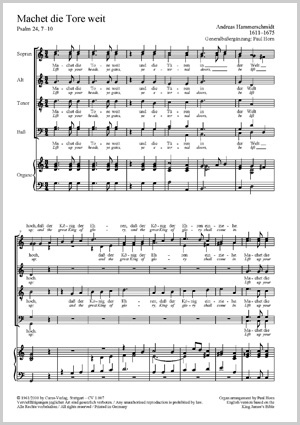
Machet die Tore weit is perhaps Andreas Hammerschmidt’s best-known composition. But it is mainly performed in a form which does not originate from the composer – considerably shortened, with altered part-writing, and less text. Carus is now making this popular piece available for choirs in the composer’s more coherent original form.
Influenced by Heinrich Schütz, Andreas Hammerschmidt and other composers in central Germany wrote sacred vocal compositions with some discreet modern influences. These were widely performed in the late 17th and early 18th century, thanks to their ease of performance and catchy music. And today this music, with its song-like melodies, continues to offer an easy way of approaching 17th century compositions.
The well-known arranged version will continue to be available (Carus 1.007).


-
Composer
Andreas Hammerschmidt
| 1612-1675Andreas Hammerschmidt grew up in a Protestant family in Bohemia, but fled with his family to Freiberg in Electoral Saxony in 1626 due to religious persecution during the Counter-Reformation. No detailed information about his musical education has been handed down. In 1635, Hammerschmidt became organist at St. Peter's Church in Freiberg, until he took up the position of organist at St. John's Church in Zittau four years later. He held this position until his death, while Zittau developed into his musical centre of activity.
Hammerschmidt composed over 400 works, mainly church cantatas, motets and sacred madrigals. Stylistically, his music follows in the footsteps of Heinrich Schütz, but he is considered an important pioneer of the German church cantata, which later flourished under Johann Sebastian Bach.
Personal details
-
Editor
Uwe Wolf
| 1961As a musicologist, Dr. Uwe Wolf is particularly at home in the 17th and 18th centuries. The focus of his work ranges from the time of Monteverdi and Schütz to Bach and the generation of Bach's sons and pupils through to Viennese Classicism. He has been head of the editorial department at Carus-Verlag since October 2011. Prior to this, he worked in Bach research for over 20 years. Personal details
-
Continuo realization
Daniel Ivo de Oliveira
Reviews on our website can only be submitted by customers with a registered user account. A check whether the rated products were actually purchased does not take place.
Frequent questions about this work
 There are no questions and answers available so far or you were unable to find an answer to your specific question about this work? Then click here and send your specific questions to our Customer Services!