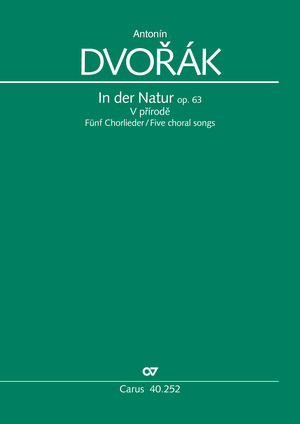
In der Natur
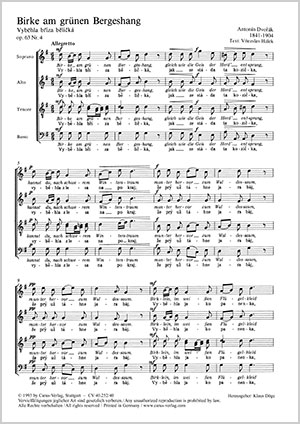
Five choral songs op. 63, 1876-1882



Contents

-
Composer
Antonín Dvorák
| 1841-1904Antonín Dvorák (1841-1904), next to Smetana and Janacek the most important exponent of specifically Czech music, now ranks (also in general) as one of the most popular composers of the nineteenth century. The son of a butcher-innkeeper in the Bohemian town of Nelahozeves (Mühlhausen) near Kralup, he first became known in his homeland for his patriotic hymn The Heirs of the White Mountain for chorus and orchestra, op.30, that he wrote in 1872. His road out into the world was opened by a commission consisting of Johannes Brahms, Eduard Hanslick and Johann von Herbeck, that selected him for an Austrian government stipend.
Brahms, who was seven years the elder, took a friendly interest in his younger colleague whose eminent talent he had recognized and had come to admire. (Brahms: "That fellow has more ideas than all of us together. Every other composer could cull main themes from what he throws away.") Brahms recommended Dvorák to his Berlin publisher, Simrock, who later became Dvorák's chief publisher though he was obstinate and at first quite difficult.
International fame came to Dvorák as a composer and – beginning in 1884 – as conductor of his own works mainly through his sensational successes in England (he went there for lengthy sojourns a total of nine times) and in the United States (two long visits spent in teaching and composing). His success was sparked chiefly by a sacred work, his Stabat Mater that was written in 1876 (Carus 27.293/03). Right until his late period, church music was never missing from the list of his important compositions: the symphonic poems, the operas (among them Rusalka), the symphonies, the string quartets and other chamber music works, the oratorio St. Ludmila - and the Slavonic Dances op.46 and op.72. To the Stabat Mater op.58 (1876/77) mentioned above, he added the 149th Psalm op.79 (1879/87), the Requiem op.89 (1890) (Carus 27.323) and the Te Deum op.103 (1892) (Carus 27.189).
Personal details
-
Editor
Klaus Döge
| 1951-2011
Reviews
Anton Dvorák: In der Natur op
Anton Dvorák: In der Natur op. 63
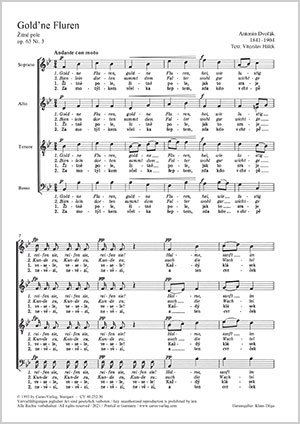
1882 entstand dieser bedeutsame Zyklus von fünf Chorliedern a cappella. Obwohl die Komposition keinen Widmungsträger kennt, darf man annehmen, dass Dvorák alle seine Chorwerke im Hinblick auf eine seiner befreundeten Chorvereinigungen schuf. Auch die Textwahl ist persönlich geprägt und entstammt seiner Naturliebe, die in den Gedichten Vitezslav Haleks ihre beste Entsprechung fand. Schließlich fand auch Dvoráks Frömmigkeit in den ausgewählten Gedichten ihren Widerhall, die alle Gottes Schöpfung preisen möchten. Zur Charakterisierung sei aus dem Vorwort der Carus-Ausgabe zitiert (Klaus Döge): „Mit ihrer dem Strophenbau der Gedichtvorlage stets folgenden Form und ihrer überwiegend homophonen Vierstimmigkeit erscheinen die Chorlieder op. 63 kompositorisch auf den ersten Blick als schlicht und einfach gehalten. Über ihrem so scheinbar einfachen Satz, ihrem dynamisch verhaltenen und oft zarten Stimmgewebe und ihrer farbigen Harmonik aber liegt eine Stimmung, deren Ausdrucksintensität und Nuancenreichtum zeigt, dass Dvorák auch hier es verstand, mit relativ bescheidenden Mitteln ein sehr persönliches und wirkungsvolles Werk zu schreiben”. Zum Kennenlernen sei aus den Einzelausgaben die Nr. 1 oder 3 empfohlen.
Quelle: Schwäbische Sängerzeitung 7 (1996), S. 7
Reviews on our website can only be submitted by customers with a registered user account. A check whether the rated products were actually purchased does not take place.
Frequent questions about this work
 There are no questions and answers available so far or you were unable to find an answer to your specific question about this work? Then click here and send your specific questions to our Customer Services!