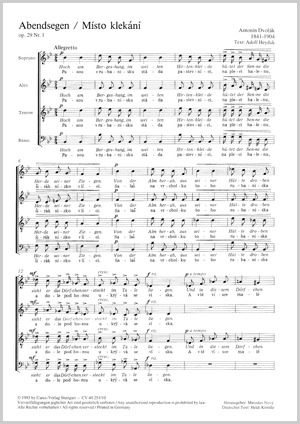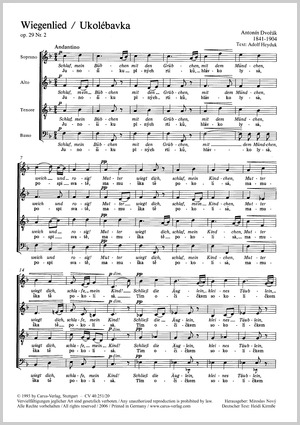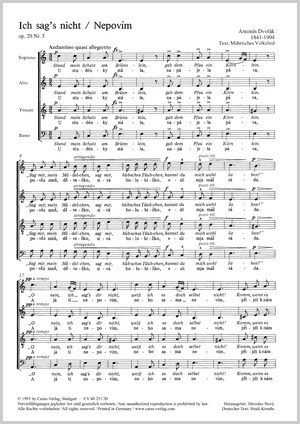
Vier Lieder für gemischten Chor
op. 29
 View
View

Contents

-
Composer
Antonín Dvorák
| 1841-1904Antonín Dvorák (1841-1904), next to Smetana and Janacek the most important exponent of specifically Czech music, now ranks (also in general) as one of the most popular composers of the nineteenth century. The son of a butcher-innkeeper in the Bohemian town of Nelahozeves (Mühlhausen) near Kralup, he first became known in his homeland for his patriotic hymn The Heirs of the White Mountain for chorus and orchestra, op.30, that he wrote in 1872. His road out into the world was opened by a commission consisting of Johannes Brahms, Eduard Hanslick and Johann von Herbeck, that selected him for an Austrian government stipend.
Brahms, who was seven years the elder, took a friendly interest in his younger colleague whose eminent talent he had recognized and had come to admire. (Brahms: "That fellow has more ideas than all of us together. Every other composer could cull main themes from what he throws away.") Brahms recommended Dvorák to his Berlin publisher, Simrock, who later became Dvorák's chief publisher though he was obstinate and at first quite difficult.
International fame came to Dvorák as a composer and – beginning in 1884 – as conductor of his own works mainly through his sensational successes in England (he went there for lengthy sojourns a total of nine times) and in the United States (two long visits spent in teaching and composing). His success was sparked chiefly by a sacred work, his Stabat Mater that was written in 1876 (Carus 27.293/03). Right until his late period, church music was never missing from the list of his important compositions: the symphonic poems, the operas (among them Rusalka), the symphonies, the string quartets and other chamber music works, the oratorio St. Ludmila - and the Slavonic Dances op.46 and op.72. To the Stabat Mater op.58 (1876/77) mentioned above, he added the 149th Psalm op.79 (1879/87), the Requiem op.89 (1890) (Carus 27.323) and the Te Deum op.103 (1892) (Carus 27.189).
Personal details
-
Editor
Miroslav Nový
Reviews
Anton Dvorák: Vier Lieder für gemischten Chor op
Anton Dvorák: Vier Lieder für gemischten Chor op. 29
Neben dem Zyklus „In der Natur” und den klavierbegleiteten „Klängen aus Mähren” gehören diese vier Lieder zu den wenigen Kompositionen Dvoráks für das Genre. Insgesamt sind seine Beiträge zur weltlichen Chormusik dem erwachenden oder zu festigenden Nationalbewusstsein des tschechischen Volkes zuzurechnen und deshalb durchaus für Laienchöre gedacht. Natürlich verleugnet ein Komponist im Range Dvoráks nicht seine Kunst und so bedarf es schon einiger Bemühungen, seine Rhythmen und Harmonien zu erfassen. Inhaltlich stehen die vier Lieder dem Volkslied nahe, die beiden letzten sind sogar ausgewiesene mährische Volkslieder. In der deutschen Übersetzung bedarf es zunächst einer Gewöhnungsphase, die naiv-bildhafte Sprache zu verstehen und als reizvolle Gebilde zu akzeptieren. Da die vier Lieder auch einzeln erschienen und nicht zyklisch gebunden sind. empfehlen wir die beiden letzten zum Kennenlernen.
Quelle: Schwäbische Sängerzeitung 7(1996), S. 7
”Vier Lieder”, written in 1876, is considered to be one of Dvorák’s most noteworhy contributions to the part-song repertoire. The four choruses are primarily homophonic and are given a strong Czechoslovakian folk flavor. The pieces are generally quite spirited in nature, and, because they were originally intended to be sung by the burgeoning amateur choruses in Czechoslovakia, they are easily singable in terms of tessitura and voice leading. Unfortunately, the publisher fails to provide either an English translation or a pronunciation guide for either the Czech or German texts. Furthermore, no piano reduction for rehearsal is given. Such omissions can only hinder access to these delightful choruses in this country.
James Maroney
Quelle: Choral Journal, Feb. 95, S. 63
Reviews on our website can only be submitted by customers with a registered user account. A check whether the rated products were actually purchased does not take place.
Frequent questions about this work
 There are no questions and answers available so far or you were unable to find an answer to your specific question about this work? Then click here and send your specific questions to our Customer Services!