

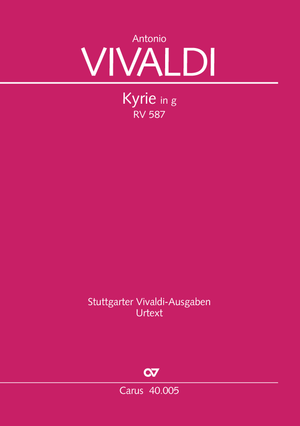
Antonio Vivaldi’s extensive oeuvre also includes a large repertoire of sacred vocal music, ranging from large-scale mass and vesper compositions to biblical oratorios and solo motets. The double-choir Kyrie in G minor RV 587, composed around the middle of the 1720s, belongs to a group of individual mass movements. The harmonically exposed opening part, a series of excitingly modulating chords that presumably goes back to a foreign model, lends the first "Kyrie" call a high intensity of expression. The "Christe" is performed by the female voices of both choirs; the final movement is an Allegro double fugue in a strict four-part movement with a short Adagio introduction.
Explore
 View
View
 Listen
(3)
Listen
(3)
- Kyrie eleison
- Christe eleison
- Kyrie eleison
 Additional material
- Purchase additional material as a download product.
-
 Digital text (without sheet music) incl. printing licence, html file, singing text, english translationhtml file, singing text, english translation (Sample)
1. Kyrie eleison Lord, have mercy on us.
2. Christe eleison Christ, have mercy on us.
3. Kyrie eleison (Coro I and Coro II) Lord, have mercy on us.
...
-
Digital text (without sheet music) incl. printing licence, html file, singing text, german translationhtml file, singing text, german translation (Sample)
1. Kyrie eleison Herr, erbarme dich unser.
2. Christe eleison Christus, erbarme dich unser.
3. Kyrie eleison (Coro I und Coro II) Herr, erbarme dich unser.
...
-
Digital text (without sheet music) incl. printing licence, html file, singing text, originalhtml file, singing text, original (Sample)
1. Kyrie eleison Kyrie eleison.
2. Christe eleison Christe eleison.
3. Kyrie eleison (Coro I und Coro II) Kyrie eleison.
...
-
Digital text (without sheet music) incl. printing licence, html file, Introductory text, englishhtml file, Introductory text, english (Sample)Text from the CD Carus 83.325
Karl Heller
Vivaldi’s setting of the Kyrie follows the common practice of assigning the outer sections (“Kyrie eleison”) to the choir and using solo singers in the “Christe eleison”. Only the inner movement uses double choir throughout; in the opening movement the two choirs often sing together, as they do throughout the final movement – an Allegro double fugue with a short Adagio introduction. This double fugue draws upon a model borrowed by Vivaldi from a work of another composer. This practice is probably also true for the harmonically striking opening section of the work, a series of tensely modulating chords which give the first “Kyrie” appeal such a great expressive power. In fashioning this “labyrinthine” sequence of chords Vivaldi also probably followed the model of an other composer, and the use of this sequence is not unique to this Kyrie: we encounter it again in the opening chorus of the Magnificat and at “Et incarnatus est” in the Credo. This harmonic progression always helps the composer to create a very special aura.
Translation (abridged): John Coombs...
-
Digital text (without sheet music) incl. printing licence, html file, Introductory text, germanhtml file, Introductory text, german (Sample)Booklet-Text der CD Carus 83.325
Karl Heller (2003)
Die Wiederbelebung der Musik Antonio Vivaldis im 20. Jahrhundert ging einher mit der Neuentdeckung bisher völlig unbekannter Schaffensbereiche des Komponisten. Für die stärksten Überraschungen sorgte dabei ein großer Bestand an geistlicher Vokalmusik, dessen Repertoire von der groß angelegten Mess- und Vesperkomposition bis zum biblischen Oratorium und zur Solomotette reicht. Die ersten Wiederaufführungen solcher Werke, darunter das Gloria RV 589 und das Credo RV 591, während einer Vivaldi-Woche in Siena 1939 wurden geradezu als Sensation empfunden. Sie ließen deutlich werden, dass der Komponist gerade auf diesem Sektor Werke höchsten künstlerischen Ranges geschaffen hat.
Vivaldis Vertonung des Kyrie folgt der weithin geübten Praxis, die beiden rahmenden Textglieder (»Kyrie eleison«) für Chor, das »Christe eleison«
...
Purchase
Additional product information
Contents
-
Composer
Antonio Vivaldi
| 1678-1741Antonio (Lucio) Vivaldi was an Italian composer and violinist of the Baroque period.
It is assumed that his father, who was a musician himself, was responsible for Vivaldi's musical education. However, he began his professional career as a priest, which earned him the nickname Il prete rosso (the red-haired priest).
From 1703, Vivaldi worked intermittently as a violin teacher and composer at the Ospedale della Pietà, an orphanage for girls in Venice, until shortly before his death. Initially, he also worked there as a priest, but relinquished this role after three years. He wrote numerous chamber music works and concertos for his pupils at the Pietà. The famous Four Seasons are particularly well-known and often performed today. Vivaldi also composed sacred and secular vocal music and was an opera composer and director.
Of over 800 works known today, only 135 were published during Vivaldi's lifetime. After his death, Vivaldi's compositions were initially largely forgotten. Many of his works were rediscovered and published, particularly in the 20th century. Among them is the Gloria in D RV 589, the very first sheet music edition published by Carus-Verlag.
Personal details
Reviews
Vivaldi, Antonio: Kyrie RV 587
Carus druckte das erste Kyrie auf 14 Seiten, Ricordi auf 16. Carus größeres Format ist bequem und deutlicher zu lesen, Ricordis klassischer Notensatz wirkt elegant, ist aber für meine Augen etwas zu klein. Ricordi hält konsequent ein ausgewogenes Notenbild, während Carus in manchen Takten, wie z.B. in den Takten 28-30 des ersten Satzes, auf dieses verzichtet. Aber natürlich die Wahl liegt bei Ihnen.
Toccata 7/03
Reviews on our website can only be submitted by customers with a registered user account. A check whether the rated products were actually purchased does not take place.
No feedback available for this product.
Frequent questions about this work
 There are no questions and answers available so far or you were unable to find an answer to your specific question about this work? Then click here and send your specific questions to our Customer Services!