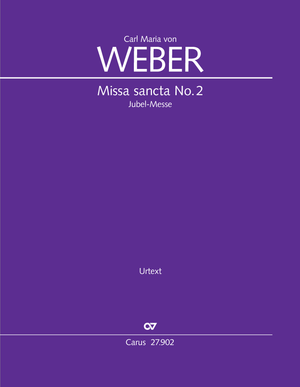
Missa sancta No. 2
“Jubel-Messe” (Jubilation Mass) WeV A.5, Offertorium (Op. 76), 1818/19
As Kapellmeister at Dresden’s royal theater, Carl Maria von Weber’s primary task was to establish a German opera. However, it was also part of his duties to take care of church music every three weeks. This assignment was gladly accepted by the opera composer Weber, who regarded his artistic talents as a “gift from heaven”. His Missa sancta No. 2, also known as the “Jubel-Messe” (Jubilation Mass), was composed for the service held to celebrate the golden wedding anniversary of the Saxon royal couple Friedrich August I (1750-1827) and Marie Amalie Auguste (1752-1828) in January 1819. The festive nature of the Mass is confirmed by the offertory “In die solemnitatis”, whose inclusion follows court practice in Dresden at the time.
Due to its relative brevity, the “Jubel-Messe” is also well suited for inclusion in a liturgical framework today. The vocal parts in this Mass can easily be mastered by amateur choirs for festive occasions in church or in concert.



-
Composer
Carl Maria von Weber
| 1786-1826Carl Maria von Weber was born in Eutin on November 18 or 19, 1786 and died in London on June 5, 1826. He is considered the founder of German Romantic opera.
As the son of the musician Franz Anton von Weber, he received musical training at an early age and had composition lessons with Michael Haydn and Abbé Vogler. His career took him through various stages. From 1804 to 1806 he was Kapellmeister at the Breslau Municipal Theater, from 1813 to 1816 Opera Director in Prague and from 1817 finally Königlicher Kapellmeister and Director of the newly founded Deutsche Oper at the Dresdner Hoftheater. It was there that Weber composed his most famous stage works. His opera Der Freischütz (The Marksman) is considered the epitome of German opera. He also composed instrumental works, including symphonies, concertos and piano pieces. During his time at the Dresden court, he also wrote sacred vocal works, such as the so-called “Jubel-Messe“ (Jubilation Mass).
Weber significantly influenced the German operatic style of the 19th century by introducing popular melodies and German texts to opera. He had a great influence on subsequent composers, especially Richard Wagner.
Personal details
-
Editor
Frank Höndgen
| 1967
Reviews on our website can only be submitted by customers with a registered user account. A check whether the rated products were actually purchased does not take place.
Frequent questions about this work
Is a second tenor soloist needed because of the two tenor solos in the Kyrie bars 42-47?
French horn III and IV are only needed in the Sanctus. Can the mass also be performed with only two french horns?
 There are no questions and answers available so far or you were unable to find an answer to your specific question about this work? Then click here and send your specific questions to our Customer Services!