

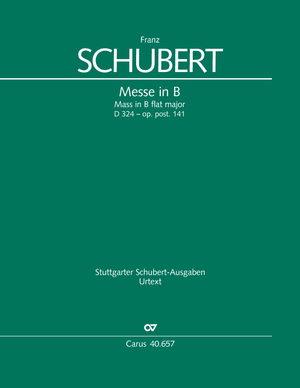
With a total duration of about 30 minutes, Schubert’s Mass in B flat major (D 324), written in 1815, is considerably longer than Mozart’s and Haydn’s classical "Brevis" masses, and its large instrumental ensemble with strings, woodwinds, brass and timpani even gives it a clearly solemn character. Overall, Schubert was inspired by the late Haydn style of the "symphonic mass" (e.g., the division into six large movements, the omission of arias for the vocal soloists who are instead juxtaposed with the choir, singing short passages either singly or as a group) without, of course, achieving its temporal expansion. This is a representative, musically appealing work that excels with its multi-layered, detailed text treatment. It is, therefore, suitable for special occasions and the high feasts of the church year and can be mastered well by experienced church choirs.
Explore



Purchase
Additional product information
-
Composer
Franz Schubert
| 1797-1828Throughout most of his life Franz Schubert was concerned with church music. When he was eleven he was chosen as treble soloist at his local church in the Vienna suburb of Lichtenthal and soon afterwards he was admitted to the choir of the Imperial Court Chapel, directed by Antonio Salieri. Soon he also began to compose; his earliest surviving sacred pieces date from 1812. During his lifetime his church music achieved a comparatively wide degree of acceptance but after his death, most notably, his smaller works were unjustly forgotten. The Carus programme encompasses Schubert’s complete sacred compositions and it is intended to emphasize the wide range of his works in this area. Many of the smaller liturgical compositions are published here for the first time in separate editions. What is to be discovered is a fascinating œuvre, rooted in the ‘stile antico’ of Antonio Salieri and in the compositions of the Viennese classical masters, but whose exquisite lyricism and harmonic subtlety reveal a typically Schubertian world of expression: works with great power of conviction and exceptional musical beauty. Personal details
-
Editor
Manuela Jahrmärker
Reviews
Württembergische Blätter für Kirchenmusik 2/2005
Franz Schubert: Messe in B
(jw) Der hier vorliegende, 2001 neu erschienene Klavierauszug zu einer der weniger bekannten Schubert-Messen knüpft an die vorbildlichen Erscheinungen im Rahmen der Gesamtausgaben aus dem Hause Carus an. Die Ausgabe beschränkt sich auf das wesentliche und verzichtet damit glücklicherweise auf unübersichtliche Kleinstichnoten oder Ossia-Fassungen, die bei einer Einrichtung für Klavier, die an sich schon eine Bearbeitung darstellt, keinen Platz haben. Wie für Schubert (und inhaltlich auch für seine Zeit) charakteristisch, verzichtet er auch in der B-Dur-Messe auf bedeutende Textteile in Gloria und Credo. Die Besetzung der Messe mit vier Solisten, zwei Oboen, zwei Fagotten, zwei Trompeten, Pauken, Streichern und Continuo als Minimalanlage dürfte den Weg in Aufführungen kleinerer Verhältnisse nicht gerade beschleunigen. Der Chorpart ist auch von geübten Kirchenchören gut zu bewältigen.
Quelle: Württembergische Blätter für Kirchenmusik 2/2005
Reviews on our website can only be submitted by customers with a registered user account. A check whether the rated products were actually purchased does not take place.
No feedback available for this product.
Frequent questions about this work
 There are no questions and answers available so far or you were unable to find an answer to your specific question about this work? Then click here and send your specific questions to our Customer Services!