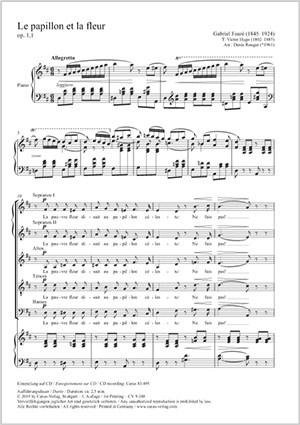
Victor Hugo’s text describes an unequal love between a fluttering, “heavenly” butterfly and a flower “rooted in the earth”. Both resemble each other in their beauty, but their love cannot be fulfilled as long as the butterfly has no roots, or the flower has no wings. The piano accompaniment in Fauré’s setting reflects in its dance-like 6/8 movement both the enraptured hovering of the butterfly, and the deep-rootedness of the flower in the earth.
This art song was originally composed not for chamber choir, but for solo voice and piano. Denis Rouger has carefully adapted it to suit the requirements and expressive possibilities offered by a larger ensemble, without losing the any of the qualities of the original in the process. Each part in the choir has a melodic line drawn from the harmonic and rhythmic framework. In the process, the variety and refinement of the choral language combines with an enormous flexibility in form and expression, as French melodies or German art song demand from a soloist and pianist.
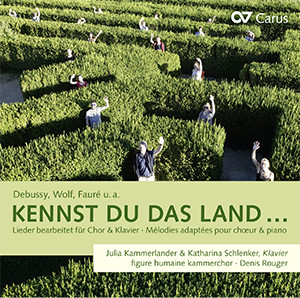
The song has been recorded by the figure humaine chamber choir on the CD Kennst du das Land... (Carus 83.495/00).
Explore
 View
View
 Listen
(1)
Listen
(1)
- Le papillon et la fleur
 Practise
-
Pronouncing Aid
- Le papillon et la fleur
 Additional material
- Purchase additional material as a download product.
-
 Digital text (without sheet music) incl. printing licence, html file, singing text, originalhtml file, singing text, original (Sample)
La pauvre fleur disait
au papillon céleste : Ne fuis pas !
Vois comme nos destins sont différents.
Je reste, tu t’en vas !Pourtant nous nous aimons,
Nous vivons sans les hommes, et loin d’eux !
Et nous nous ressemblons,
Et l’on dit que nous sommes fleurs tous deux !Mais hélas ! l’air t’emporte
Et la terre m’enchaîne, sort cruel !
Je voudrais embaumer
Ton vol de mon haleine dans le ciel !Mais non, tu vas trop loin !
Parmi des fleurs sans nombre, vous fuyez,
Et moi je reste seule
À voir tourner mon ombre a mes pieds !Tu fuis, puis tu reviens,
Puis tu t’en vas encore luire ailleurs !
Aussi me trouves-tu toujours
À chaque aurore toute en pleurs!...
-
Digital text (without sheet music) incl. printing licence, html file, singing text, german translationhtml file, singing text, german translation (Sample)
Die arme Blume sagte
zum himmlischen Schmetterling: Fliehe nicht!
Sieh, wie unsere Schicksale verschieden sind,
ich bleibe, du gehst davon!Dabei lieben wir uns, wir leben
ohne die Menschen und weit weg von ihnen!
Und wir sind uns ähnlich,
und man sagt, dass wir alle beide Blumen sind!Aber leider trägt dich die Luft hinweg,
und die Erde legt mich in Ketten, grausames Los!
Ich würde gerne deinen Flug mit meinem
duftenden Atem erfüllen, dort im Himmel!Aber nein, du gehst zu weit!
Unter die zahllosen Blumen, ihr flieht,
und ich bleibe alleine zurück, um meinen Schatten zu meinen Füßen wandern zu sehen!Du fliehst, dann kommst du zurück, dann gehst du wieder davon, um anderswo zu leuchten!
Auch findest du mich
bei jeder Morgendämmerung in Tränen aufgelöst!Ach! Damit unsere Liebe
aus den treuen Tagen heraus fließt, oh mein König!...
Purchase
Additional product information
-
Composer
Gabriel Fauré
| 1845-1924French composer, 1845-1924.
He was a pupil of Camille Saint-Saëns and studied at the Paris School of Sacred Music. Fauré worked as an organist and choirmaster and gave piano lessons and recitals in Parisian salons. He was able to improvise brilliantly on the piano, which is also reflected in his compositions. He was director of the Paris Conservatoire from 1905 to 1920.
Fauré mainly wrote vocal, piano and chamber music. He is best known for his piano songs for solo voice and his Requiem, which was also performed at his own funeral service.
Personal details
-
Songwriter / Librettist
Victor Hugo
| 1802-1885
-
Arranger
Denis Rouger
| 1961Denis Rouger gained his initial musical experience as the son of a Parisian family of musicians and during his studies at the Conservatoire National Supérieur de Musique de Paris, where he received first prizes in harmony, fugue and counterpoint.
He was a lecturer and choirmaster at the University of Paris-Sorbonne for 20 years and choirmaster at Notre-Dame de Paris Cathedral for 10 years. He is honorary conductor of the Parisian church La Madeleine. He also collaborates with numerous ensembles in Germany. He has been invited as a guest conductor by radio choirs, the Balthasar-Neumann-Chor, the Baden-Württemberg State Youth Choir and the Stuttgart Philharmonic Orchestra, among others. Concerts have taken him to Italy, the Netherlands, Canada, Russia, the United Arab Emirates and Switzerland (Lucerne Festival).
He gives master classes in Sweden, Bulgaria, France, Germany, as well as in Switzerland.
Denis Rouger has been Professor of Choral Conducting at the Stuttgart State University of Music and Performing Arts since 2011. The chamber choir he founded at the university in the fall of 2011 won first prize at the International Choir Competition in Mosbach (Germany) in 2014.
In addition to his work as a choirmaster, he composes and arranges French and German songs for choir. His arrangements on the CDs Kennst Du das Land ... and ... wo die Zitronen blühn (Carus) were well received by the press and radio. In collaboration with Carus-Verlag, he has edited the choir book Französische Chormusik, which received the German Music Edition Award “Best Edition” in 2019.
In 2016, Denis Rouger founded the figure humaine kammerchor (www.figurehumaine.de), with which he regularly gives concerts at renowned festivals.
Personal details
Reviews on our website can only be submitted by customers with a registered user account. A check whether the rated products were actually purchased does not take place.
No feedback available for this product.
Frequent questions about this work
 There are no questions and answers available so far or you were unable to find an answer to your specific question about this work? Then click here and send your specific questions to our Customer Services!