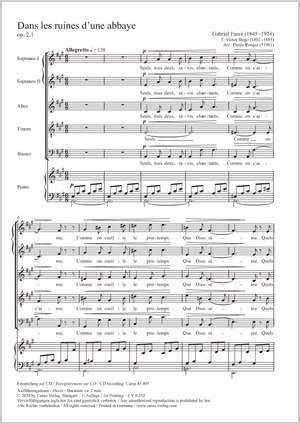
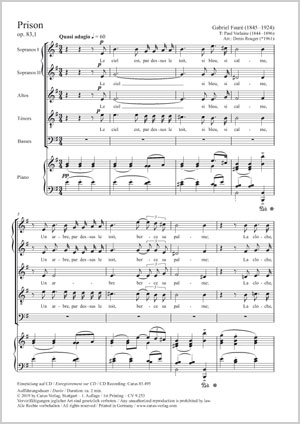
1873–1875 Paul Verlaine spent 555 days in prison because he had shot his fellow poet and companion Arthur Rimbaud with a revolver whilst in a drunken state. This spell in prison evidently fostered his artistic inspiration, so at least it did his literary career some good. The world of French literature even gave Verlaine the unofficial title “Prince des Poètes”. In the poem Prison the author was able to draw on his very own experiences: the monotony behind bars (expressed musically in Gabriel Fauré’s setting through the repeated target note of b), the inner rebelling against this monotonous stillness (surprising forte dynamic), and the reproachful self-questioning: “What have you done? ... What have you done with your youth?” (diminishing piano).
These art songs were originally composed not for chamber choir, but for solo voice and piano. Denis Rouger has carefully adapted them to suit the requirements and expressive possibilities offered by a larger ensemble, without losing the any of the qualities of the original in the process. Each part in the choir has a melodic line drawn from the harmonic and rhythmic framework. In the process, the variety and refinement of the choral language combines with an enormous flexibility in form and expression, as French melodies or German art song demand from a soloist and pianist.
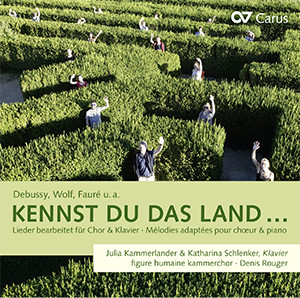
The songs have been recorded by the figure humaine chamber choir on the CD Kennst du das Land... (Carus 83.495/00).
Explore
 View
View
 Listen
(1)
Listen
(1)
- Prison
 Practise
-
Pronouncing Aid
- Prison
 Additional material
- Purchase additional material as a download product.
-
 Digital text (without sheet music) incl. printing licence, html file, singing text, originalhtml file, singing text, original (Sample)
Le ciel est par-dessus le toit, si bleu, si calme,
Un arbre par-dessus le toit berce sa palme ;
La cloche, dans le ciel qu’on voit,
doucement tinte,
Un oiseau sur l’arbre qu’on voit,
chante sa plainte.Mon Dieu, mon Dieu, la vie est là,
simple et tranquille !
Cette paisible rumeur-là vient de la ville.
Qu’as-tu fait, ô toi que voilà,
pleurant sans cesse,
Dis, qu’as-tu fait, toi que voilà,
de ta jeunesse ?Paul Verlaine (1844–1896)
...
-
Digital text (without sheet music) incl. printing licence, html file, singing text, german translationhtml file, singing text, german translation (Sample)
Der Himmel ist über dem Dach so blau, so still,
Ein Baum über dem Dach wiegt seinen Palmzweig;
Die Glocke klingt leise in dem Himmel,
den man sieht,
Ein Vogel singt seine Klage auf dem Baum,
den man sieht.Mein Gott, mein Gott, das Leben ist da,
einfach und ruhig!
Dieses friedliche Gemurmel kommt aus der Stadt.
Was hast du getan, oh du,
der du ohne Unterlass weinst,
Sag, was hast du, der du da bist,
aus deiner Jugend gemacht?Paul Verlaine (1844–1896)
Übersetzung: Christiane Rouger-Ortwein
...
Purchase
Additional product information
-
Composer
Gabriel Fauré
| 1845-1924French composer, 1845-1924.
He was a pupil of Camille Saint-Saëns and studied at the Paris School of Sacred Music. Fauré worked as an organist and choirmaster and gave piano lessons and recitals in Parisian salons. He was able to improvise brilliantly on the piano, which is also reflected in his compositions. He was director of the Paris Conservatoire from 1905 to 1920.
Fauré mainly wrote vocal, piano and chamber music. He is best known for his piano songs for solo voice and his Requiem, which was also performed at his own funeral service.
Personal details
-
Songwriter / Librettist
Paul Verlaine
| 1844-1896
-
Arranger
Denis Rouger
| 1961Denis Rouger gained his initial musical experience as the son of a Parisian family of musicians and during his studies at the Conservatoire National Supérieur de Musique de Paris, where he received first prizes in harmony, fugue and counterpoint.
He was a lecturer and choirmaster at the University of Paris-Sorbonne for 20 years and choirmaster at Notre-Dame de Paris Cathedral for 10 years. He is honorary conductor of the Parisian church La Madeleine. He also collaborates with numerous ensembles in Germany. He has been invited as a guest conductor by radio choirs, the Balthasar-Neumann-Chor, the Baden-Württemberg State Youth Choir and the Stuttgart Philharmonic Orchestra, among others. Concerts have taken him to Italy, the Netherlands, Canada, Russia, the United Arab Emirates and Switzerland (Lucerne Festival).
He gives master classes in Sweden, Bulgaria, France, Germany, as well as in Switzerland.
Denis Rouger has been Professor of Choral Conducting at the Stuttgart State University of Music and Performing Arts since 2011. The chamber choir he founded at the university in the fall of 2011 won first prize at the International Choir Competition in Mosbach (Germany) in 2014.
In addition to his work as a choirmaster, he composes and arranges French and German songs for choir. His arrangements on the CDs Kennst Du das Land ... and ... wo die Zitronen blühn (Carus) were well received by the press and radio. In collaboration with Carus-Verlag, he has edited the choir book Französische Chormusik, which received the German Music Edition Award “Best Edition” in 2019.
In 2016, Denis Rouger founded the figure humaine kammerchor (www.figurehumaine.de), with which he regularly gives concerts at renowned festivals.
Personal details
Reviews on our website can only be submitted by customers with a registered user account. A check whether the rated products were actually purchased does not take place.
No feedback available for this product.
Frequent questions about this work
 There are no questions and answers available so far or you were unable to find an answer to your specific question about this work? Then click here and send your specific questions to our Customer Services!