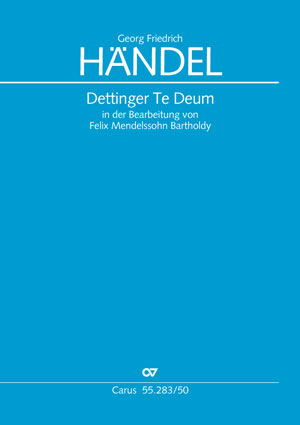
Dettinger Te Deum
In der Bearbeitung von Felix Mendelssohn Bartholdy 1829


 Listen
(13)
- Herr Gott, dich loben wir (Coro)
- Der Engel Chor erhebt sein Lied (Coro)
- Und Cherubim und Seraphim (Coro)
- Der heil’gen zwölf Boten (Coro)
- Du König der Ehren (Basso solo, Coro)
- Ach, du hast nicht verachtet (Basso solo)
- Hast überwunden (Coro)
- Du sitzest zu der Rechten (Coro)
- Drum flehen wir dir (Coro)
- Nimm uns in die Zahl (Coro)
- Tag vor Tag sei Dank und Lob dir (Coro)
- Erbarme, Herr (Basso solo)
- Herr, auf dich steht meine Hoffnung (Coro)
Contents
-
Composer
Georg Friedrich Händel
| 1685-1759George Frideric Handel put his exceptionally versatile compositional abilities to the test at an early age. After moving to London in 1712, where he was appointed Composer of Musick for His Majesty’s Chapel Royal in 1723, he wrote numerous masterpieces for the royal court as well as his major opere serie. For many years he enjoyed triumphant successes with his operas, which were sung by outstanding performers, with serenades, and later also with oratorios such as Saul and Israel in Egypt. Over the years Handel’s reputation grew far beyond the city where he worked; some of his choral works, particularly Messiah, have enjoyed a performance tradition which remains unbroken to this day, and are sung by choirs throughout the world. Personal details
-
Editor
Benedikt Poensgen
-
Arranger
Felix Mendelssohn Bartholdy
| 1809-1847Felix Mendelssohn Bartholdy (1809–1847) is regarded as one of the most important composers of the Romantic period. His compositions combine the formal clarity of the Viennese Classical period with the heightened expressiveness of the 19th century. His engagement with the music of Johann Sebastian Bach was particularly influential; he played a key role in its rediscovery through the performance of the St Matthew Passion in 1829.
Among his best-known vocal works are his two oratorios, Paulus and Elias, as well as his chorale cantata Verleih uns Frieden gnädiglich. Furthermore, Mendelssohn worked as a conductor, pianist and music teacher, and made a significant contribution to the professionalisation of the concert scene and to the development of the Leipzig Conservatoire. His work occupies a central position in 19th-century music history and combines a sense of tradition with Romantic sound aesthetics.
Personal details
Reviews on our website can only be submitted by customers with a registered user account. A check whether the rated products were actually purchased does not take place.
Frequent questions about this work
Can the vocal score of Handel's original version also be used for this arrangement?
 There are no questions and answers available so far or you were unable to find an answer to your specific question about this work? Then click here and send your specific questions to our Customer Services!